Jump to HeaderJump to Main ContentJump to Footer
Michigan State University
MSUTODAY
  • Browse Stories By

    Topics

    Explore stories by subject area

    • Arts and Culture
    • Business and Economy
    • Climate and Environment
    • Education and Learning
    • Engineering, Science and Technology
    • Government and Society
    • Health and Medicine
    • Media and Communications
    • MSU Leadership and Impact
    • Sports and Recreation
    • Student and Campus Experience
    View All Stories

    Collections

    Curated story series

    • Alumni stories
    • Turfgrass
    • Ask the Expert
    • Big Ideas
    • Climate solutions
    • Water at MSU
    • Mobility
    • Spartan Perspectives
    • Student views
    • Graduate voices
    • Faculty voices
    View All Collections

    Featured

    Editor's picks

    • 9 reasons to love being a Spartan

      Aug. 28, 2026

      9 reasons to love being a Spartan

    • NIH awards multi-university team over $4M to improve women’s health

      Sept. 15, 2026

      NIH awards multi-university team over $4M to improve women’s health

MSUTODAY
  • Browse Stories By

< Browse Stories By

Topics

Explore stories by subject area

  • Arts and Culture
  • Business and Economy
  • Climate and Environment
  • Education and Learning
  • Engineering, Science and Technology
  • Government and Society
  • Health and Medicine
  • Media and Communications
  • MSU Leadership and Impact
  • Sports and Recreation
  • Student and Campus Experience
  • View All Stories

Collections

Curated story series

  • Alumni stories
  • Turfgrass
  • Ask the Expert
  • Big Ideas
  • Climate solutions
  • Water at MSU
  • Mobility
  • Spartan Perspectives
  • Student views
  • Graduate voices
  • Faculty voices
  • View All Collections

Featured

Editor's picks

  • 9 reasons to love being a Spartan

    Aug. 28, 2026

    9 reasons to love being a Spartan

  • NIH awards multi-university team over $4M to improve women’s health

    Sept. 15, 2026

    NIH awards multi-university team over $4M to improve women’s health

  • For Media
  • Experts
  • Releases and Statements
  • Sign Up
  • Update Information

Resources

  • A to Z Index
  • Find People
  • Maps
  • Email
  • Student Information System (SIS)
  • D2L
  • Libraries
  • Tech Support
  • MSU Misconduct Hotline
  • Social Media Directory
  • Events Calendar
  • For Media
Michigan State University
MSUToday
  • For Media
  • Experts
  • Releases and Statements
  • Sign Up
  • Update Information
Natural Sciences

June 6, 2023

Radical new chemistry from MSU

Researchers have created a new class of single-molecule magnets that could help usher in more advanced data storage and computer technology

By: Matt Davenport

There’s a scene in the 1992 movie “A League of Their Own” in which Tom Hanks’ character says, “It’s supposed to be hard. If it wasn’t hard, everyone would do it.”


He’s talking about baseball, but a similar sentiment applies to synthetic chemistry: Doing either at the highest level is no easy task.

 

Michigan State University Assistant Professor Selvan Demir

That’s especially evident in recent research from a team of Michigan State University chemists who have unveiled a new class of magnetic molecules.


Reporting in the Journal of the American Chemical Society, researchers led by Selvan Demir have brought together famously challenging building blocks to push single-molecule magnets a step closer to their promising applications.


“Realizing these molecules in a laboratory setting is extremely difficult,” said Demir, an assistant professor in the College of Natural Science. “But this challenge has been met by Spartan chemists for the first time.”


These single molecules work like ultratiny bar magnets and were first synthesized in the 1990s. Since then, researchers have been developing new types with the goal of pushing established magnetic technology, including hard drives, to a whole new level. Single-molecule magnets also could open new doors in emerging technologies, such as quantum computers.


Getting to those applications, though, still requires fundamental innovations. Demir and her team have a history of demonstrating the ingenuity and persistence needed to deliver those.


A lanthanide and a bismuth radical walk into a bar magnet


On paper, the approach Demir and her team took makes a ton of sense.


The electrons zipping around the exterior of atoms have something called spin. It’s a fundamental physical property of tiny particles that researchers can take advantage of for certain applications, similar in that regard to electric charge.


While charge gives rise to electricity, spin is more connected to other things, including magnetism.
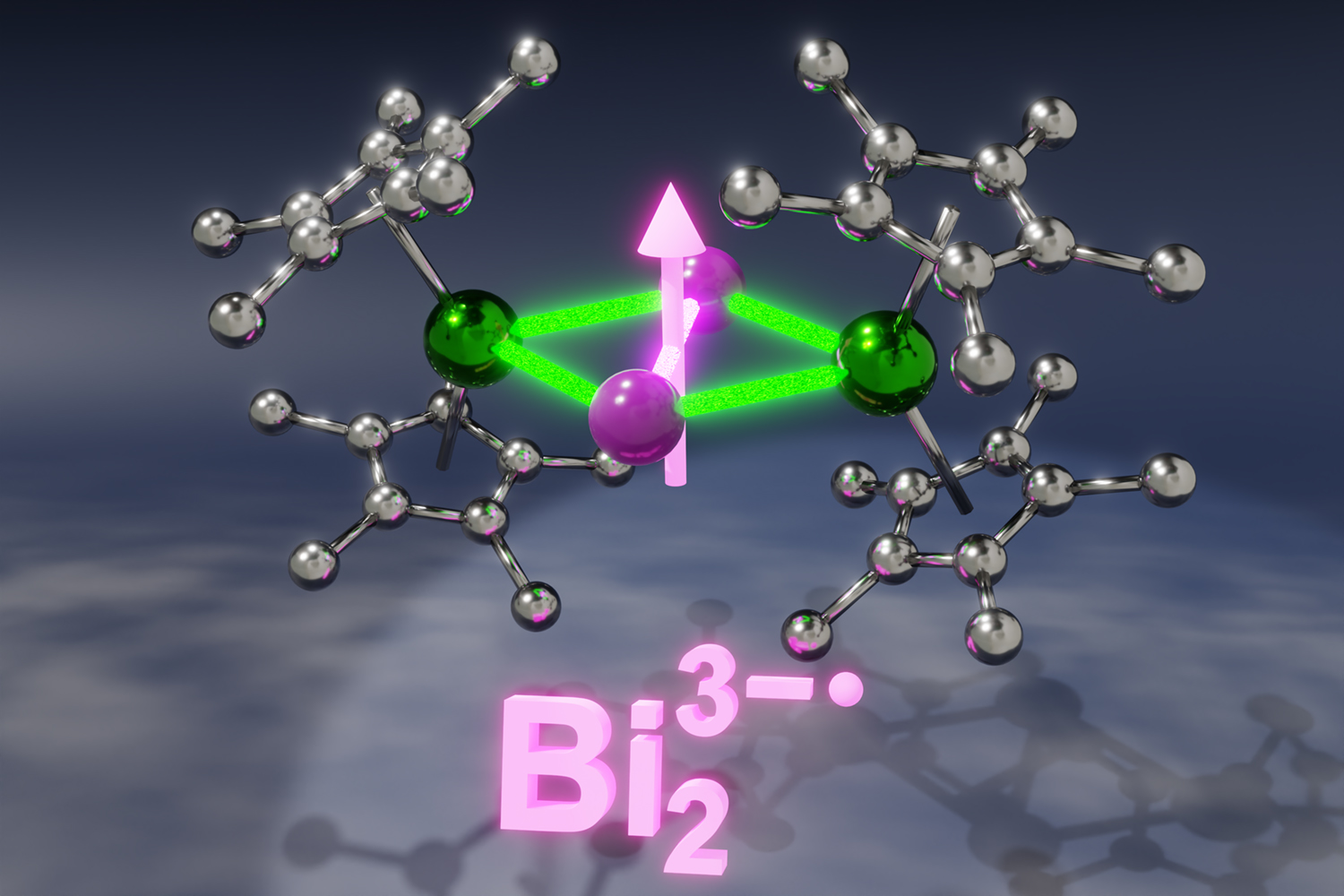
 

An illustration features lanthanide ions, each encased by two hydrocarbon rings, bridged through a Bi<sub>2</sub><sup>3−•</sup> radical anion. The spin of the Bi<sub>2</sub><sup>3−•</sup> radical is key for the magnetic communication between the lanthanide ions.
In new single-molecule magnets produced by Michigan State University chemists, a bismuth radical anion, shown in pink and labeled Bi23−•, bridges two lanthanide ions shown in green. Credit: Courtesy of the Demir Group

In building their new single-molecule magnets, Demir and her team wanted to combine different atomic building blocks whose electron spins could interact or couple in a way that would yield molecules with tantalizing magnetic properties.


So the team picked two building blocks that could couple spins in an unprecedented way. But these choices still had their challenges.


The first key component are lanthanides, which are large, unwieldy elements that live at the bottom of the periodic table. The other is what’s known as a bismuth radical anion.


It’s the “radical anion” part that makes it particularly challenging. That means it’s a version of bismuth that carries a negative charge and is typically very reactive and short-lived.


The team’s earlier work had hinted that combining the ingredients could be fertile ground for making single-molecule magnets, but progress was hard won because making the molecules presented obstacles in virtually every phase: synthesis, isolation and purification.
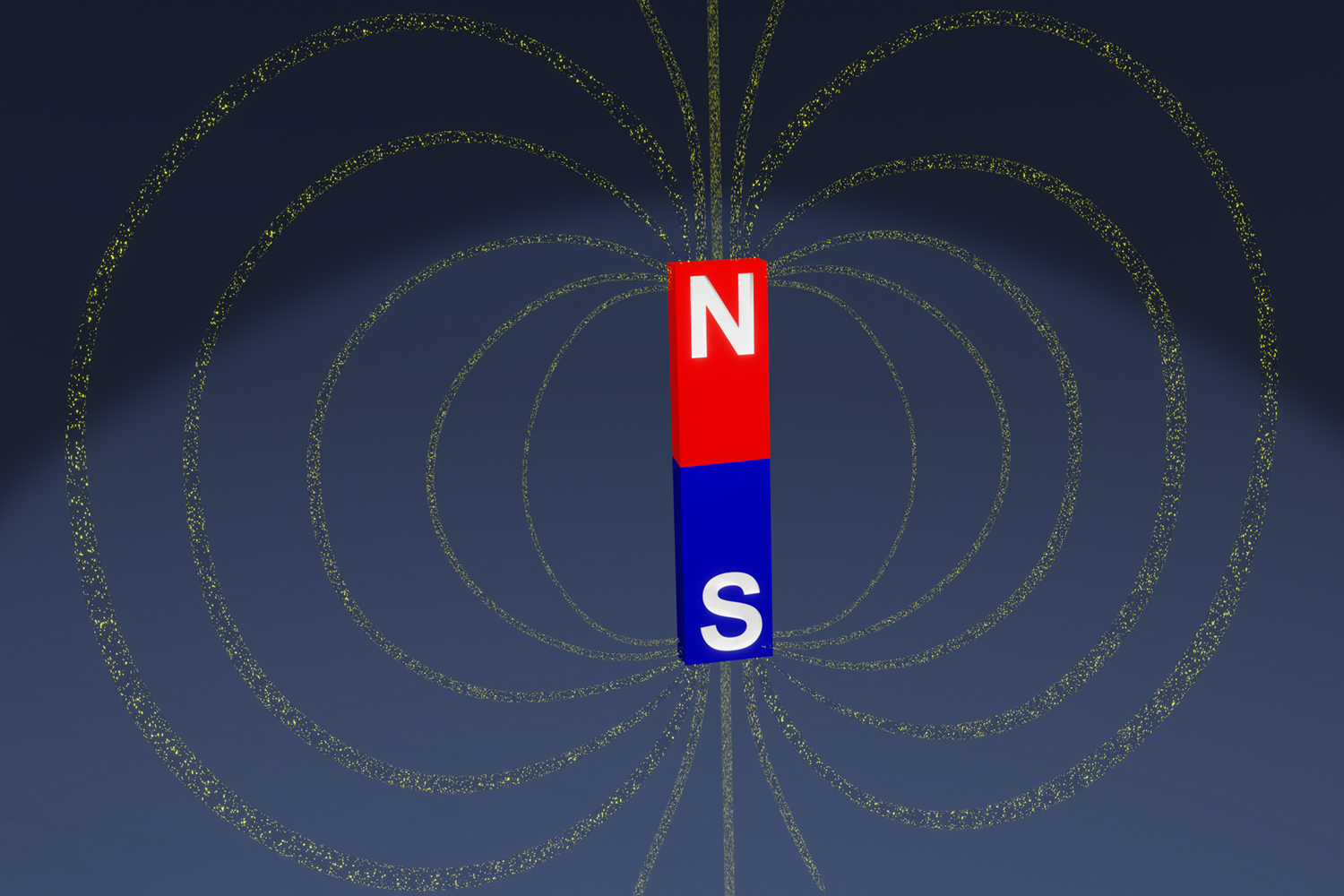
 

A 3D computer rendering shows a bar magnet. To show its north and south poles, respectively, its upper half is red and labeled with an “N,” while its lower half is blue and labeled with an “S.” Yellow loops emanate from the magnet, representing its magnetic field.
The new single-molecule magnets created at Michigan State University work like bar magnets, such as the one shown here, but are much, much smaller. Credit: Courtesy of the Demir Group

Still, Demir knew that these cantankerous components could actually work together.


“An elegant way to stabilize a radical anion is to pair it with lanthanide ions,” Demir said. “And placing a bismuth radical in between lanthanides would result in effective magnetic communication between the species.”


Capitalizing on its experience, Demir’s team realized this synergy and overcame the hurdles presented by the individual pieces with careful design and judicious planning, she said.


“The new molecules constitute the first single-molecule magnets containing bismuth radicals,” Demir said. “This is also the first time that a bismuth radical was isolated with any lanthanide or transition metal from the periodic table.”


Also joining the MSU researchers on this project were chemists led by Nicholas F. Chilton, a professor at the University of Manchester in England. Chilton’s team performed computations to help better understand the electronic and magnetic properties of the new molecules.


Although more research and development will be required to bring these molecules to commercial technologies, this discovery creates new opportunities to reach that goal.


MEDIA CONTACTS

Selvan Demir, Emilie Lorditch
Natural SciencesEngineering, Science and TechnologyEngineering, Science and TechnologyEngineering, Science and Technology

Latest News

MSUToday Weekly Update

The MSUToday Weekly Update email showcases how Spartans are making a difference through academic excellence, research impact and community outreach. Get inspired by these stories of innovation, collaboration and determination. Plus, enjoy photos and videos of campus and more MSU content to help keep you connected to the Spartan community.

Sign UpUpdate My Information

Connect With Us

Visit our Facebook pageVisit our page on XVisit our Instagram pageVisit our LinkedIn pageVisit our YouTube pageVisit our TikTok page

Health and Safety

  • MSU Police and Public Safety
  • Olin Health Center
  • Counseling & Psychiatric Services (CAPS)
  • University Health and Wellbeing
  • MSU Health Care
  • Civil Rights and Title IX
  • Our Commitment
  • Center for Survivors
  • Security & Fire Safety Report
  • University Policy on Relationship Violence and Sexual Misconduct
  • Notice of Non-Discrimination, Anti-Harassment and Non-Retaliation
  • Health Care Non-Discrimination Notice

Support Services

  • Disability Resources
  • Supportive Services
  • Learning Resources

Working at MSU

  • Human Resources
  • EBS Login
  • Job Postings
  • Employee Assistance Program

Reports

  • CARES Act Funding
  • Student Achievement and Outcomes

Contact us

517-355-1855

Address

Michigan State University 426 Auditorium Road East Lansing, MI 48824

Follow Us

  • Visit our Facebook page
  • Visit our page on X
  • Visit our Instagram page
  • Visit our TikTok page
  • Visit our LinkedIn page
  • Visit our YouTube page

If you're having accessibility issues, please let us know.

Know More: Campus Safety Information and ResourcesTransparency Reporting: Budget & Salary/Compensation
  • Contact Information|
  • Site Map|
  • Privacy Statement|
  • Site Accessibility|
  • Call MSU: (517) 355-1855|
  • Visit: msu.edu|
  • Notice of Nondiscrimination|

SPARTANS WILL|© Michigan State University|