Jump to HeaderJump to Main ContentJump to Footer
Michigan State University
  • Browse Stories By

    Topics

    Explore stories by subject area

    • Arts and Culture
    • Business and Economy
    • Climate and Environment
    • Education and Learning
    • Engineering, Science and Technology
    • Government and Society
    • Health and Medicine
    • Media and Communications
    • MSU Leadership and Impact
    • Sports and Recreation
    • Student and Campus Experience
    View All Stories

    Collections

    Curated story series

    • Turfgrass
    • Ask the Expert
    • Big Ideas
    • Climate solutions
    • Water at MSU
    • Mobility
    • Spartan Perspectives
    • Student views
    • Graduate voices
    • Faculty voices
    View All Collections

    Featured

    Editor's picks

    • The Spartans behind your favorite Michigan golf courses

      July 22, 2026

      The Spartans behind your favorite Michigan golf courses

    • MSU in the 1990s: 10 Spartan milestones

      July 14, 2026

      MSU in the 1990s: 10 Spartan milestones

MSUTODAY
  • Browse Stories By

< Browse Stories By

Topics

Explore stories by subject area

  • Arts and Culture
  • Business and Economy
  • Climate and Environment
  • Education and Learning
  • Engineering, Science and Technology
  • Government and Society
  • Health and Medicine
  • Media and Communications
  • MSU Leadership and Impact
  • Sports and Recreation
  • Student and Campus Experience
  • View All Stories

Collections

Curated story series

  • Turfgrass
  • Ask the Expert
  • Big Ideas
  • Climate solutions
  • Water at MSU
  • Mobility
  • Spartan Perspectives
  • Student views
  • Graduate voices
  • Faculty voices
  • View All Collections

Featured

Editor's picks

  • The Spartans behind your favorite Michigan golf courses

    July 22, 2026

    The Spartans behind your favorite Michigan golf courses

  • MSU in the 1990s: 10 Spartan milestones

    July 14, 2026

    MSU in the 1990s: 10 Spartan milestones

  • For Media
  • Experts
  • Releases and Statements
  • Sign Up
  • Update Information

Resources

  • A to Z Index
  • Find People
  • Maps
  • Email
  • Student Information System (SIS)
  • D2L
  • Libraries
  • Tech Support
  • MSU Misconduct Hotline
  • Social Media Directory
  • Events Calendar
  • For Media
Michigan State University
MSUToday
  • For Media
  • Experts
  • Releases and Statements
  • Sign Up
  • Update Information
MSUTODAY
MSU Research

March 9, 2023

Going up: Discovering a protein’s ‘elevator motion’ could spur new cancer treatments

Spartan researchers help show how omnipresent biomolecular machines with important health implications transport metals

By: Matt Davenport

Michigan State University researcher Jian Hu has taken another important step in learning as much as possible about tiny protein machines that help shuttle metals into living cells.


This latest step, published in the journal Nature Communications, provides detailed new insights into how these machines work. Though this is a study in fundamental biology, Hu and his team are working to use this knowledge to develop new cancer therapies and enable people to live healthier lives.


“Almost 10 years ago, I chose to study this family of proteins because they’re very important and little structural biology was being conducted on them,” said Hu, an associate professor in the Department of Biochemistry and Molecular Biology and the Department of Chemistry. “They’re crucial for life, and they are connected to disease.”

Members of the Michigan State University research team are pictured outdoors in front of MSU?s Biochemistry Building. From left to right: graduate students Peixuan Yu and Yuhan Jiang, postdoctoral research associate Yao Zhang, Associate Professor Jian Hu and MSU Foundation Professor Guowei Wei.Part of the research team at Michigan State University that has revealed how the protein family known as ZIP works in atomic detail. From left to right: graduate students Peixuan Yu (rotation student) and Yuhan Jiang, postdoctoral research accociate Yao Zhang, Associate Professor Jian Hu and MSU Foundation Professor Guowei Wei. Credit: Tianqi Wang

Organisms across the tree of life — including bacteria, plants and people — use these proteins, which are called ZIPs for short. That stands for “Zrt-/Irt-like proteins,” which looks a little intimidating, but essentially means that these proteins transport zinc, iron and manganese, in most cases.


Although there’s only a tiny bit of these metals in biological systems, ZIPs are critically important for healthy living.


A more intimate understanding of how ZIPs transport these metals through cell membranes would better equip researchers to study dysfunctions caused by problematic mutations. But even when the proteins are functioning properly, they present important health considerations.


For example, in humans, many types of cancer cells host an abnormally large number of a protein called ZIP4.


“There are 14 different types of ZIPs in humans that are involved in different biological functions,” said Hu. “We’re particularly interested in ZIP4 because it’s aberrantly upregulated in about half of the different types of cancer, including breast cancer, ovarian cancer and pancreatic cancer.”


Additionally, a ZIP in plants that transports life-essential iron is also implicated in absorbing cadmium from soil. Cadmium is a toxic metal found in industrial pollution and contaminated soils.
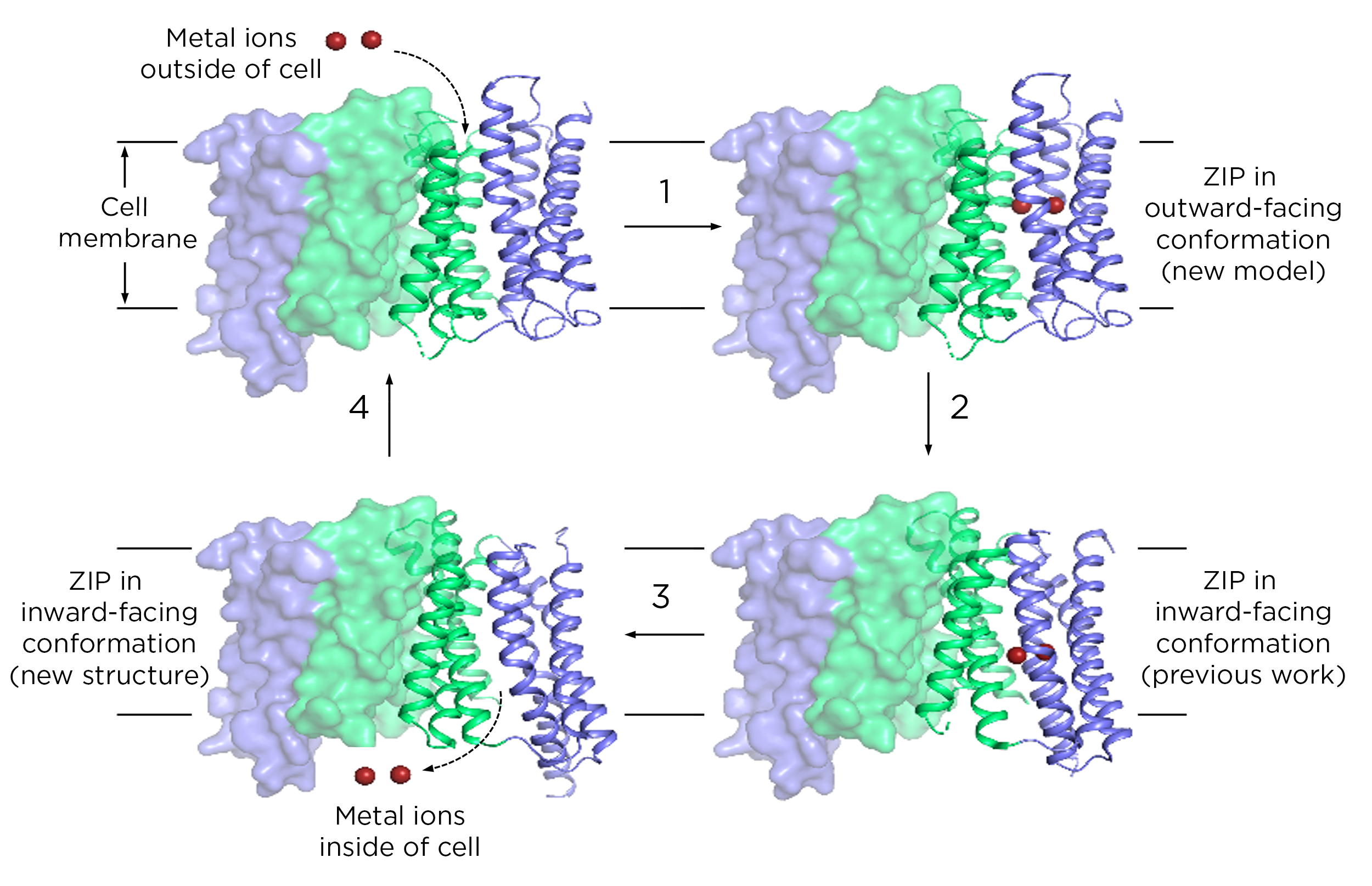
 

A four-paneled schematic shows how a ZIP protein moves metals from outside a cell into its interior through a cell membrane. In the first panel, two red metal ions begin their journey outside the cell. In the next panel, the metals bind inside ZIP protein, a green and light purple structure that spans the cell membrane. The metals bind inside protein, which is oriented in what’s called its outward conformation (meaning it’s open to the outside). Next, the metals shift downward, still inside the protein, as the ZIP adjusts to its inward conformation (meaning it is now open to the cell’s interior). In the final panel, the metals are released from the protein and into the cell, after which the protein switches back to the original status for a new cycle of transport.
New research from Michigan State University has shown how proteins known as ZIPs transport metal into living cells. ZIPs are found across the tree of life, playing important roles in health and disease. Adapted by Zhang, Y., Jian, Y., et al. Nature Communications (2023). Licensed under CC BY 4.0.

That means demystifying these proteins’ secrets could help researchers develop new cancer therapies, protect crops from toxic metals and even remediate heavy metal pollution.


“That’s what we’re working toward, but we need to understand their fundamental properties and behaviors first,” Hu said.


With support from the National Institutes of Health and the Plant Resilience Institute at MSU, Hu and his colleagues focused on some of that fundamental science in their new report. The researchers provided the first comprehensive explanation for how the proteins physically move metals into cells.


What the team found was that ZIPs have internal structures that move up and down to transport metals.


“This is called the elevator-type mode,” Hu said. His team was the first to propose this transport mode, initially at the 65th Biophysical Society Annual Meeting and now by publishing it in a peer-reviewed journal.


Hu stressed that this discovery was a team effort, with collaborators providing valuable insights from different research backgrounds.


“This work provides structural, computational, biochemical and functional evidence to convincingly support the proposed transport mechanism,” Hu said. “Previously, people had no idea how this works.”


The team included Guowei Wei, an MSU Foundation Professor in the College of Natural Science, and Min Su, who was an assistant research scientist at the University of Michigan during this project. He’s now the director of the Center for Electron Microscopy at the University of Missouri.


Molecular biology is a team sport


When it comes to understanding proteins, knowing what they look like is a big deal. It helps researchers see how the biomolecules work and is a prerequisite to applications such as designing drugs that can target the protein.

 

A collage shows photographs of Kaifu Gao, Dexin Sui and Min Su.
The research team led by Michigan State University also included (top to bottom) Kaifu Gao and Dexin Sui, formerly of MSU; and Min Su, who is the director of the University of Missouri’s Electron Microscopy Core. Gao now works in industry as a senior machine learning drug discovery scientist and Sui is a research laboratory specialist at the Life Sciences Institute at the University of Michigan.

When it comes to ZIPs, though, determining their structure is also incredibly challenging.


ZIPs were first discovered in the 1990s, but it wasn’t until 2017 that researchers knew with certainty what one looked like. That was thanks to Hu and his team publishing research on a ZIP found in bacteria.


“That was great. It was the first time we saw the structure,” Hu said. “But it didn’t solve the problem of how these things work.”


Researchers knew that ZIPs had to change their conformation to collect metals from outside a cell and then release them into the cell’s interior. The 2017 paper was a milestone, showing what one of those conformations looked like for the first time. Yet a single structure goes only so far in explaining a dynamic process. It was akin to having a still frame from a movie.


In the new paper, researchers have filled in the rest of that movie. For their part, Hu and members of his lab discovered a new frame. That is, they’ve shown a ZIP structure in a different conformation than what they published in 2017.


They’ve also been working with collaborators who could help them make the most of that new structure, in part, through computational modeling led by Guowei Wei’s research group.


“This is a significant achievement and we’re really proud of it,” said Wei, an MSU Foundation Professor in the Department of Mathematics and the Department of Biochemistry and Molecular Biology. “It shows the power of collaboration between experiment and simulation.”


For its new report, the team now had two experimentally determined structures and a computational model that researchers validated with biochemical studies. Together, these set important constraints on how a ZIP could reorient itself as it ferried metals from point A to point B. With those constraints, the team figured out how different parts of the protein could shift as the ZIP passed metals through a cell membrane.


Although making this breakthrough took six years, the researchers are optimistic that the pace of progress will accelerate with their new discovery. With more data available, researchers can start thinking about how to study ZIPs with more tools, including artificial intelligence.


During the pandemic, for example, Wei and his team published several papers in the span of months, using AI to make predictions about the novel coronavirus, such as which variants would become dominant.


“For the coronavirus, there were thousands of labs producing data simultaneously,” Wei said. “For ZIPs, there wasn’t that much data available. Dr. Hu is one of the few people focusing on these proteins.”


Now, Hu, Wei and Hideki Takahashi, an associate professor of biochemistry and molecular biology at MSU, are working to secure funding for a project that would apply machine learning to studies of plant ZIPs.


“It takes time at the beginning,” said Wei, “but I believe this is going to enable a lot of things and help the future impact grow.”


MEDIA CONTACTS

Jian Hu, Emilie Lorditch
MSU ResearchMSU Leadership and ImpactNatural SciencesEngineering, Science and TechnologyNatural Sciences

Collection

more content from this collection

Fighting Cancer

Latest News

MSUToday Weekly Update

The MSUToday Weekly Update email showcases how Spartans are making a difference through academic excellence, research impact and community outreach. Get inspired by these stories of innovation, collaboration and determination. Plus, enjoy photos and videos of campus and more MSU content to help keep you connected to the Spartan community.

Sign UpUpdate My Information

Connect With Us

Visit our Facebook pageVisit our page on XVisit our Instagram pageVisit our LinkedIn pageVisit our YouTube pageVisit our TikTok page

Health and Safety

  • MSU Police and Public Safety
  • Olin Health Center
  • Counseling & Psychiatric Services (CAPS)
  • University Health and Wellbeing
  • MSU Health Care
  • Civil Rights and Title IX
  • Our Commitment
  • Center for Survivors
  • Security & Fire Safety Report
  • University Policy on Relationship Violence and Sexual Misconduct
  • Notice of Non-Discrimination, Anti-Harassment and Non-Retaliation
  • Health Care Non-Discrimination Notice

Support Services

  • Disability Resources
  • Supportive Services
  • Learning Resources

Working at MSU

  • Human Resources
  • EBS Login
  • Job Postings
  • Employee Assistance Program

Reports

  • CARES Act Funding
  • Student Achievement and Outcomes

Contact us

517-355-1855

Address

Michigan State University 426 Auditorium Road East Lansing, MI 48824

Follow Us

  • Visit our Facebook page
  • Visit our page on X
  • Visit our Instagram page
  • Visit our TikTok page
  • Visit our LinkedIn page
  • Visit our YouTube page

If you're having accessibility issues, please let us know.

Know More: Campus Safety Information and ResourcesTransparency Reporting: Budget & Salary/Compensation
  • Contact Information|
  • Site Map|
  • Privacy Statement|
  • Site Accessibility|
  • Call MSU: (517) 355-1855|
  • Visit: msu.edu|
  • Notice of Nondiscrimination|

SPARTANS WILL|© Michigan State University|
