Jump to HeaderJump to Main ContentJump to Footer
Michigan State University
MSUTODAY
  • Browse Stories By

    Topics

    Explore stories by subject area

    • Arts and Culture
    • Business and Economy
    • Climate and Environment
    • Education and Learning
    • Engineering, Science and Technology
    • Government and Society
    • Health and Medicine
    • Media and Communications
    • MSU Leadership and Impact
    • Sports and Recreation
    • Student and Campus Experience
    View All Stories

    Collections

    Curated story series

    • Turfgrass
    • Ask the Expert
    • Big Ideas
    • Climate solutions
    • Water at MSU
    • Mobility
    • Spartan Perspectives
    • Student views
    • Graduate voices
    • Faculty voices
    View All Collections

    Featured

    Editor's picks

    • 9 reasons to love being a Spartan

      Aug. 28, 2026

      9 reasons to love being a Spartan

    • NIH awards multi-university team over $4M to improve women’s health

      Sept. 15, 2026

      NIH awards multi-university team over $4M to improve women’s health

MSUTODAY
  • Browse Stories By

< Browse Stories By

Topics

Explore stories by subject area

  • Arts and Culture
  • Business and Economy
  • Climate and Environment
  • Education and Learning
  • Engineering, Science and Technology
  • Government and Society
  • Health and Medicine
  • Media and Communications
  • MSU Leadership and Impact
  • Sports and Recreation
  • Student and Campus Experience
  • View All Stories

Collections

Curated story series

  • Turfgrass
  • Ask the Expert
  • Big Ideas
  • Climate solutions
  • Water at MSU
  • Mobility
  • Spartan Perspectives
  • Student views
  • Graduate voices
  • Faculty voices
  • View All Collections

Featured

Editor's picks

  • 9 reasons to love being a Spartan

    Aug. 28, 2026

    9 reasons to love being a Spartan

  • NIH awards multi-university team over $4M to improve women’s health

    Sept. 15, 2026

    NIH awards multi-university team over $4M to improve women’s health

  • For Media
  • Experts
  • Releases and Statements
  • Sign Up
  • Update Information

Resources

  • A to Z Index
  • Find People
  • Maps
  • Email
  • Student Information System (SIS)
  • D2L
  • Libraries
  • Tech Support
  • MSU Misconduct Hotline
  • Social Media Directory
  • Events Calendar
  • For Media
Michigan State University
MSUToday
  • For Media
  • Experts
  • Releases and Statements
  • Sign Up
  • Update Information
Nuclear Science

April 3, 2025

When a black hole winks at you

MSU researcher identifies variability in supermassive black hole at the heart of the Andromeda galaxy

By: Stacy Kish

Why this matters:

  • NASA’s Chandra X-Ray Observatory was essential to this research. The researcher would not have been able to see the X-rays coming from a black hole without this telescope.

  • Astronomical research has real-world impacts on Earth. For example, supermassive black holes test Albert Einstein's theory of relativity which is used to help navigate with GPS satellites and communicate around the world. 

  • This research also helps explain our natural curiosity about how Earth came to exist.

A Michigan State University researcher saw X-rays coming from a black hole using the NASA Chandra X-Ray Observatory telescope.

“Every large galaxy has a supermassive black hole, but the exact nature of the relationship between the two is still mysterious,” said Stephen DiKerby, a physics and astronomy research associate in College of Natural Science. “After analyzing data [from the Chandra telescope], I had a chill, because I realized I was looking at the X-rays from a supermassive black hole flicker on and off.” 

Black holes have a mystique, an aura. They are the unseen monsters in the universe, but scientists around the world do not shy away from these behemoths. They embrace them as laboratories for physics and astronomy research.

Supermassive black holes are objects with millions or billions of times the Sun’s mass crammed into such a small space that even light cannot escape. Material falling into the intense gravity of the black hole can heat up to extreme temperatures.

X-rays from the environment near supermassive black holes can be observed with telescopes, such as the Chandra X-ray Observatory that orbits the Earth.

DiKerby, who’s also a member of the IceCube Neutrino Observatory, and his collaborators including his supervisor, Shuo Zhang, examined 15 years of data collected by Chandra. Then, they pieced together a record of the X-ray light produced by a supermassive black hole in the Andromeda galaxy called M31 star or M31*. 
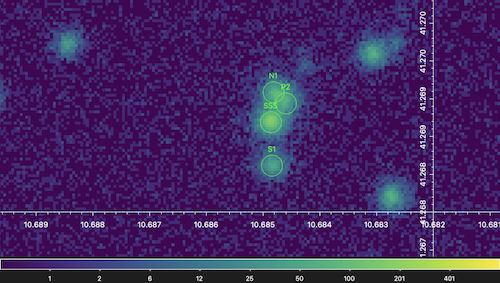
An image of four sources of X-rays — S1, SSS, N1, and P2 — from the center of the Andromeda galaxy.
X-ray data gathered by the Chandra telescope from the center of M31, highlighting the four nuclear sources — S1, SSS, N1, and P2. P2 corresponds to the position of the supermassive black hole at the center of the Andromeda galaxy. Credit: DiKerby, Zhang, & Irwin 2025, ApJ

Their research provides insight into the unique relationship between a galaxy and its black hole.  This is critical to understanding how the universe developed over the past 14 billion years. The results of their analyses were recently published in The Astrophysics Journal.

It began with a line of neutrino breadcrumbs

The story does not begin with black holes but neutrinos — tiny, electrically neutral particles that zoom through space to Earth. DiKerby and his IceCube colleagues follow neutrinos like a trail of breadcrumbs through space to gain greater insight into how the most extreme systems in the universe function. Neutrinos may be produced by the environments near supermassive black holes like M31*.

“Chandra has such fine spatial resolution that it can pick apart the X-ray emission from M31* from three other X-ray sources that crowd around it in the core of Andromeda. It’s the only telescope that can do this,” DiKerby said. “We were able to reconstruct the image — zoom and enhance like in a cop TV show — to pick apart the emission to only measure the X-rays from M31*, not the other sources.” 

Winking photons illuminate the black hole

They determined that M31* has been in an elevated state since 2006, when it ejected a dramatic X-ray flare. They also discovered M31* experienced another X-ray flare in 2013 before settling to the post-2006 state. This finding aligns with a recent discovery by IceCube that linked neutrino-related flares in another galaxy to its supermassive black hole. These results show how observations of nearby supermassive black holes can reveal likely time windows for neutrino emissions.

Their work used the precise positions of four X-ray sources deep in the core of the Andromeda galaxy — S1, SSS, N1, and P2 — to pinpoint the location of the supermassive black hole to P2. 
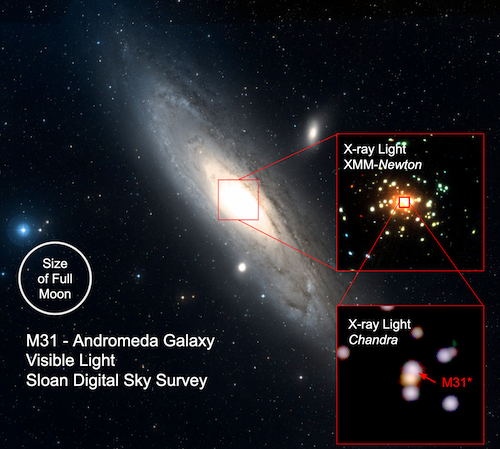
A diagram showing the Andromeda galaxy
A view of the Andromeda galaxy in optical light and an enhanced, zoomed view using the XMM Newton and the Chandra telescope. Credit: Sloan Digital Sky Survey, XMM-Newton, Chandra X-ray Observatory, collected via Aladin

DiKerby compares tracking the X-ray brightness of these objects to standing in one end zone and measuring the intensity of four flickering candles at the far end of a football stadium. With the power and resolution of the Chandra telescope, the team could differentiate the data to isolate each of the neighboring objects.

This work is only possible because of Chandra’s unique observational capabilities. Despite continuing to work well, the telescope is in peril of losing funding. A proposed next generation telescope, AXIS, is still in the early stages of development and would not be operational until the 2030s.

“If Chandra is turned off, the resource to do these fine resolution observations would go away forever,” said DiKerby. “Maintaining these capabilities and planning for the next generation of telescopes is vital.”

DiKerby hopes this paper motivates people to continue to analyze data from M31*. The Chandra telescope needs to be maintained while plans continue for future telescope development. 

“I want us to keep watching the system, to keep watching these flares, and to continue to write the history of super massive black holes,” he said.


MEDIA CONTACTS

Emilie Lorditch
Nuclear ScienceEngineering, Science and TechnologyNatural SciencesMSU ResearchMSU Leadership and Impact

Latest News

MSUToday Weekly Update

The MSUToday Weekly Update email showcases how Spartans are making a difference through academic excellence, research impact and community outreach. Get inspired by these stories of innovation, collaboration and determination. Plus, enjoy photos and videos of campus and more MSU content to help keep you connected to the Spartan community.

Sign UpUpdate My Information

Connect With Us

Visit our Facebook pageVisit our page on XVisit our Instagram pageVisit our LinkedIn pageVisit our YouTube pageVisit our TikTok page

Health and Safety

  • MSU Police and Public Safety
  • Olin Health Center
  • Counseling & Psychiatric Services (CAPS)
  • University Health and Wellbeing
  • MSU Health Care
  • Civil Rights and Title IX
  • Our Commitment
  • Center for Survivors
  • Security & Fire Safety Report
  • University Policy on Relationship Violence and Sexual Misconduct
  • Notice of Non-Discrimination, Anti-Harassment and Non-Retaliation
  • Health Care Non-Discrimination Notice

Support Services

  • Disability Resources
  • Supportive Services
  • Learning Resources

Working at MSU

  • Human Resources
  • EBS Login
  • Job Postings
  • Employee Assistance Program

Reports

  • CARES Act Funding
  • Student Achievement and Outcomes

Contact us

517-355-1855

Address

Michigan State University 426 Auditorium Road East Lansing, MI 48824

Follow Us

  • Visit our Facebook page
  • Visit our page on X
  • Visit our Instagram page
  • Visit our TikTok page
  • Visit our LinkedIn page
  • Visit our YouTube page

If you're having accessibility issues, please let us know.

Know More: Campus Safety Information and ResourcesTransparency Reporting: Budget & Salary/Compensation
  • Contact Information|
  • Site Map|
  • Privacy Statement|
  • Site Accessibility|
  • Call MSU: (517) 355-1855|
  • Visit: msu.edu|
  • Notice of Nondiscrimination|

SPARTANS WILL|© Michigan State University|