Jump to HeaderJump to Main ContentJump to Footer
Michigan State University
MSUTODAY
  • Browse Stories By

    Topics

    Explore stories by subject area

    • Arts and Culture
    • Business and Economy
    • Climate and Environment
    • Education and Learning
    • Engineering, Science and Technology
    • Government and Society
    • Health and Medicine
    • Media and Communications
    • MSU Leadership and Impact
    • Sports and Recreation
    • Student and Campus Experience
    View All Stories

    Collections

    Curated story series

    • Turfgrass
    • Ask the Expert
    • Big Ideas
    • Climate solutions
    • Water at MSU
    • Mobility
    • Spartan Perspectives
    • Student views
    • Graduate voices
    • Faculty voices
    View All Collections

    Featured

    Editor's picks

    • 9 reasons to love being a Spartan

      Aug. 28, 2026

      9 reasons to love being a Spartan

    • NIH awards multi-university team over $4M to improve women’s health

      Sept. 15, 2026

      NIH awards multi-university team over $4M to improve women’s health

MSUTODAY
  • Browse Stories By

< Browse Stories By

Topics

Explore stories by subject area

  • Arts and Culture
  • Business and Economy
  • Climate and Environment
  • Education and Learning
  • Engineering, Science and Technology
  • Government and Society
  • Health and Medicine
  • Media and Communications
  • MSU Leadership and Impact
  • Sports and Recreation
  • Student and Campus Experience
  • View All Stories

Collections

Curated story series

  • Turfgrass
  • Ask the Expert
  • Big Ideas
  • Climate solutions
  • Water at MSU
  • Mobility
  • Spartan Perspectives
  • Student views
  • Graduate voices
  • Faculty voices
  • View All Collections

Featured

Editor's picks

  • 9 reasons to love being a Spartan

    Aug. 28, 2026

    9 reasons to love being a Spartan

  • NIH awards multi-university team over $4M to improve women’s health

    Sept. 15, 2026

    NIH awards multi-university team over $4M to improve women’s health

  • For Media
  • Experts
  • Releases and Statements
  • Sign Up
  • Update Information

Resources

  • A to Z Index
  • Find People
  • Maps
  • Email
  • Student Information System (SIS)
  • D2L
  • Libraries
  • Tech Support
  • MSU Misconduct Hotline
  • Social Media Directory
  • Events Calendar
  • For Media
Michigan State University
MSUToday
  • For Media
  • Experts
  • Releases and Statements
  • Sign Up
  • Update Information
Agricultural Sciences and Farming

April 22, 2025

Should farm fields be used for crops or solar? MSU research suggests both

As farmers debate whether fields should be used for agriculture or solar panels, new research from Michigan State University says the answer could be both.
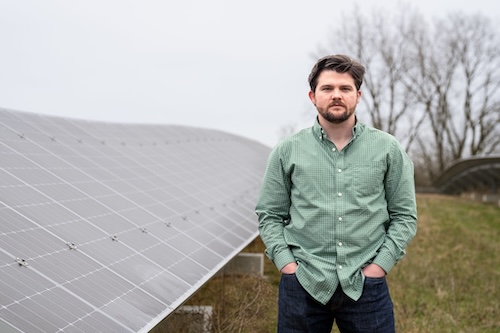
photo of Jake Stid, a graduate student
Jake Stid, a graduate student in Michigan State University’s Department of Earth & Environmental Sciences, studied the impact solar panels have on agriculture. Photo by Finn Gomez; courtesy Michigan State University.

Jake Stid, a graduate student in the College of Natural Science Hydrogeology Lab, analyzed remote sensing and aerial imagery to study how fields have been used in California for the last 25 years. Using databases to estimate revenues and costs, Stid found that farmers who used a small percentage of their land for solar arrays were more financially secure per acre than those who didn’t.

His research, now published in Nature Sustainability, could provide a new roadmap to solvency for farmers struggling to pay the bills. Instead of converting entire fields to solar arrays, Stid hopes this research will help more farmers decide to keep producing crops by strategically placing arrays on lower-yield spots in their fields.

“The conversation shouldn’t be as much about solar or agriculture, but solar and agriculture,” Stid said. “They can work together, and it can be a collaboration rather than a conflict.”

Stid’s work with solar panels began when he joined the lab of Anthony Kendall, an MSU assistant professor who’s also a co-author on the paper. Kendall saw Stid working with Google Earth Engine, a public satellite-image database and cloud computing tool. A casual suggestion that Stid try to pinpoint solar panels on the landscape sparked his curiosity.

He narrowed his focus to the California region for multiple reasons. The state boasts some of the most valuable and productive agricultural land in the United States, and it’s a nationwide leader in solar energy production and installation.
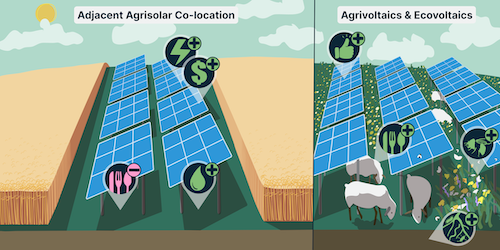
Diagram of  Farms practicing adjacent agrisolar.
: Farms practicing adjacent agrisolar co-location exchange food production for enhanced energy, water, and economic resource security (left). Agrivoltaic and ecovoltaic co-location provide additional benefits (non-exhaustive) to food, ecology, soil health, and community acceptance (right). Original artwork by Bonnie McGill; courtesy Michigan State University College of Natural Science.

As increasingly extreme weather threatens food, energy and water resources, new energy sources have emerged, such as solar, to help decrease carbon emissions. The solar boom has led to concerns of reduced food production, especially as an expanding population and growing consumption place a greater strain on agriculture.

Because of these competing interests, some farmers have turned to what’s called a colocation method: purposefully installing solar arrays alongside crops to maximize the landscape’s production.

Stid wanted to find out how these colocated installations affected a farmer’s bottom line and how that compared to conventional solar arrays where entire fields are turned into solar farms versus farms that continue to grow crops with no solar.

“We’re taking a balanced approach to not just focus on the negatives or the positives, but to take them both together to look more deeply at what people are actually doing on the landscape,” Stid said. “We’re asking what it means and how we can better plan for the future.”

The team used the solar panel footprint in California previously published by Stid in 2022. From there, they used available data sets to calculate that 86,000 people could have been fed by what’s now solar-occupied land.

Then, they used crop cost studies from the University of California-Davis, U.S. annual crop prices, the California Water Rights Fee and other data to calculate the average farmer’s costs and revenue. They modeled solar electricity production from each installation to estimate how much of a farmer’s costs could be offset by selling energy back to the grid.

The results confirmed their hypothesis — farmers who used a few acres of land for solar arrays had more financial stability than those who took an all-or-nothing approach to solar. They spent less on fertilizer, water and farming supplies, and the income from selling energy from their solar arrays made up for the decrease in crops produced. They were even likely to save water by offsetting irrigation, which could benefit the water-stressed region.

“If I’m a farmer, these two acres of solar arrays are going to pay me a certain amount of money throughout the year,” Stid said. “I don’t have to worry about yield instability, or whether it’s going to be a wet or dry year.”

Looking ahead, Stid hopes to expand his research to look at food production and solar arrays across the continental U.S. He’s also working with Kendall to explore other ways that solar arrays impact the environment.

He hopes this research becomes part of the conversation as farmers debate the best way to use land without hurting food production. Solar arrays can be part of a sustainable food system if they’re placed deliberately.

“There are arguments to be made that that’s a more resilient landscape,” Stid said. “You have more benefits being distributed to more people, which we think is impactful.”


 

MEDIA CONTACTS

Bethany Mauger, Emilie Lorditch
Agricultural Sciences and FarmingClimate and EnvironmentWaterNatural SciencesEngineering, Science and Technology

Latest News

MSUToday Weekly Update

The MSUToday Weekly Update email showcases how Spartans are making a difference through academic excellence, research impact and community outreach. Get inspired by these stories of innovation, collaboration and determination. Plus, enjoy photos and videos of campus and more MSU content to help keep you connected to the Spartan community.

Sign UpUpdate My Information

Connect With Us

Visit our Facebook pageVisit our page on XVisit our Instagram pageVisit our LinkedIn pageVisit our YouTube pageVisit our TikTok page

Health and Safety

  • MSU Police and Public Safety
  • Olin Health Center
  • Counseling & Psychiatric Services (CAPS)
  • University Health and Wellbeing
  • MSU Health Care
  • Civil Rights and Title IX
  • Our Commitment
  • Center for Survivors
  • Security & Fire Safety Report
  • University Policy on Relationship Violence and Sexual Misconduct
  • Notice of Non-Discrimination, Anti-Harassment and Non-Retaliation
  • Health Care Non-Discrimination Notice

Support Services

  • Disability Resources
  • Supportive Services
  • Learning Resources

Working at MSU

  • Human Resources
  • EBS Login
  • Job Postings
  • Employee Assistance Program

Reports

  • CARES Act Funding
  • Student Achievement and Outcomes

Contact us

517-355-1855

Address

Michigan State University 426 Auditorium Road East Lansing, MI 48824

Follow Us

  • Visit our Facebook page
  • Visit our page on X
  • Visit our Instagram page
  • Visit our TikTok page
  • Visit our LinkedIn page
  • Visit our YouTube page

If you're having accessibility issues, please let us know.

Know More: Campus Safety Information and ResourcesTransparency Reporting: Budget & Salary/Compensation
  • Contact Information|
  • Site Map|
  • Privacy Statement|
  • Site Accessibility|
  • Call MSU: (517) 355-1855|
  • Visit: msu.edu|
  • Notice of Nondiscrimination|

SPARTANS WILL|© Michigan State University|