Michigan State University researchers along with colleagues at the University of Florida, citizen scientists and their “truffle dogs” have discovered two new species of truffle.
Tuber canirevelatum, meaning the ‘dog-found’ truffle, was named in honor of truffle dogs and Monza, the dog who discovered it with her trainer Lois Martin. The other, Tuber cumberlandense, was named for the Cumberland Plateau where it was found by Margaret Townsend and her truffle dog, Luca.
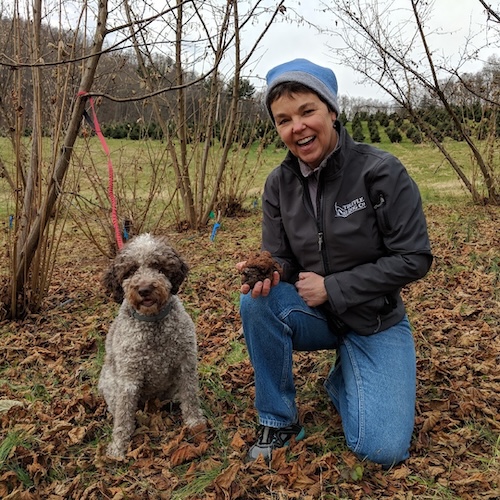
T. canirevelatum did not look or smell like anything known to grow in North America so, curious to know what it was, Martin mailed it to the lab of Gregory Bonito, associate professor in the Department of Plant, Soil and Microbial Sciences at the MSU College of Agriculture and Natural Resources. Bonito and his undergraduate research student, Alassane Sow, lead author on the study, used DNA analyses to identify the two truffles and to place them in the tree of life.
“Receiving these samples was very exciting, especially because they looked very similar to the well-known edible European truffles Tuber macrosporumand Tuber aestivum,” Sow said. “We hope that by describing both of these species there will be increased interest in cultivating North American truffles. Our analyses show that each has aromatic compounds found in some of the most valuable truffle species.”
Due to their rarity, truffles are expensive and highly prized in the culinary world. According to Bonito, both these new truffle species have economic potential. “In international markets, fresh truffles are sold for hundreds and thousands of dollars per kilogram,” Bonito said.
Although T. cumberlandense has been harvested in truffle orchards and in woodlands and has been sold under various names, the analysis showed that it is a distinct and previously undescribed species native to North America, Bonito said.
Currently, efforts are underway in Kentucky to cultivate this native truffle by the distiller Maker’s Mark.
“This particular species enjoys a symbiotic relationship with their host, white oaks, growing from their roots and providing nutrition to the trees,” Bonito said. “Maker’s Mark is interested in cultivating T. cumberlandense because they store their whiskey in white oak barrels. They will be reforesting their land in Kentucky with white oaks for the barrels and hope one day to harvest truffles as well; perhaps they will even create truffle-infused whiskey.”
Historically, the attention has been on cultivating and selling European truffle species, but there is growing interest in cultivating, wild-harvesting and selling species of truffles native to North America.
Bonito said more and more people are trying to grow truffles, which means more truffle dogs are needed for sniffing out these fungal fruits since they grow underground.
“If you have $20,000 of truffles growing underground, you need to find them before they perish, so the dogs are very important,” Bonito said.
Bonito, along with Matthew Smith from the Department of Plant Pathology at the University of Florida, has been surveying and identifying native North American truffles since before 2010. Bonito and Smith received NSF-funding in 2020 to research the evolution of truffles, morels and their relatives known as Pezizales, which supported this work.
Benjamin Lemmond, a member of the Smith lab in Florida, said, “Truffles are some of the most mysterious and alluring fungi on the planet. They live their lives underground, out of sight, but people all around the world are eager to find them and enjoy their unique culinary qualities. This study shows that there are still undiscovered truffles right under our nose, so to speak, and that without the help of dogs (and their incredible noses) we might never find them.”
In addition to naming and describing these new species, Bonito said that each species of truffle produces a unique aroma, which is the basis for the culinary potential of truffles and, therefore, their value.
Bonito and Sow worked with MSU’s Randy Beaudry, professor in the Department of Horticulture, to qualify and characterize the volatiles using gas chromatography. Volatiles are the chemical compounds that create a truffle’s aroma.
“This instrument allowed us to measure the volatile organic compounds released by a truffle,” Sow said. “We found that T. canirevelatum was enriched in compounds such as dimethyl sulfide and methyl 1-propenyl sulfide, which contribute to the truffle’s savory garlic aroma. In T. cumberlandense, we found the compounds dimethyl sulfide (found in the Périgord black truffle and the Piedmont white truffle) and 2,4-dithiapentane (commonly used when making synthetic truffle products).”
“Our research reinforces the importance of using trained truffle dogs in tuber research and truffle farming,” Bonito said. “We suspect many native tuber species remain to be discovered and described. This task will be enhanced through the continued collaboration between mycologists — scientists who study fungi — the public and trained truffle dogs.”

