Elad Harel is used to shining a light on the mysteries of the natural world.
Working at the cutting-edge of ultrafast spectroscopy — the application of short laser pulses to analyze the dynamics of molecules — the Michigan State University associate professor’s research aims to reveal how microscopic phenomena impact large complex systems.
One promising frontier Harel has been working on is the development of new methods of microscopy that will allow researchers to observe molecular and atomic landscapes in motion rather than through static imagery. Such work has earned Harel MSU’s 2023 Innovation of the Year award, as well as MSU’s first-ever grant from the W.M. Keck Foundation.
Now, in a new publication appearing in the Proceedings of the National Academy of Sciences, Harel and his Spartan collaborators report using light to observe and study the “sound” of a virus — an auditory breakthrough that provides a glimpse into elusive, real-time biology.
Harel’s lab worked closely with Dohun Pyeon, a professor in MSU’s Department of Microbiology, Genetics and Immunology, or MGI, who lent his group’s expertise in providing virus targets.
“Teamwork really matters in this challenging and exciting project, and it’s fascinating to experimentally observe the nanoscale motion of these tiny virus particles — they are actually ‘breathing’ under laser illumination,” said Yaqing Zhang, a postdoctoral researcher in the Harel lab and first author of the study.
“I am confident that this technique can be widely utilized for millions of viruses and other biological samples and will acquire more invaluable information from them. The more we know them, the better we can prepare for the next pandemic,” Zhang added.
The College of Natural Science caught up with Harel to learn more about this discovery and a process he calls BioSonic spectroscopy.
This conversation has been edited for length and clarity.
Not many people would string together the words “virus,” “light” and “listen” in a sentence. Could you talk a bit about the fundamental science behind this discovery?
Every type of system has a natural vibrational frequency, whether it’s a star or a biological entity like a virus. You can think of it as the sound the material has, whereby all the atoms vibrate together like balls connected by a complex network of springs.
The arrangement of atoms and their interactions is why when I bang on a table, it sounds different than if I bang on a wall. Of course, sound can be much more complex and contain important information: If you hear a familiar voice across the room, you can immediately identify who it is coming from. Sound, therefore, is a powerful means of identification.
Researchers have been looking at ultrasonic vibrations of metal nanoparticles for several years, but we wanted to ask the question, ‘Do biological systems produce a sound when experiencing some force?’
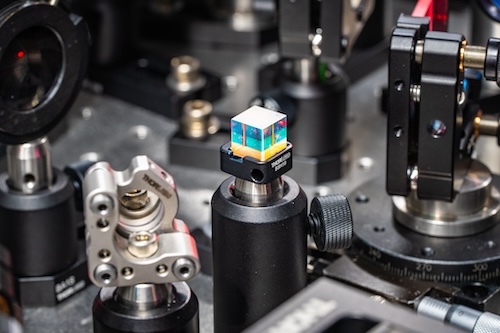
To initiate the sound, we use short pulses of light that generate coherent motion in the system. We then use a second pulse of light to probe that motion at different moments in time. By stringing together all the snapshots in time, we can produce a molecular movie that captures the vibrational motion of the object.
This was a kind of far-out idea, and there wasn’t really any precedent for it, and we discovered that viruses do have a unique sound, which opens a whole new way of thinking about biology.
Whether it’s a virus, a protein, bacteria or the nucleus of a cell — each one will have this unique signature we can detect.
Why did “listening” to a biological system seem like an effective approach compared to other methods of analysis?
We were trying to tackle a fundamental problem in biology, which was also the focus of our Keck Foundation grant — to get the resolution of electron microscopy, but for living systems.
Electron microscopy, or EM, itself is very powerful, but you’re really taking snapshots of life, and you’re doing it in an environment that’s quite different than what you find in living organisms. EM is done in vacuum, and with cryo-EM, it is done at very low temperatures where life cannot be sustained. The goal of the Keck grant was to develop microscopy methods that can visualize and track biology in the hot and wet environment where living things operate.
We spent several years developing more and more sensitive techniques that can measure acoustic vibrations, especially at the single particle level. This was in collaboration with the Pyeon lab in MGI, which helped us gain access to different viruses.
The bigger picture was also thinking of how this acoustic approach could be used as a powerful imaging probe without the need for labeling. This is the process in which a marker is attached to a molecule, allowing researchers to track and study its behaviors and interactions. While extremely useful and specific, the labeling process can be slow and intensive.
One of our goals is to show that this new methodology could use a virus’s or molecule’s natural labeling — basically, the sound of its own materials that distinguishes it from everything else in a system.
So, what did these viruses end up sounding like? Do they ever change their tune?
It turned out the vibrations occur in the gigahertz region. This is a very, very low frequency from the point of optical transitions. For instance, visible light is in the hundreds of terahertz, so these are thousands to millions of times lower energy than what we typically think of in terms of optical spectroscopy.
In this paper, we showed that we can track single viruses and even listen to a virus rupture. As the virus begins to break open and weaken, its acoustics start to change, going lower — almost like a deflating balloon.
What does the future look like for these discoveries?
What we want to do next is show that we could actually dynamically track how a virus is moving. If we want to watch a virus go into a cell now, the process is very, very challenging and slow via electron microscopy or utilizing complex fluorescence labeling.
For example, we have a grant with the Defense Threat Reduction Agency that is interested in biological and chemical detection. One of the things they do is develop drugs, or antivirals, for combating viral infections.
The thinking is: Can we use this kind of technique to speed up that development process — because we could potentially watch a virus’s life cycle from start to finish and better understand the influence of antivirals or drugs in disrupting that process.

