Jump to HeaderJump to Main ContentJump to Footer
Michigan State University
MSUTODAY
  • Browse Stories By

    Topics

    Explore stories by subject area

    • Arts and Culture
    • Business and Economy
    • Climate and Environment
    • Education and Learning
    • Engineering, Science and Technology
    • Government and Society
    • Health and Medicine
    • Media and Communications
    • MSU Leadership and Impact
    • Sports and Recreation
    • Student and Campus Experience
    View All Stories

    Collections

    Curated story series

    • Turfgrass
    • Ask the Expert
    • Big Ideas
    • Climate solutions
    • Water at MSU
    • Mobility
    • Spartan Perspectives
    • Student views
    • Graduate voices
    • Faculty voices
    View All Collections

    Featured

    Editor's picks

    • The Spartans behind your favorite Michigan golf courses

      July 22, 2026

      The Spartans behind your favorite Michigan golf courses

    • MSU in the 1990s: 10 Spartan milestones

      July 14, 2026

      MSU in the 1990s: 10 Spartan milestones

MSUTODAY
  • Browse Stories By

< Browse Stories By

Topics

Explore stories by subject area

  • Arts and Culture
  • Business and Economy
  • Climate and Environment
  • Education and Learning
  • Engineering, Science and Technology
  • Government and Society
  • Health and Medicine
  • Media and Communications
  • MSU Leadership and Impact
  • Sports and Recreation
  • Student and Campus Experience
  • View All Stories

Collections

Curated story series

  • Turfgrass
  • Ask the Expert
  • Big Ideas
  • Climate solutions
  • Water at MSU
  • Mobility
  • Spartan Perspectives
  • Student views
  • Graduate voices
  • Faculty voices
  • View All Collections

Featured

Editor's picks

  • The Spartans behind your favorite Michigan golf courses

    July 22, 2026

    The Spartans behind your favorite Michigan golf courses

  • MSU in the 1990s: 10 Spartan milestones

    July 14, 2026

    MSU in the 1990s: 10 Spartan milestones

  • For Media
  • Experts
  • Releases and Statements
  • Sign Up
  • Update Information

Michigan State University

Resources

  • A to Z Index
  • Find People
  • Maps
  • Email
  • Student Information System (SIS)
  • D2L
  • Libraries
  • Tech Support
  • MSU Misconduct Hotline
  • Social Media Directory
  • Events Calendar
  • For Media
Michigan State University
MSUToday
  • For Media
  • Experts
  • Releases and Statements
  • Sign Up
  • Update Information
Diseases, Conditions and Treatments

Feb. 4, 2025

Henry Ford + MSU researchers collaborate to shift pancreatic cancer outlook from bleak to bright

By: Dalin Clark

Pancreatic cancer is one of the most aggressive and deadly forms of cancer. The five-year survival rate is just 13%. On average, patients survive for only nine months after diagnosis and roughly 66,000 people are diagnosed in the U.S. each year. Now, researchers from Henry Ford Health and MSU are coming together to share their knowledge and expertise with the aim of changing this somber prognosis.

“I completely believe in team science,” said Jennifer Klomp, a pancreatic cancer researcher at Michigan State University. “I think the resulting science is better and more rigorous. You come at something with different approaches, different ways of thinking and different ideas. And the output, in the end, is more beneficial.”


Klomp, who is also an assistant professor in the Department of Medicine at the Michigan State University College of Human Medicine, recently joined MSU, partly because of the opportunity to conduct team science with pancreatic cancer researchers at Henry Ford Health. This is part of the partnership between the two organizations. Her husband, Jeff Klomp, also a pancreatic cancer researcher and assistant professor, joined MSU at the same time. Their labs are located at the Grand Rapids Research Center.


“The Henry Ford Health + Michigan State University Health Sciences partnership really gave us confidence that we could be part of a pancreatic cancer research community,” Klomp said. “Howard Crawford, a senior researcher at Henry Ford Health, developed a research organization dedicated to pancreatic cancer care. He’s added people who have diverse experience, which has opened multiple collaborative projects between our groups.”
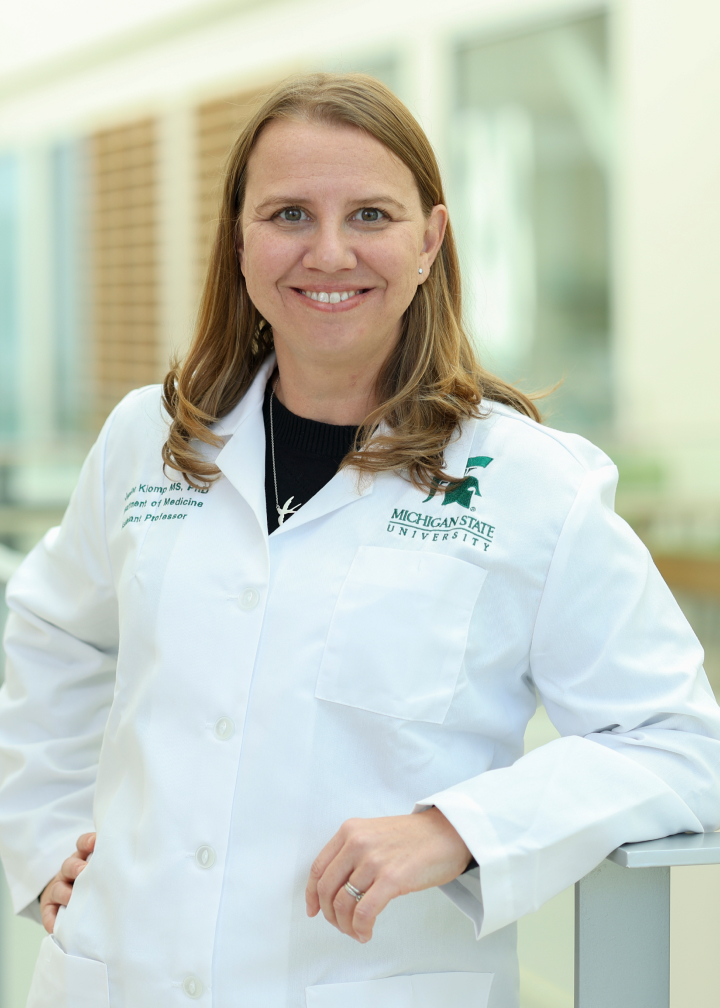
 

Jennifer Klomp, assistant professor, College of Human Medicine.


About pancreatic cancer


“Early symptoms are pretty nonspecific,” said Crawford, who is also a research professor in the Department of Pharmacology and Toxicology in the College of Human Medicine. “The most common risk factor is age. Most people are diagnosed in their mid-70s. Common symptoms are back pain, gastrointestinal problems and jaundice. All of these can also be attributed to other conditions, especially in patients who are over 70 years old. And that’s why it’s so hard to diagnose this cancer at an early stage.


“The wasting effect also happens with pancreatic cancer,” he added. “In a very short amount of time, people will go from looking fully healthy to like a ghost of their former selves. Unfortunately, the actor Patrick Swayze was an example of that.”


Reasons for hope


“When I started as a pancreatic cancer researcher in 2017, the goal was to get five-year survival rates into double digits,” Klomp said. “Now we’re at 13%, and I think that number is going to increase significantly, very quickly.”


“There has been a core cluster of senior researchers who started recruiting people into the pancreatic cancer field and I happened to be included in the early stages,” Crawford said. “This is an incredibly supportive field. We all really want this disease to go away.”

 

Howard Crawford, senior researcher at Henry Ford Health.


Currently, Henry Ford + MSU pancreatic cancer researchers are focused on genetic indicators that play a crucial role in the ways cells communicate through the exchange of chemical signals. As pancreatic cancer cell behaviors are identified, researchers can start to create pharmaceutical drugs and work toward cures.


“RAS was identified as an oncogene in 1982 and is the prominent driver of pancreatic cancer,” Klomp said. “The fact that we have known about the prominent driver of pancreatic and other cancers for so long has made it an obvious therapeutic target. But it hasn’t been easy. It took nearly 40 years because RAS is kind of like a greasy ball or a tennis ball so there have not been obvious spots for a drug to bind and block its activity.”


The Henry Ford + MSU team is working with the National Cancer Institute and others to manage RAS activity, which has implications for lung and colorectal cancer patients too.


“The exciting thing for pancreatic cancer patients is that we are already seeing improvements from drugs that are RAS inhibitors,” Klomp said. “And if we can use an RAS inhibitor to shrink a tumor to a size that can be helped with surgery, maybe we can also improve the patient’s quality of life and extend life in later-stage patients.”


The team also manages a large biobank that includes blood and tumor samples from a diverse population of patients.


“Researchers around the world ask for access to our tissue database and biobank,” Crawford said. “Right now, pancreatic cancer is impossible to detect in the early stages, so having blood collected from 600 diverse patients is the gold standard.


“The big hope for us right now is the RAS inhibitors, and that’s a major part of the research programs for Jenny and Jeff Klomp,” he added. “We’re thrilled to have them on board, and it’s been absolutely seamless.”


MEDIA CONTACTS

Dalin Clark
Diseases, Conditions and TreatmentsHealth and MedicineMSU ResearchMSU Leadership and Impact

Collection

more content from this collection

West Michigan

Latest News

MSUToday Weekly Update

The MSUToday Weekly Update email showcases how Spartans are making a difference through academic excellence, research impact and community outreach. Get inspired by these stories of innovation, collaboration and determination. Plus, enjoy photos and videos of campus and more MSU content to help keep you connected to the Spartan community.

Sign UpUpdate My Information

Connect With Us

Visit our Facebook pageVisit our page on XVisit our Instagram pageVisit our LinkedIn pageVisit our YouTube pageVisit our TikTok page

Health and Safety

  • MSU Police and Public Safety
  • Olin Health Center
  • Counseling & Psychiatric Services (CAPS)
  • University Health and Wellbeing
  • MSU Health Care
  • Civil Rights and Title IX
  • Our Commitment
  • Center for Survivors
  • Security & Fire Safety Report
  • University Policy on Relationship Violence and Sexual Misconduct
  • Notice of Non-Discrimination, Anti-Harassment and Non-Retaliation
  • Health Care Non-Discrimination Notice

Support Services

  • Disability Resources
  • Supportive Services
  • Learning Resources

Working at MSU

  • Human Resources
  • EBS Login
  • Job Postings
  • Employee Assistance Program

Reports

  • CARES Act Funding
  • Student Achievement and Outcomes

Contact us

517-355-1855

Address

Michigan State University 426 Auditorium Road East Lansing, MI 48824

Follow Us

  • Visit our Facebook page
  • Visit our page on X
  • Visit our Instagram page
  • Visit our TikTok page
  • Visit our LinkedIn page
  • Visit our YouTube page

If you're having accessibility issues, please let us know.

Know More: Campus Safety Information and ResourcesTransparency Reporting: Budget & Salary/Compensation
Michigan State University
  • Contact Information|
  • Site Map|
  • Privacy Statement|
  • Site Accessibility|
  • Call MSU: (517) 355-1855|
  • Visit: msu.edu|
  • Notice of Nondiscrimination|

SPARTANS WILL|© Michigan State University|