Why this matters:
-
Warming ocean temperatures are causing a phenomenon called coral bleaching, putting corals at a greater risk of starvation, disease and death.
-
This study shows that rice coral, an important reef-building species, passes on thermal resistance to their offspring and avoids coral bleaching. Understanding this is important to building healthier coral reefs and protecting their future.
-
Coral reefs are habitats for nearly a quarter of all marine life, protect coasts from erosion and support the livelihoods of millions. Protecting coral reefs is crucial to preserving the future of our oceans.
Plunge into the shallows off the Florida Keys, Hawaiʻi or the Great Barrier Reef in Australia and you are likely to meet a startling sight.
Where there were once acres of dazzling coral — an underwater world of dayglo greens, brassy yellows and midnight blues — is now a ghostly landscape, with many reefs seemingly drained of their pigment.
Caused by stressful conditions like warming ocean temperatures, coral bleaching is a leading threat to some of our planet’s most diverse and vital ecosystems.
Now, a team of researchers has found that some corals survive warming ocean temperatures by passing heat-resisting abilities on to their offspring.
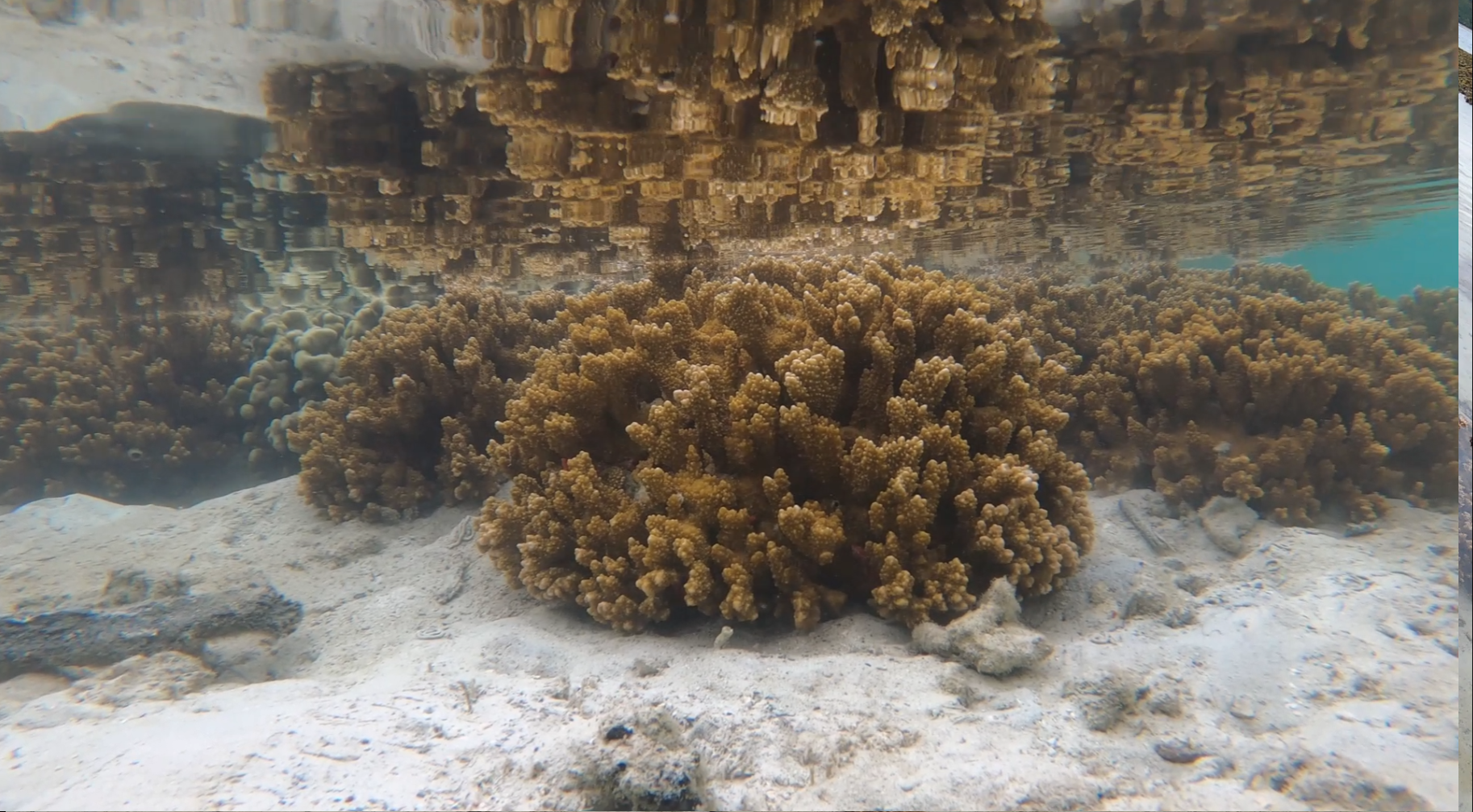
The findings, published in the journal Nature Communications, are the result of a collaboration between Michigan State University, Duke University and the Hawaiʻi Institute of Marine Biology, or HIMB, at the University of Hawaiʻi at Mānoa. This work, funded by the National Science Foundation and a Michigan State University Climate Change Research grant, is crucial in the race to better conserve and restore threatened reefs across the globe.
Coral reefs are habitats for nearly a quarter of all marine life, protecting coastlines from storms and erosion and supporting the livelihoods of millions of people around the world. Though still alive, bleached corals are at a much higher risk of disease, starvation and eventual mortality.
In their latest study, the team explored how resistance to thermal stress is passed down from parent to offspring in an important reef-building species known as rice coral. These findings are helping researchers breed stronger, heat-tolerant generations to better face environmental stress.

“The Coral Resilience Lab in Hawaiʻi has developed amazing methods to breed and rear corals during natural summer spawning,” said Spartan biochemist and study co-author Rob Quinn, whose lab takes samples of these corals and generates massive datasets on their biochemistry with instruments at MSU.
“This is a true scientific collaboration that can support coral breeding and reproduction to cultivate more resilient corals for the warming oceans of the future.”
A colorful crowd
The kaleidoscopic of shades we associate with healthy coral is the product of a bustling exchange of resources between a coral animal and its algae partners.
When all is well, you might think of this relationship as that of tenants living in a home and paying a bit of rent.
In exchange for cozy, sheltered spaces found within the coral tissue as well as nutrients, algae use photosynthesis to produce sugars. These sugars can provide up to 95% of the energy that coral needs to grow and form the sprawling, breathtaking reefs we know.
In tropical waters often lacking nutrients, disruptions in this exchange — like those that occur during bleaching events — can be disastrous.
When looking at a specimen of coral that’s suffered bleaching, you’re glimpsing a coral that’s “kicked out” its algae, leaving behind a pale skeleton.

“Corals are like the trees in an old growth forest; they build the ecosystems we know as reefs on the energetic foundation between the animal and algae,” explained Crawford Drury, an assistant researcher at the Coral Resilience Lab at HIMB and co-author of the study
In the waters of Kāneʻohe Bay, the Coral Resilience Lab is spearheading research to best understand this coral reef ecology and the molecular mechanisms driving thermal stress.
The lab is likewise pioneering the breeding of thermally resistant coral for experiments and the restoration of reefs, a highly specialized process few labs in the world can achieve.
So, while you’d usually be hard pressed to find fresh coral for study in East Lansing, MSU’s partnership with the Coral Resilience Lab has led to a globe-spanning collaboration that closes the gap between field and laboratory.
“HIMB and MSU have developed a really amazing partnership. I’m just happy they’ve let me be a part of it. I can’t wait to see what comes out of it next,” said Ty Roach, a visiting faculty at Duke University and lead author of the new study.
Heat-resistant hand-me-downs
In the wild, rice coral takes on a dizzying array of shapes, from jutting, spiky protrusions to flat, tiered terraces — all identifiable by the tiny grain-like projections that lend the species its name.
When samples arrive at MSU, Quinn applies an analytical approach known as metabolomics to understand the complex biochemistry of the organisms.
Like a snapshot of life in motion, metabolomics allows researchers to get an idea of what’s occurring within a cell or tissue sample at a precise moment in time.
Leveraging advanced instrumentation found in MSU’s Mass Spectrometry and Metabolomics Core, the team searched for biochemical signatures associated with bleaching resistance in their samples.
This included analyzing coral sperm, eggs, embryos and larvae, as well as their algal “collaborators.”
Through their analyses, the researchers discovered that both coral and algae pass along the biochemical signature of thermal tolerance, and that this tolerance was successfully maintained from parent coral into the next generation.
Given rice coral’s method of reproduction and the numerous stages of the coral life cycle, this was an impressive feat.
“Corals usually spawn based on the lunar cycle; for our experiment, this means late nights around the summer new moons and months of work rearing coral larvae and juveniles,” said Drury.

This summer, Quinn group graduate student Sarah VanDiepenbos had the chance to join Coral Resilience Lab researchers to witness one such nighttime coral spawning and breeding event.
“It was such a serene, beautiful experience. The timing is impeccable, as the process only lasts 20 to 30 minutes total,” VanDiepenbos explained.
“The coral bundles slowly float upward, trying to find another gamete to combine with once they get to the surface. This release is gradual, so they can have a maximum chance of finding spawn from a different coral,” she added.
Tougher genes for warmer seas
While many species of corals uptake symbionts from the surrounding seawater, rice coral provide their eggs with algae, handing this relationship down from parent to child.
“To have this algae’s thermal tolerance remain through an entire generation and all the stages of coral development, that’s surprising, and promising for the future of coral reefs,” Quinn said, who’s also an associate professor in MSU’s Department of Biochemistry and Molecular Biology.
Especially compelling was the fact that the earliest stages of the coral lifecycle, like embryos and larva, showed chemical signatures linked to whether parent organisms were thermally tolerant or not.
This means that not only do offspring receive heat-resistant genes, but also beneficial molecules to give them a head start against heat stress.
“Some of the most interesting findings from this work is that coral lipid biochemistry is maintained through all stages of development during reproduction,” Quinn said.
“Importantly, these lipids come from both the host coral and its algal symbiont, indicating there is crosstalk between them to prepare the next generation to resist bleaching,” he added.
In showing how inherited thermal resistance originates from both coral and algae, this research provides deeper insight into the finely tuned, symbiotic microcosm found in corals across the world’s oceans.
Most exciting for the team is how these findings are contributing to the science behind the restoration of reefs and the breeding of stronger, more heat-tolerant coral generations.
“Our metabolomics research at MSU could support reef restoration efforts at places like the Kāneʻohe Bay by identifying corals that are resistant to bleaching,” Quinn said.

