Jump to HeaderJump to Main ContentJump to Footer
Michigan State University
  • Browse Stories By

    Topics

    Explore stories by subject area

    • Arts and Culture
    • Business and Economy
    • Climate and Environment
    • Education and Learning
    • Engineering, Science and Technology
    • Government and Society
    • Health and Medicine
    • Media and Communications
    • MSU Leadership and Impact
    • Sports and Recreation
    • Student and Campus Experience
    View All Stories

    Collections

    Curated story series

    • Turfgrass
    • Ask the Expert
    • Big Ideas
    • Climate solutions
    • Water at MSU
    • Mobility
    • Spartan Perspectives
    • Student views
    • Graduate voices
    • Faculty voices
    View All Collections

    Featured

    Editor's picks

    • The Spartans behind your favorite Michigan golf courses

      July 22, 2026

      The Spartans behind your favorite Michigan golf courses

    • MSU in the 1990s: 10 Spartan milestones

      July 14, 2026

      MSU in the 1990s: 10 Spartan milestones

MSUTODAY
  • Browse Stories By

< Browse Stories By

Topics

Explore stories by subject area

  • Arts and Culture
  • Business and Economy
  • Climate and Environment
  • Education and Learning
  • Engineering, Science and Technology
  • Government and Society
  • Health and Medicine
  • Media and Communications
  • MSU Leadership and Impact
  • Sports and Recreation
  • Student and Campus Experience
  • View All Stories

Collections

Curated story series

  • Turfgrass
  • Ask the Expert
  • Big Ideas
  • Climate solutions
  • Water at MSU
  • Mobility
  • Spartan Perspectives
  • Student views
  • Graduate voices
  • Faculty voices
  • View All Collections

Featured

Editor's picks

  • The Spartans behind your favorite Michigan golf courses

    July 22, 2026

    The Spartans behind your favorite Michigan golf courses

  • MSU in the 1990s: 10 Spartan milestones

    July 14, 2026

    MSU in the 1990s: 10 Spartan milestones

  • For Media
  • Experts
  • Releases and Statements
  • Sign Up
  • Update Information

Resources

  • A to Z Index
  • Find People
  • Maps
  • Email
  • Student Information System (SIS)
  • D2L
  • Libraries
  • Tech Support
  • MSU Misconduct Hotline
  • Social Media Directory
  • Events Calendar
  • For Media
Michigan State University
MSUToday
  • For Media
  • Experts
  • Releases and Statements
  • Sign Up
  • Update Information
MSUTODAY
Nuclear Science

June 12, 2025

Where did cosmic rays come from? MSU astrophysicists are closer to finding out

By: Bethany Mauger
Cosmic rays
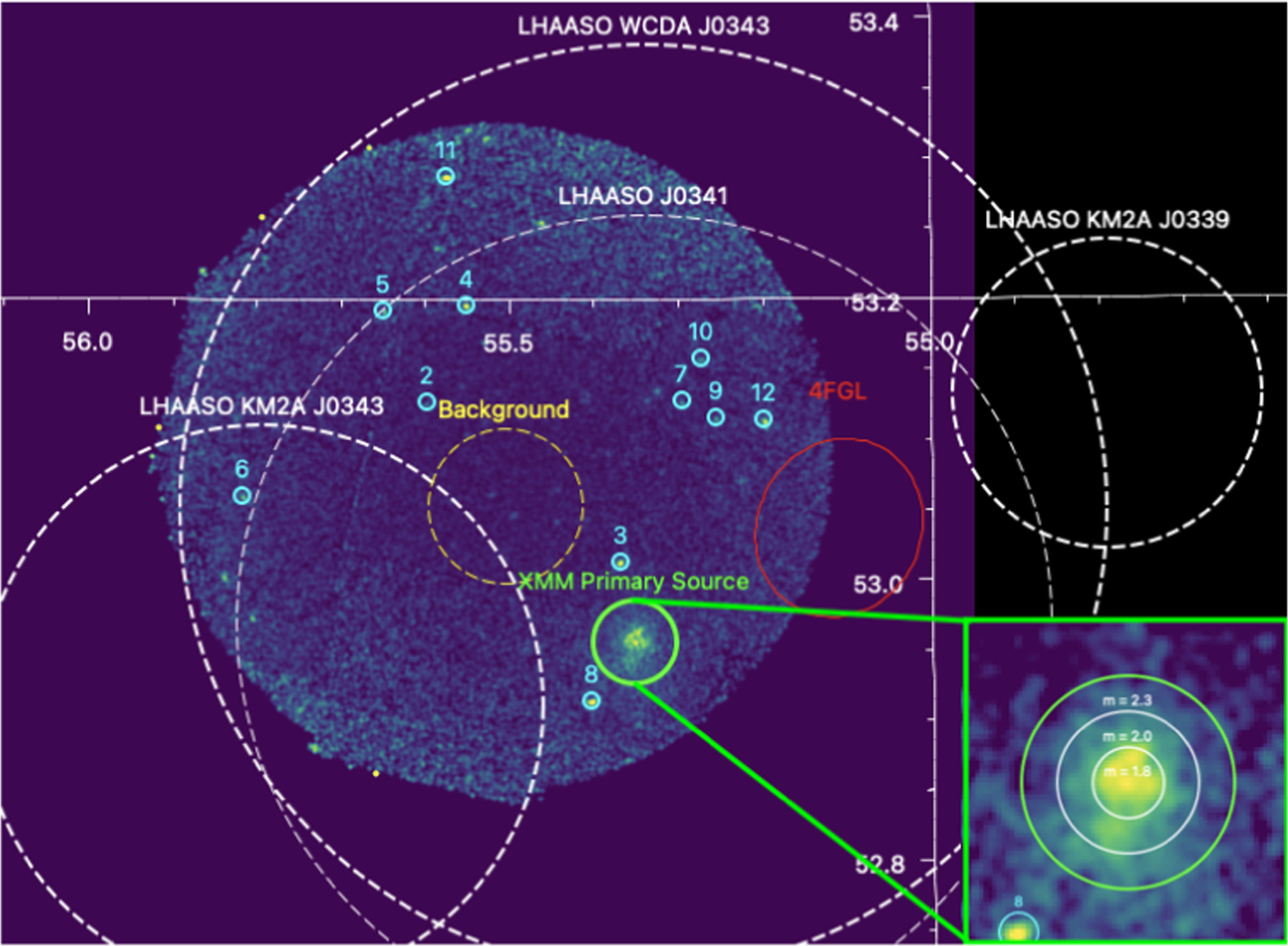
X-ray image of the newly discovered pulsar wind nebular associated with an extreme Galactic cosmic ray source 1LHAASO J0343+5254u, obtained by the XMM-Newton space telescope (DiKerby, Zhang, et al., ApJ, 983, 21)

New research published by Michigan State University astrophysicists could help scientists answer a century-old question: where did galactic cosmic rays come from?

Cosmic rays — high-energy particles moving close to the speed of light — originated from somewhere in the Milky Way galaxy and beyond, but exactly where has been a mystery since they were discovered in 1912. Shuo Zhang, MSU assistant professor of physics and astronomy and her group led two studies that shed new light on where cosmic rays might have come from. The recently published findings were presented this week at the 246th meeting of the American Astronomical Society in Anchorage, Alaska.

The sources of these high-energy, fast-moving particles could bear the nature of black holes, supernova remnants and star forming regions. These extreme astrophysical events are also known to produce neutrinos — tiny, nearly massless particles that are found in abundance not only deep in space, but also on our planet.

“Cosmic rays are a lot more relevant to life on Earth than you might think,” Zhang said. “About 100 trillion cosmic neutrinos from far, far away sources like black holes pass through your body every second. Don’t you want to know where they came from?”

Cosmic ray sources are so powerful that they can accelerate a proton or electron into energies far beyond what humans are able to do with the most advanced particle accelerator. Zhang’s group is studying these cosmic particle accelerators, known as PeVatrons, to find out where and what they are and how they’re able to accelerate small particles into extremely high energies. Understanding more about them can help unlock fundamental questions in physics, such as galaxy evolution and the nature of dark matter.

Her group’s latest papers explore multi-wavelength studies of PeVatron candidates whose sources remained unknown. In the first paper, Stephen DiKerby, a postdoctoral student in Zhang’s group, investigated a mysterious PeVatron candidate discovered by the Large High Altitude Air Shower Observatory, but the nature of the source was still unknown. Using X-ray data from the XMM-Newton space telescope, DiKerby found a pulsar wind nebula — an expanding bubble with relativistic electrons and positions with energy injection from a pulsar. This finding established this PeVatron as a pulsar wind nebula type of cosmic ray source and is one of a few cases where scientists can identify the nature of PeVatrons.

In the second paper, three MSU undergraduate students in Zhang’s group — Ella Were, Amiri Walker and Shaan Karim — used NASA’s Swift X-ray telescope to observe X-ray emissions from little-explored LHAASO cosmic ray sources. The team calculated the upper limits for the X-ray emission and their work could serve as a pathfinder for future studies.

“Through identifying and classifying cosmic ray sources, our effort can hopefully provide a comprehensive catalogue of cosmic ray sources with classification,” Zhang said. “That could serve as a legacy for future neutrino observatory and traditional telescopes to perform more in-depth study in particle acceleration mechanisms.” 

Next, Zhang’s team plans to tackle another study on cosmic ray sources by combining data it collects from the IceCube Neutrino Observatory with those from X-ray and gamma-ray telescopes. They want to explore why some cosmic ray sources emit neutrinos but not others, as well as where and how the neutrinos are produced.

“This work will call for collaboration between particle physicists and astronomers,” Zhang said. “It’s an ideal project for the MSU high-energy physics group.”

This work is supported by multiple NASA observation grants and the National Science Foundation IceCube analysis grant. 

This story originally appeared on the College of Natural Science website.

MEDIA CONTACTS

Emilie Lorditch
Nuclear ScienceEngineering, Science and Technology

Latest News

MSUToday Weekly Update

The MSUToday Weekly Update email showcases how Spartans are making a difference through academic excellence, research impact and community outreach. Get inspired by these stories of innovation, collaboration and determination. Plus, enjoy photos and videos of campus and more MSU content to help keep you connected to the Spartan community.

Sign UpUpdate My Information

Connect With Us

Visit our Facebook pageVisit our page on XVisit our Instagram pageVisit our LinkedIn pageVisit our YouTube pageVisit our TikTok page

Health and Safety

  • MSU Police and Public Safety
  • Olin Health Center
  • Counseling & Psychiatric Services (CAPS)
  • University Health and Wellbeing
  • MSU Health Care
  • Civil Rights and Title IX
  • Our Commitment
  • Center for Survivors
  • Security & Fire Safety Report
  • University Policy on Relationship Violence and Sexual Misconduct
  • Notice of Non-Discrimination, Anti-Harassment and Non-Retaliation
  • Health Care Non-Discrimination Notice

Support Services

  • Disability Resources
  • Supportive Services
  • Learning Resources

Working at MSU

  • Human Resources
  • EBS Login
  • Job Postings
  • Employee Assistance Program

Reports

  • CARES Act Funding
  • Student Achievement and Outcomes

Contact us

517-355-1855

Address

Michigan State University 426 Auditorium Road East Lansing, MI 48824

Follow Us

  • Visit our Facebook page
  • Visit our page on X
  • Visit our Instagram page
  • Visit our TikTok page
  • Visit our LinkedIn page
  • Visit our YouTube page

If you're having accessibility issues, please let us know.

Know More: Campus Safety Information and ResourcesTransparency Reporting: Budget & Salary/Compensation
  • Contact Information|
  • Site Map|
  • Privacy Statement|
  • Site Accessibility|
  • Call MSU: (517) 355-1855|
  • Visit: msu.edu|
  • Notice of Nondiscrimination|

SPARTANS WILL|© Michigan State University|
