Jump to HeaderJump to Main ContentJump to Footer
Michigan State University
MSUTODAY
  • Browse Stories By

    Topics

    Explore stories by subject area

    • Arts and Culture
    • Business and Economy
    • Climate and Environment
    • Education and Learning
    • Engineering, Science and Technology
    • Government and Society
    • Health and Medicine
    • Media and Communications
    • MSU Leadership and Impact
    • Sports and Recreation
    • Student and Campus Experience
    View All Stories

    Collections

    Curated story series

    • Turfgrass
    • Ask the Expert
    • Big Ideas
    • Climate solutions
    • Water at MSU
    • Mobility
    • Spartan Perspectives
    • Student views
    • Graduate voices
    • Faculty voices
    View All Collections

    Featured

    Editor's picks

    • 9 reasons to love being a Spartan

      Aug. 28, 2026

      9 reasons to love being a Spartan

    • NIH awards multi-university team over $4M to improve women’s health

      Sept. 15, 2026

      NIH awards multi-university team over $4M to improve women’s health

MSUTODAY
  • Browse Stories By

< Browse Stories By

Topics

Explore stories by subject area

  • Arts and Culture
  • Business and Economy
  • Climate and Environment
  • Education and Learning
  • Engineering, Science and Technology
  • Government and Society
  • Health and Medicine
  • Media and Communications
  • MSU Leadership and Impact
  • Sports and Recreation
  • Student and Campus Experience
  • View All Stories

Collections

Curated story series

  • Turfgrass
  • Ask the Expert
  • Big Ideas
  • Climate solutions
  • Water at MSU
  • Mobility
  • Spartan Perspectives
  • Student views
  • Graduate voices
  • Faculty voices
  • View All Collections

Featured

Editor's picks

  • 9 reasons to love being a Spartan

    Aug. 28, 2026

    9 reasons to love being a Spartan

  • NIH awards multi-university team over $4M to improve women’s health

    Sept. 15, 2026

    NIH awards multi-university team over $4M to improve women’s health

  • For Media
  • Experts
  • Releases and Statements
  • Sign Up
  • Update Information

Resources

  • A to Z Index
  • Find People
  • Maps
  • Email
  • Student Information System (SIS)
  • D2L
  • Libraries
  • Tech Support
  • MSU Misconduct Hotline
  • Social Media Directory
  • Events Calendar
  • For Media
Michigan State University
MSUToday
  • For Media
  • Experts
  • Releases and Statements
  • Sign Up
  • Update Information
Education Policy

June 3, 2025

MSU study: Virtual reality beneficial for remote instruction — but there’s a time limit

Slowly but surely virtual reality, or VR, headsets are becoming a part of classrooms in colleges, high schools and even middle schools. Meanwhile, large companies such as Apple and Meta continue to spend billions on VR headsets, betting on eventual mainstream VR adoption. But there is very little data examining the costs and benefits of this new technology over time.
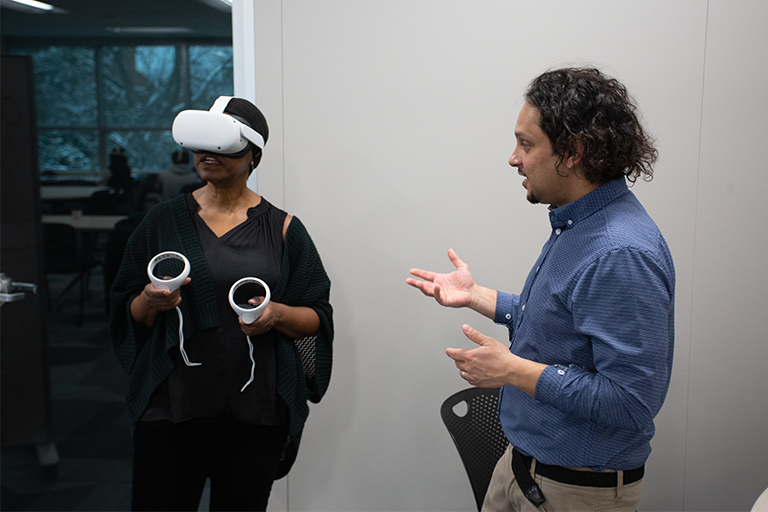
A person uses a virtual reality headset while another person talks with them.
Rabindra “Robby” Ratan (right) gives instruction during a workshop on teaching with virtual reality at MSU.

New research from Michigan State University with colleagues at Stanford shows that the sense of social connection in VR during classroom instruction (called social presence) enhances student outcomes compared to videoconferencing — until virtual meeting fatigue sets in.

The study, published in Computers and Education and partially funded by the National Science Foundation, notes that both the benefits of use and virtual meeting fatigue increase with time spent in VR. Notably, certain benefits — like students’ social presence with peers and perceived competence in the class — start to decline after about 45 minutes of VR use on average. However, this optimal level of VR duration differs widely between students, ranging from about 20 minutes to 280 minutes.

“Class time spent in VR likely leads to a net benefit despite meeting fatigue,” said Rabindra “Robby” Ratan, associate professor of media and information and AT&T Endowed Chair in the MSU College of Communication Arts and Sciences. “Virtual reality amplifies the benefits of online learning because of its ability to provide immersive, interactive and personalized experiences that enhance learner engagement with course content and peers.”

Ratan and his colleagues conducted the study as part of a 15-week online undergraduate class in which students used VR headsets regularly. The class met twice weekly for 80 minutes and used a combination of videoconferencing and virtual reality. Of the 30 students who participated in the study, the majority had not used VR prior to the class.

The study builds on Ratan’s previous research on social presence and online education, which examined a student’s perceived course gains through three constructs:

  • Perceived learning, which is generally, though not perfectly, correlated with grades.
  • Perceived competence, which refers to students’ self-assessed abilities in class performance.
  • Class enjoyment, which reflects students’ perceptions of the class as fun and engaging.

“Class meetings in VR improve social connectivity and enjoyment — at least until the detrimental effects of virtual meeting fatigue build up and become harder to manage,” said Ratan.


In partnership with the federal government, Spartan researchers drive lifesaving breakthroughs and address society’s most pressing challenges.

Learn More

Social presence — the sense of being together with others in a mediated environment, shaped by reactions to social cues — may buffer against virtual meeting fatigue, according to the study. Peer social presence was more positively related to VR duration than it was to virtual meeting fatigue, though it peaked around an average of 45 minutes, again with large differences between students.

“Social presence plays a vital role in online learning, influencing outcomes such as engagement, class performance and learner satisfaction,” said Ratan. “VR can facilitate more natural communication in online classrooms by providing interactive avatars and nonverbal cues.”
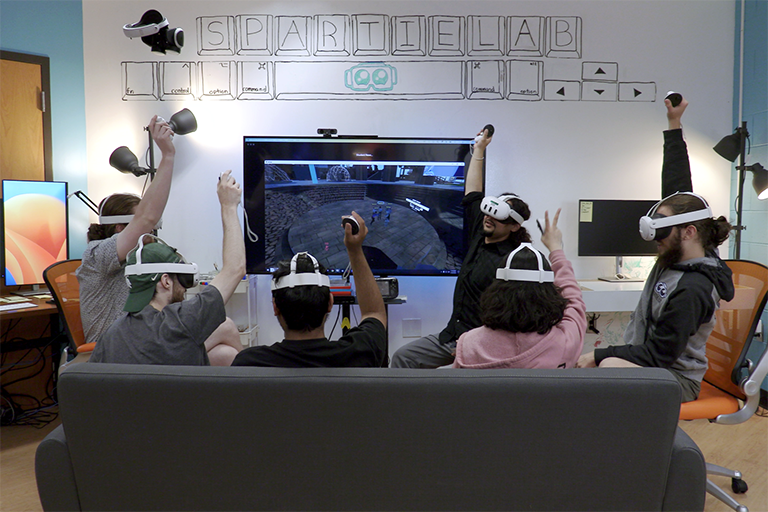
People sitting on a couch using virtual reality headsets while computer animation is on a TV screen.
Ratan leads the MSU SPARTIE Lab, which focuses on the social dimensions of virtual reality, particularly in educational contexts.

Ratan recommends keeping VR duration low for new users but notes that VR duration may increase as students become more comfortable with the medium. He also suggests employing it for activities that emphasize active engagement, such as small group discussions, not lectures, as VR is more effective for participative activities than for passive learning.

“Instructors should find a balance to harness the benefits of social presence in VR, be mindful of new users as they acclimate to the technology and offer alternative modes of access to classes in virtual worlds,” he said. “Instructors should use virtual reality platforms that offer desktop computer and mobile applications, allowing students to participate without a VR headset and avoid fatigue and simulator sickness when they need to.”

Simulator sickness is a type of motion sickness that can occur from prolonged exposure to VR.

“At any class duration, providing alternative access options can enhance accessibility, inclusivity and sustained engagement across students,” Ratan said


MEDIA CONTACTS

Alex Tekip
Education PolicyEducation and LearningEngineeringEngineering, Science and TechnologyMSU ResearchMSU Leadership and Impact

Latest News

MSUToday Weekly Update

The MSUToday Weekly Update email showcases how Spartans are making a difference through academic excellence, research impact and community outreach. Get inspired by these stories of innovation, collaboration and determination. Plus, enjoy photos and videos of campus and more MSU content to help keep you connected to the Spartan community.

Sign UpUpdate My Information

Connect With Us

Visit our Facebook pageVisit our page on XVisit our Instagram pageVisit our LinkedIn pageVisit our YouTube pageVisit our TikTok page

Health and Safety

  • MSU Police and Public Safety
  • Olin Health Center
  • Counseling & Psychiatric Services (CAPS)
  • University Health and Wellbeing
  • MSU Health Care
  • Civil Rights and Title IX
  • Our Commitment
  • Center for Survivors
  • Security & Fire Safety Report
  • University Policy on Relationship Violence and Sexual Misconduct
  • Notice of Non-Discrimination, Anti-Harassment and Non-Retaliation
  • Health Care Non-Discrimination Notice

Support Services

  • Disability Resources
  • Supportive Services
  • Learning Resources

Working at MSU

  • Human Resources
  • EBS Login
  • Job Postings
  • Employee Assistance Program

Reports

  • CARES Act Funding
  • Student Achievement and Outcomes

Contact us

517-355-1855

Address

Michigan State University 426 Auditorium Road East Lansing, MI 48824

Follow Us

  • Visit our Facebook page
  • Visit our page on X
  • Visit our Instagram page
  • Visit our TikTok page
  • Visit our LinkedIn page
  • Visit our YouTube page

If you're having accessibility issues, please let us know.

Know More: Campus Safety Information and ResourcesTransparency Reporting: Budget & Salary/Compensation
  • Contact Information|
  • Site Map|
  • Privacy Statement|
  • Site Accessibility|
  • Call MSU: (517) 355-1855|
  • Visit: msu.edu|
  • Notice of Nondiscrimination|

SPARTANS WILL|© Michigan State University|