Jump to HeaderJump to Main ContentJump to Footer
Michigan State University
MSUToday
  • For Media
  • Experts
  • Releases and Statements
  • Sign Up
  • Update Information
MSUTODAY
  • Browse Stories By

    Topics

    Explore stories by subject area

    • Arts and Culture
    • Business and Economy
    • Climate and Environment
    • Education and Learning
    • Engineering, Science and Technology
    • Government and Society
    • Health and Medicine
    • Media and Communications
    • MSU Leadership and Impact
    • Sports and Recreation
    • Student and Campus Experience
    View All Stories

    Collections

    Curated story series

    • Alumni stories
    • Turfgrass
    • Ask the Expert
    • Big Ideas
    • Climate solutions
    • Water at MSU
    • Mobility
    • Spartan Perspectives
    • Student views
    • Graduate voices
    • Faculty voices
    View All Collections

    Featured

    Editor's picks

    • 9 reasons to love being a Spartan

      Aug. 28, 2026

      9 reasons to love being a Spartan

    • NIH awards multi-university team over $4M to improve women’s health

      Sept. 15, 2026

      NIH awards multi-university team over $4M to improve women’s health

MSUTODAY
  • Browse Stories By

< Browse Stories By

Topics

Explore stories by subject area

  • Arts and Culture
  • Business and Economy
  • Climate and Environment
  • Education and Learning
  • Engineering, Science and Technology
  • Government and Society
  • Health and Medicine
  • Media and Communications
  • MSU Leadership and Impact
  • Sports and Recreation
  • Student and Campus Experience
  • View All Stories

Collections

Curated story series

  • Alumni stories
  • Turfgrass
  • Ask the Expert
  • Big Ideas
  • Climate solutions
  • Water at MSU
  • Mobility
  • Spartan Perspectives
  • Student views
  • Graduate voices
  • Faculty voices
  • View All Collections

Featured

Editor's picks

  • 9 reasons to love being a Spartan

    Aug. 28, 2026

    9 reasons to love being a Spartan

  • NIH awards multi-university team over $4M to improve women’s health

    Sept. 15, 2026

    NIH awards multi-university team over $4M to improve women’s health

  • For Media
  • Experts
  • Releases and Statements
  • Sign Up
  • Update Information

Resources

  • A to Z Index
  • Find People
  • Maps
  • Email
  • Student Information System (SIS)
  • D2L
  • Libraries
  • Tech Support
  • MSU Misconduct Hotline
  • Social Media Directory
  • Events Calendar
  • For Media
Climate and Climate Solutions

June 13, 2025

SHARE

Amazon trees under pressure: New study reveals how forest giants handle light and heat

By: Lauren Noel

Why this matters:


  • Scientists use satellite images of light given off by plants — called solar-induced fluorescence, or SIF — to check how healthy the Amazon forest is. SIF is often used to estimate how much photosynthesis is happening. But this study shows that SIF may not be a reliable predictor of photosynthesis functionality. When the climate is stressful, like during a drought, leaves might still glow more even though their ability to photosynthesize is diminished. This could lead scientists to think the forest is doing better than it really is.
  • The findings offer a first-of-its-kind, high-resolution look at how the Amazon canopy navigates seasonal extremes.
  • Understanding how trees manage light energy is important worldwide, as the Amazon plays a vital role in global climate regulation, recycling moisture into rainfall and storing vast amounts of carbon. 

In a recent study published in New Phytologist, researchers at Michigan State University have uncovered how Amazon rainforest canopy trees manage the intense sunlight they absorb — revealing resilience to hot and dry conditions in the forest canopy while also offering a way to greatly improve the monitoring of canopy health under increasing extreme conditions. The study was made possible by funding from the National Science Foundation and NASA.
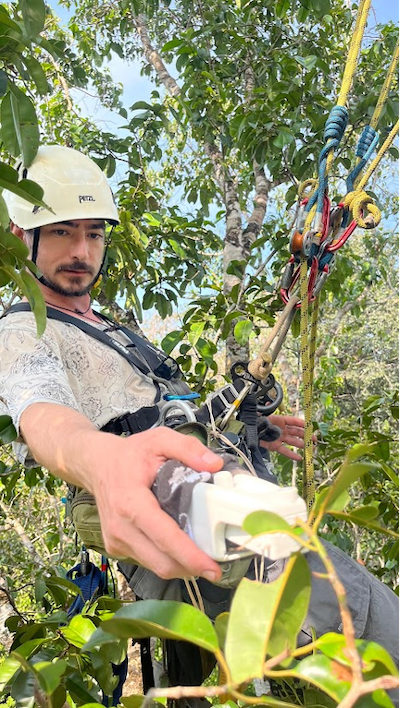
Leonardo Ziccardi in the tree canopy. Photo by Rafael Francisco Grilo.
Leonardo Ziccardi using a MultispeQ device developed at Michigan State to measure leaf photosynthesis in the mid-canopy of an Amazonian forest. Photo credit Rafael Francisco Grilo.

The study, led by doctoral candidate Leonardo Ziccardi with Associate Professor Scott Stark in the MSU Department of Forestry, shows how tropical trees act like giant solar antennas — absorbing vast quantities of light energy that must be carefully managed. When trees absorb more energy than they can use for photosynthesis, it must be safely dissipated, either as heat or re-emitted as light — a process called chlorophyll fluorescence.

“It’s been a long journey,” said Ziccardi. “Since 2019, we’ve run multiple field campaigns across seasons, climbing giant trees in the heart of the Amazon to understand how these forests respond to environmental changes. We’ve spent hundreds of hours up in the canopy doing measurements —some of the most intense and rewarding work I’ve ever done.”

Ziccardi spent more than four years climbing trees nearly 200 feet tall in the central Amazon, measuring the fates of absorbed photons in thousands of leaves across many species, canopy heights, and light exposure conditions, producing a truly unique and unprecedented dataset.

Using a revolutionary handheld instrument — the MultispeQ, developed at MSU by co-author David Kramer in the MSU-DOE Plant Research Laboratory — Ziccardi captured how leaves in natural settings balance incoming light with their ability to photosynthesize or dissipate excess energy.

The findings offer a first-of-its-kind, high-resolution look at how the Amazon canopy navigates seasonal extremes. As the Amazon experiences increasing stress, due to both greenhouse gases and deforestation leading to hotter and drier conditions in the canopy, understanding how trees manage light energy is essential to predicting their future survival. Not only does this climate change lead to greater physiological stress due to more frequent extreme conditions related to lower soil water availability and dry and hot air, it also can increase the amount of sunlight hitting the forest. This happens because drier conditions have less clouds and that lets more sunlight through. This study helps address whether Amazon trees can absorb and use this extra light under stressful conditions. 

Leonardo Ziccardi in the tree canopy with fellow researchers.
Leonardo Ziccardi and his climbing team (Kleber Silva Campos, Elcielde Oliveira Coronel, and Rafael Francisco Grilo) ascending a tree at approximately 90 feet.

Despite facing intense sunlight and atmospheric dryness, many canopy leaves were able to continue photosynthesizing, but only by increasing their allocation to energy dissipation pathways.

For the first time in the Amazon, the study revealed a nuanced, three-phase response of leaves to rising light and drought conditions. Under low to moderate light, leaves balance energy use between photosynthesis and fluorescence, so these processes tend to increase and decrease together. As light and drought stress increase, however, this balance breaks down. Heat-protective dissipation mechanisms become overwhelmed, photosynthesis drops, and fluorescence can spike — signaling potential damage to the photosynthetic machinery.

The implications are critical for scientists using satellite observations of fluorescence — the so-called solar-induced fluorescence, or SIF — to monitor Amazon forest health. While SIF is often used as a proxy for photosynthesis, this study shows that photosynthesis and fluorescence do not always go up and down together. Under high light and stress, this relationship breaks down and leaves may fluoresce more even as their photosynthetic machinery declines, potentially leading to overestimates of ecosystem productivity during droughts.


 

Climate and Climate SolutionsClimate and EnvironmentNatural Resources and ConservationMSU ResearchMSU Leadership and Impact

Collection

more content from this collection

Climate Solutions

Latest News

MSUToday Weekly Update

The MSUToday Weekly Update email showcases how Spartans are making a difference through academic excellence, research impact and community outreach. Get inspired by these stories of innovation, collaboration and determination. Plus, enjoy photos and videos of campus and more MSU content to help keep you connected to the Spartan community.

Sign UpUpdate My Information

Connect With Us

Visit our Facebook pageVisit our page on XVisit our Instagram pageVisit our LinkedIn pageVisit our YouTube pageVisit our TikTok page

Health and Safety

  • MSU Police and Public Safety
  • Olin Health Center
  • Counseling & Psychiatric Services (CAPS)
  • University Health and Wellbeing
  • MSU Health Care
  • Civil Rights and Title IX
  • Our Commitment
  • Center for Survivors
  • Security & Fire Safety Report
  • University Policy on Relationship Violence and Sexual Misconduct
  • Notice of Non-Discrimination, Anti-Harassment and Non-Retaliation
  • Health Care Non-Discrimination Notice

Support Services

  • Disability Resources
  • Supportive Services
  • Learning Resources

Working at MSU

  • Human Resources
  • EBS Login
  • Job Postings
  • Employee Assistance Program

Reports

  • CARES Act Funding
  • Student Achievement and Outcomes

Contact us

517-355-1855

Address

Michigan State University 426 Auditorium Road East Lansing, MI 48824

Follow Us

  • Visit our Facebook page
  • Visit our page on X
  • Visit our Instagram page
  • Visit our TikTok page
  • Visit our LinkedIn page
  • Visit our YouTube page

If you're having accessibility issues, please let us know.

Know More: Campus Safety Information and ResourcesTransparency Reporting: Budget & Salary/Compensation
  • Contact Information|
  • Site Map|
  • Privacy Statement|
  • Site Accessibility|
  • Call MSU: (517) 355-1855|
  • Visit: msu.edu|
  • Notice of Nondiscrimination|

SPARTANS WILL|© Michigan State University|