It was his first year at MSU, and Dave Weatherspoon had just missed his 8 a.m. class.
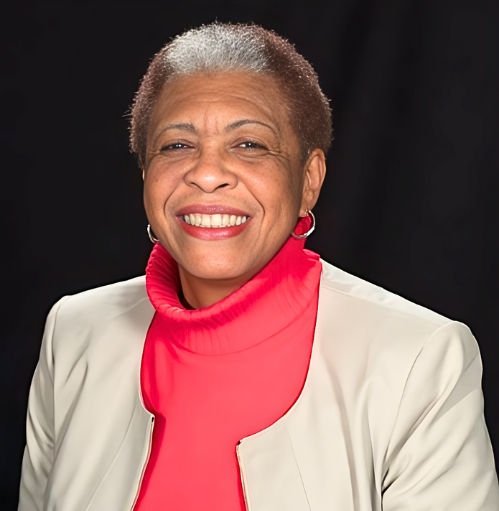
Exhausted from an early football practice, Weatherspoon could not work up the energy to walk across campus to that morning’s lecture. A few hours later, the landline telephone in his dorm room rang, and much to his surprise, on the other side of the line was Dr. Eunice Foster, the professor whose class he had just skipped.
“I never used to answer that phone, and stupid me, I answered it now!” said Weatherspoon.
Weatherspoon, who went on to become a professor himself and now serves as MSU’s vice provost of enrollment and academic strategic planning, said he was shocked by the call because until then he felt like he was anonymous. “Mind you, this was not a small class.” He wasn’t in any trouble; Foster was just calling because she noticed his absence and wanted to check in and make sure he was doing OK.
“I was stunned because I thought I was invisible.” That one short phone call was the start of a mentorship that has lasted over 40 years and shaped the trajectory of his entire career.
“I was stunned because I thought I was invisible.” -Dave Weatherspoon
And Weatherspoon’s story is far from the only one. Since retiring from MSU in July 2024, Foster has received an outpouring of gratitude from former students, staff and faculty colleagues whose lives she has shaped.
Empowerment through education
Foster learned from her parents that education is the key to empowerment. Born in the 1920s in rural Georgia, neither of Foster’s parents had the opportunity to finish high school. Despite their circumstances, her parents instilled in Foster and her siblings a love of learning, emphasizing education as the pathway to a better future.
After earning her bachelor's degree in elementary education from Otterbein College, Foster spent four years teaching sixth grade in an inner-city school, where she inspired her students to develop their own love for learning.
Confronted with the global food shortages of the 1970s, Foster became interested in how she could address the growing problem of world hunger. She decided to go back to school and earned a master’s degree in agronomy from Ohio State University and later a Ph.D. in crop physiology from the University of Arkansas. After completing her doctorate, Foster started her career at MSU in 1982 as an assistant professor.
The impact of Foster’s 42-year career can be felt at every level of the College of Agriculture and Natural Resources, or CANR, through her research achievements and her transformative influence on the community.
A career defined by ‘firsts’
While Foster’s achievements have often led her to be characterized as a trailblazer, that never was the goal. But her career is defined by many notable firsts.
Foster earned the distinction of becoming the first woman and first African American to earn tenure in the Department of Plant, Soil and Microbial Sciences. She is the first African American and first female associate dean for CANR, serving as associate dean for undergraduate and certificate programs and the director of the Institute of Agricultural Technology from 2002 to 2009.
From 2005 to 2007, she served as interim director of the CANR Office of Diversity and Pluralism, the precursor to the Office of Culture, Access and Belonging. She was actively involved in the MSU Black Faculty, Staff and Administrators Association, serving as a past president and treasurer.
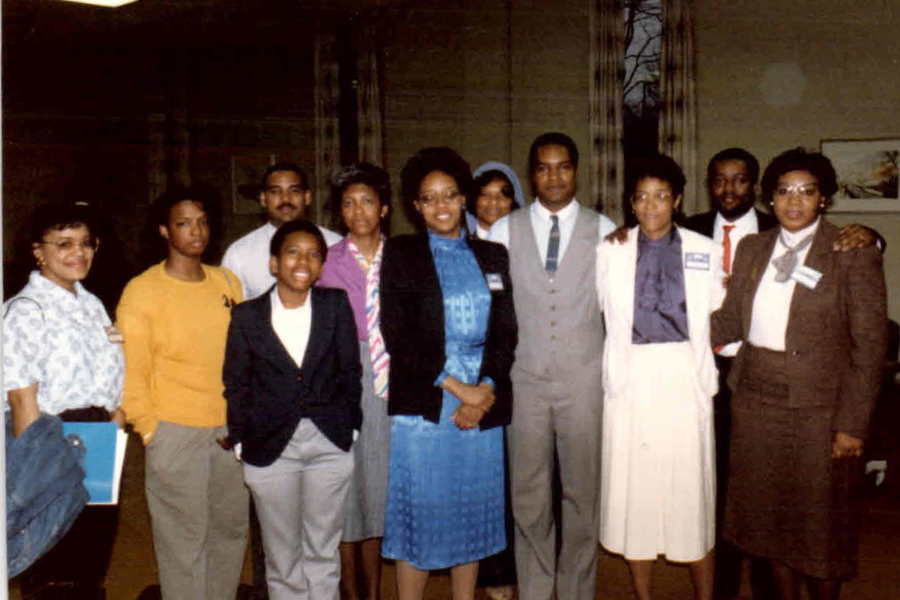
Dr. Foster and student organizers from MSU and Penn State at the 1987 MANRRS conference. Courtesy of CANR
In 1984, a group of students including Weatherspoon enlisted the assistance of Don Wallace, a graduate student; James E. Jay, CANR assistant dean; and Foster, an assistant professor to found the campus organization Minorities in Agriculture and Natural Resources Association (MANRA). In 1985 Foster, Weatherspoon, and other students traveled to Penn State University to help start Minorities in Agriculture, a pivotal meeting leading to the subsequent development of MANRA into the national organization, Minorities in Agriculture, Natural Resources and Related Sciences (MANRRS).
Today, MANRRS has expanded into a national society with 74 collegiate chapters, one international chapter and 34 junior chapters, encompassing over 22,000 members. “Without her (Foster), we would have floundered,” said Weatherspoon. “She was the glue.
"She makes people feel included, important and valued," said Stephanie Chau, CANR assistant director of student support and belonging, who worked with Foster as a MANRRS co-advisor for over 14 years. “She has high expectations. She pushes people to do their best – and inspires them to keep up with her.”
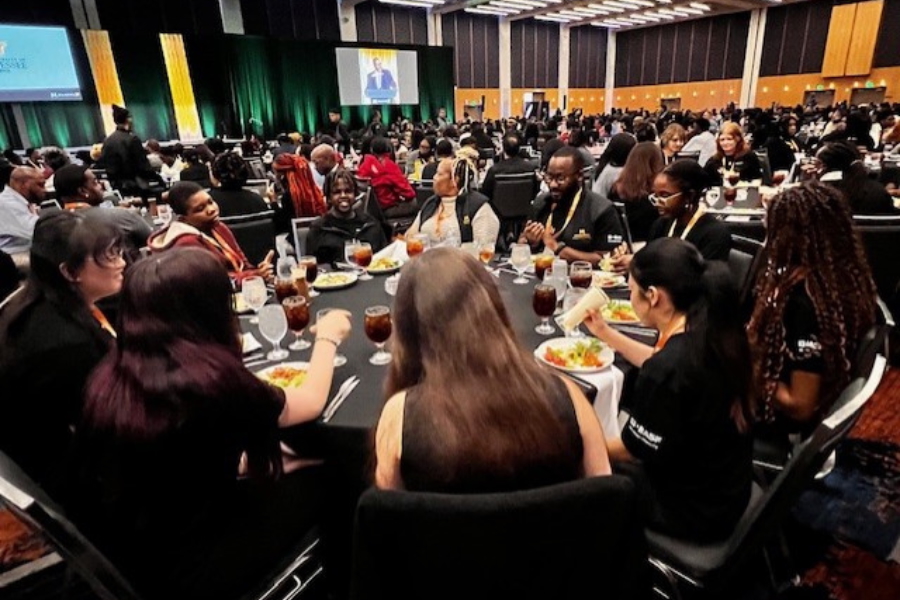
CANR students and staff at the 2025 MANRRS Conference in Memphis, TN. Courtesy of CANR
Issa Yattassaye, the current MSU MANRRS chapter vice president, said he is most inspired by Foster’s passion for lifting up communities and pushing for lasting change. “Her work at MSU and CANR created a space where students from all backgrounds feel seen,” said Yattassaye.
For Ty'Carria Trevino, a first-generation fisheries and wildlife senior, Foster's impact is reflected in the opportunities she has shaped for students like herself. “She created opportunities for generational change and evokes a future where all people have the support they need.”
A global scholar and a fearless advocate
Foster’s extensive research and engagement efforts have reached all corners of the world. Focusing on drought resistance and nitrogen utilization in a variety of crops, Foster conducted research across Michigan, Mexico and the U.S. Virgin Islands.
She also engaged in projects throughout Africa including in Botswana and Malawi and played a pivotal role in implementing the MSU China Turfgrass Program. These initiatives bolstered CANR's global standing, advancing results that support food security and sustainable agriculture.
As she gained recognition for her research and global engagement, the core of Foster's work consistently focused on empowering people, especially students and young faculty members seeking their own opportunities. “She is someone I could go to whenever I needed advice on critical decisions,” said Dr. Cholani Weebadde, an associate professor and plant breeder for international programs at MSU, who was mentored by Foster as a young MSU professor.
“She always stood up for junior faculty members and provided them a strong voice.” -Cholani Weebadde
“She always stood up for junior faculty members and provided them a strong voice,” said Weebadde. “She would go out of the way to help without even mentioning what she had done to help.”
Dr. Dieudonne Baributsa, a Purdue University entomology professor, credited Foster's unwavering support during his graduate studies for giving him the confidence to succeed. "She invested in my education, yielding tremendous outcomes," Baributsa said. "Her inspiration empowered me to lead major initiatives across Sub-Saharan Africa benefiting over 20 million households."
Foster was never afraid to speak out if she felt someone was being treated unfairly or if there was a problem not being addressed. “She fought for people,” said Weatherspoon. “If there is something that didn't quite add up, she would ask the questions that a student wouldn't know how to ask. She's a force field. But in order to be a force, I think you have to be a bit fearless as well.”
A legacy of impact
Never one to look forward to retirement, Foster has intentionally remained busy. A lifelong champion for increasing representation in agriculture and STEM fields, Foster remains highly engaged with K-12 students, supporting Junior MANRRS chapters at Lansing Sexton and Eastern High School. She has kept a 1% appointment at MSU … although she admits she does a lot more than 1%. She is also an active member of her church and the wider Lansing community.
“She has left an indelible mark at multiple levels,” said Dr. Lorraine Weatherspoon, professor, associate chairperson and director of the Didactic Program in Dietetics. “She is a trailblazer, someone who has risked her own career to accomplish her goals of ensuring that where justice is needed, it is achieved.”
Foster hasn’t spent much time thinking about her legacy. But her mission remains as clear as it was when she was teaching sixth grade: to empower people and create opportunities through education.
“There's no scarcity of intelligence,” said Foster. “The question is whether or not we've helped people develop it or have we put obstacles in their path.”
Removing those obstacles has been Foster’s life’s work, a mission inspired by her upbringing and a deep commitment to justice and her faith. And it’s a mission she still pursues fearlessly.
This story first appeared on the College of Agriculture and Natural Resources website.

