When a medical examiner needs help identifying a deceased person and determining how that person died, they turn to forensic anthropologists.
To aid in the identification of unknown human remains, forensic anthropologists are often called upon to create a biological profile, or an estimation of the unknown individual’s age, biological sex, social race (or ancestry) and stature.
If you’ve watched the TV show, “Bones,” in which the FBI teams up with a forensic anthropologist to solve federal cases that may involve murder and human skeletal remains, you have some familiarity with the field of forensic anthropology. However, the real work of a forensic anthropologist isn’t exactly like it’s portrayed on the show; their work is generally slow, methodical, and often low-tech. Like the show’s protagonist, forensic anthropologists do work with a bewildering array of methods, but those methods may produce idiosyncratic results. Currently, forensic anthropologists have no way to determine how differing results should be weighed or reported.
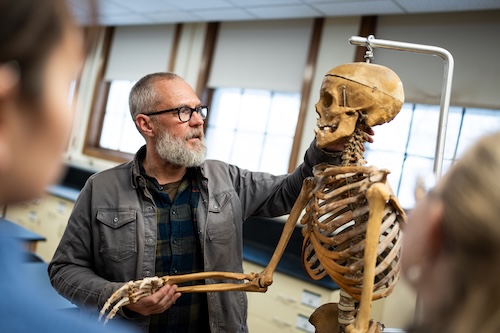
Michigan State University is leading the effort to create a computer program that produces a holistic biological profile of human remains and makes the investigative process clearer and more efficient. The project, called MOSAIC, or Methods of Sex, Stature, Affinity and Age for Identification through Computational Standardization, is funded through a $2.1 million grant from the National Institute of Justice.
“MOSIAC will take data from skeletal remains and put them into a single algorithm, which will determine what is and isn’t important for the various components of the biological profile,” said Joe Hefner associate professor of anthropology in MSU’s College of Social Science. “This is the first time this has ever been attempted and it’s the first program in forensic anthropology that’ll do it.”
Hefner noted there are other programs that can estimate age, biological sex, height and social race, referred to as “population affinity” in forensic anthropology, separately. These existing programs measure each component in a vacuum: They do not talk to each other. It’s up to forensic anthropologists who specialize in specific elements of determining a biological profile to work together and form a comprehensive picture.
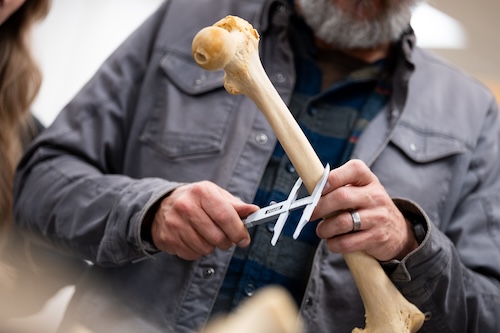
Hefner mainly researches aspects of social race and specializes in how skull shapes vary across the globe. So, if he was analyzing a skull, he would look at the size of the brow ridge above the eye and the shape of the bone behind the ear to determine biological sex. He would check the roof of the palate to see if sutures there are fusing and the level of tooth development to determine age. He would measure the long bones to determine their height and look at the base of the nose, the shape of the eye orbits, and the muscle attachment points on the cheek to determine roughly where their ancestors would have been from.
“But I do all of those independent of one another and they don’t inform each other,” he said. “MOSIAC is going to leverage the relationship between all those structures and actually provide estimates for us without potentially biasing ourselves by focusing on one aspect of the biological profile, and then another, and another, and so on. Instead, MOSAIC processes everything at one time.”
The MOSIAC project originated from conversations Hefner had with Kate Spradley, a professor of anthropology at Texas State University and one of his co-principal investigators on the project. Other MOSIAC collaborators include Heather Joy Hecht Edgar, professor of anthropology and forensic anthropologist in the Office of the Medical Investigator at the University of New Mexico; Kate Lesciotto, assistant professor at the University of North Texas Health Science Center; and Alexandra Klales, professor of forensic anthropology at Washburn University.
“[Spradley and I] started talking about how we can combine our data, which led us to think about combining other anthropologists’ data,” Hefner said.” The next step was MOSAIC, which takes all of this to the next level.”
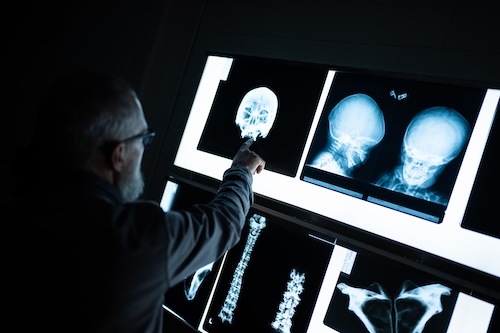
To gather skeletal data for this project, Hefner and his research team will be visiting collections across the U.S., but also in Mexico, Japan and South Africa.
“All of those data are going to better account for human variation, or the range of physical characteristics humans can have, that exists around the globe,” Hefner said. “That expands the possibilities for MOSIAC — it can be used not only by U.S.-based forensic anthropologists, but also by forensic anthropologists around the world.”
Hefner is in the process of hiring a postdoctoral researcher to be part of the project and will be bringing a graduate student on in fall semester 2025. These researchers will travel around the world logging skeletal collections to create the MOSIAC database and develop and test the software.
“We’re going to get to train the next generation of forensic anthropologists at MSU,” he said. “The MOSIAC Lab is going to give our graduate students exciting real-world experience; they basically get to create a computer program that I believe will change forensic anthropology.”
Hefner said he’s proud to continue MSU’s legacy of innovation.
“In 20 years, the work we did with this project will remain incredibly important and will have resulted in a true paradigm shift in how data are collected, analyzed and interpreted in forensic anthropology,” he said.

