Jump to HeaderJump to Main ContentJump to Footer
Michigan State University
  • Browse Stories By

    Topics

    Explore stories by subject area

    • Arts and Culture
    • Business and Economy
    • Climate and Environment
    • Education and Learning
    • Engineering, Science and Technology
    • Government and Society
    • Health and Medicine
    • Media and Communications
    • MSU Leadership and Impact
    • Sports and Recreation
    • Student and Campus Experience
    View All Stories

    Collections

    Curated story series

    • Turfgrass
    • Ask the Expert
    • Big Ideas
    • Climate solutions
    • Water at MSU
    • Mobility
    • Spartan Perspectives
    • Student views
    • Graduate voices
    • Faculty voices
    View All Collections

    Featured

    Editor's picks

    • The Spartans behind your favorite Michigan golf courses

      July 22, 2026

      The Spartans behind your favorite Michigan golf courses

    • MSU in the 1990s: 10 Spartan milestones

      July 14, 2026

      MSU in the 1990s: 10 Spartan milestones

MSUTODAY
  • Browse Stories By

< Browse Stories By

Topics

Explore stories by subject area

  • Arts and Culture
  • Business and Economy
  • Climate and Environment
  • Education and Learning
  • Engineering, Science and Technology
  • Government and Society
  • Health and Medicine
  • Media and Communications
  • MSU Leadership and Impact
  • Sports and Recreation
  • Student and Campus Experience
  • View All Stories

Collections

Curated story series

  • Turfgrass
  • Ask the Expert
  • Big Ideas
  • Climate solutions
  • Water at MSU
  • Mobility
  • Spartan Perspectives
  • Student views
  • Graduate voices
  • Faculty voices
  • View All Collections

Featured

Editor's picks

  • The Spartans behind your favorite Michigan golf courses

    July 22, 2026

    The Spartans behind your favorite Michigan golf courses

  • MSU in the 1990s: 10 Spartan milestones

    July 14, 2026

    MSU in the 1990s: 10 Spartan milestones

  • For Media
  • Experts
  • Releases and Statements
  • Sign Up
  • Update Information

Resources

  • A to Z Index
  • Find People
  • Maps
  • Email
  • Student Information System (SIS)
  • D2L
  • Libraries
  • Tech Support
  • MSU Misconduct Hotline
  • Social Media Directory
  • Events Calendar
  • For Media
Michigan State University
MSUToday
  • For Media
  • Experts
  • Releases and Statements
  • Sign Up
  • Update Information
MSUTODAY
Diseases, Conditions and Treatments

April 23, 2025

MSU researchers fight cancer for you

From detection to treatments, Spartan experts develop solutions that could stop cancer in its tracks

By: Dalin Clark

A single breakthrough can change everything. In the 1960s, Michigan State University researchers discovered cisplatin, one of the world’s most effective cancer-fighting drugs, with support from the National Institutes of Health and the National Cancer Institute. It transformed treatment for millions of patients and launched a wave of Spartan-led research that’s still saving lives today. From understanding the origins of cancer to engineering precision therapies, MSU scientists continue to push the boundaries of what’s possible in the fight against this disease.

More than 250 researchers with Henry Ford Health + Michigan State University Health Sciences are working on solutions for better diagnosis and treatment for cancer patients. They bring together diverse expertise across disciplines and, often, one advancement contributes to another. This is the beauty of discovery. Many of these researchers receive funding from federal agencies as well as other sources.

Improving the outlook for pancreatic cancer patients

Pancreatic cancer is one of the deadliest cancers with an average survival of just nine months after diagnosis. Roughly 66,000 people are diagnosed in the U.S. each year. To change this grim outlook, researchers from Henry Ford Health and MSU have joined forces to improve diagnosis and treatment.
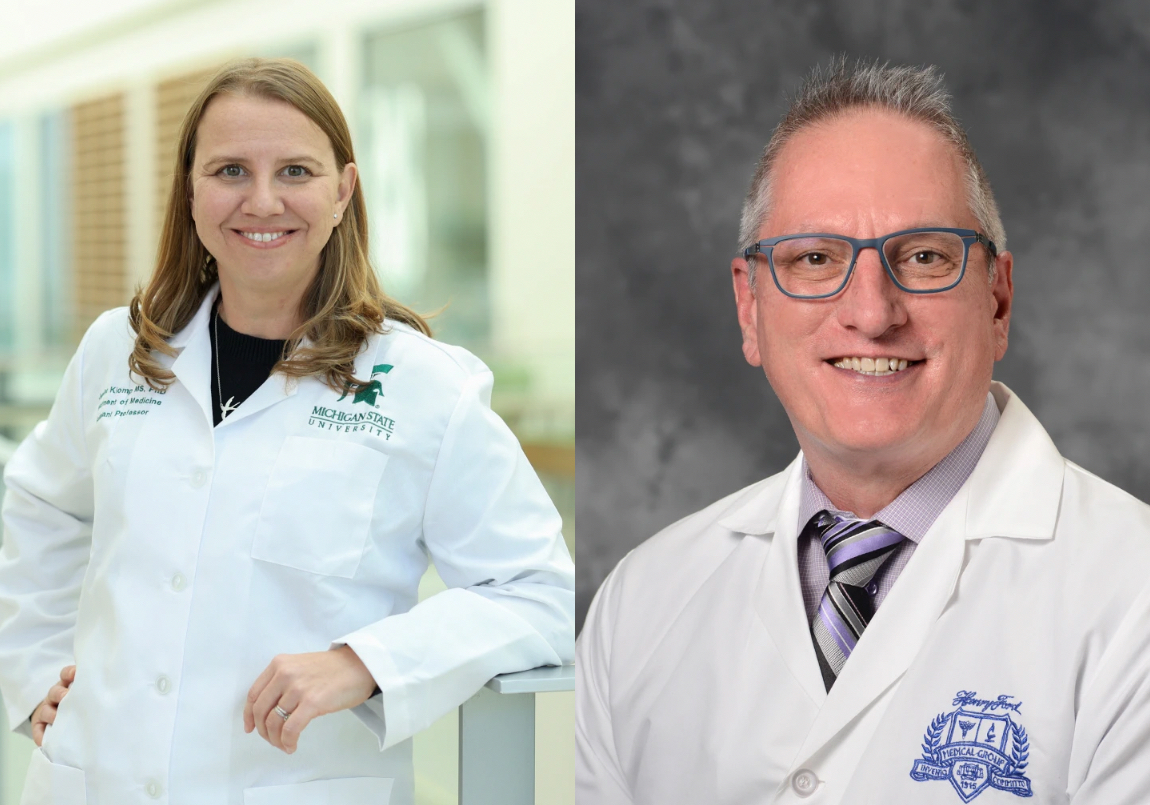
Two photos side by side, the left photo is of a woman smiling and posing in a Michigan State University lab coat and the photo on the right is a portrait of a man wearing glasses and a lab coat over a purple shirt and tie
Jennifer Klomp (right), assistant professor, College of Human Medicine, and Howard Crawford, senior researcher at Henry Ford Health. Courtesy photos

“When I started as a pancreatic cancer researcher in 2017, the goal was to get five-year survival rates into double digits,” says Jennifer Klomp, assistant professor in the Department of Medicine in the MSU College of Human Medicine. “Now we’re at 13%, and I think that number is going to increase significantly, very quickly.”

Klomp works with fellow MSU researcher and husband Jeff Klomp as part of a wider effort led by Howard Crawford, a senior researcher at Henry Ford Health who created a research team focused on pancreatic cancer. Together, the researchers are studying how cancer cells communicate and are focusing on RAS, a gene known to drive cancer. Although RAS has been a challenging target for drugs, new RAS inhibitors are showing promising results, shrinking tumors and potentially making surgery possible for some patients.

The collaboration also includes a large, diverse biobank of blood and tumor samples, helping researchers worldwide. With these joint efforts and cutting-edge research, the outlook for pancreatic cancer patients is becoming more hopeful, and the team believes major improvements in survival rates are on the horizon.

This research is funded by the National Cancer Institute of the National Institutes of Health.   

Read more on MSUToday.



In partnership with the federal government, Spartan researchers drive lifesaving breakthroughs and address society’s most pressing challenges.

Learn More


Driving early advances in brain cancer treatment

“Non-cancerous cells are going the speed limit,” says Charles “Chaz” Hong, chair of the Department of Medicine in MSU’s College of Human Medicine. “A cancerous cell is going 100 miles per hour and has turbo drive. We’ve discovered a mechanism to target the turbo drive and turn it off. And it seems to stop cancer cells in their tracks.”

A man in glasses wearing a blue sportcoat over a a purple shirt and a green tie
Charles Hong, chair of the Department of Medicine at MSU College of Human Medicine. Courtesy photo

Hong and his team discovered a compound that may hold the key to improving the prognosis for glioblastoma, the most common and aggressive form of brain cancer. In 2023, nearly 15 million Americans were diagnosed with glioblastoma, which has a five-year survival rate of just 6.9%. 

“We found that GPR68, an extracellular proton sensing receptor, detects pH drops in tumors, triggering pathways that promote cancer cell survival and growth and help them dodge anticancer treatments,” Hong says. “We also identified a compound, dubbed Ogremorphin, that blocks GPR68 and destroys cancer cells.”  

Hong is hopeful that the discovery of Ogremorphin is a step toward a future where glioblastoma — and potentially other forms of cancer — are manageable diseases. 

“We can potentially keep glioblastoma in check and transform the definition of the disease from a fatal condition to something that you simply live with, or even cure,” he says. 

This research is funded by the National Institutes of Health.

Read more on MSUToday.

a microscopic image of cancer cells that resemble blue and pink circles

Destroying breast cancer with “smart” bomb therapy

MSU researchers have developed a new “smart” treatment that uses light to destroy aggressive breast cancer cells while leaving healthy cells unharmed. According to the National Breast Cancer Foundation, in 2025 nearly 317,000 women and 2,800 men will be diagnosed with invasive breast cancer. Additionally, roughly 60,000 new cases of noninvasive breast cancer will be diagnosed.

“Our work offers an effective treatment for aggressive breast cancers,” says Amir Roshanzadeh, a graduate student at MSU who is part of the research team. “It also opens the door to breakthroughs for treating additional cancers and targeted drug delivery.” 

The research team also included Sophia Lunt, an MSU professor in biochemistry and molecular biology in the College of Natural Science; Richard Lunt, an MSU professor and Johansen-Crosby Endowed Professor in Chemical Engineering in the College of Engineering; and a professor of chemistry at the University of California, Riverside.

The team created special light-sensitive chemicals called cyanine-carborane salts. These are used in a method called photodynamic therapy, or PDT.

In PDT, these chemicals are injected into the body and collect inside cancer cells. Then, near-infrared light, which can reach deep into the body, activates the chemicals. Once activated, they act like a “smart” bomb — killing the cancer cells but not hurting healthy ones.

This new therapy is better than older PDT treatments because it works faster and leaves the body more quickly, and researchers expect it to help deliver drugs directly to other types of cancers as well.

This research was supported in part by funding from the U.S. Department of Agriculture, the National Science Foundation, and the National Cancer Institute and National Institute of Environmental Health Sciences — both within the National Institutes of Health.

Read more on MSUToday.

A honey bee is encased in a clear, light amber-colored block of what appears to be resin or a similar transparent material.Photo courtesy Saha lab

Detecting cancer with honeybees

Just like dogs, honeybees have an incredible sense of smell. And researchers at MSU have discovered that they can help detect lung cancer — the most common cancer type in both men and women worldwide — based on a person’s breath.

The research team, led by Debajit Saha, an assistant professor in the College of Engineering and MSU’s Institute for Quantitative Health Science and Engineering, created fake breath samples — some that mimicked a healthy person and others that mimicked a person with lung cancer. They tested around 20 bees by placing them in tiny 3D-printed harnesses and attaching small sensors to their brains.

When the bees were exposed to the different breath samples, their brain activity changed. The bees could even detect very tiny amounts of cancer-related chemicals — just a few parts per billion. The bees also showed they could detect different types of lung cancer cells just by the smell.

This research could lead to a new noninvasive way to detect lung cancer early. In the future, people might simply breathe into a device that uses a bee-brain-inspired sensor to check for cancer and send results quickly to doctors.

This research was supported in part by funding from the National Science Foundation.

Read more on MSUToday.

In the fight to save lives, MSU’s decades-long track record of advances and therapies, wide-ranging faculty expertise and leading-edge labs make the university a powerful partner for federal investment — turning today’s support into tomorrow’s cancer breakthroughs.

Read more stories about how MSU researchers are fighting cancer.


For generations, Spartans have been changing the world through research. Federal funding helps power many of the discoveries that improve lives and keep America at the forefront of innovation and competitiveness. From lifesaving cancer treatments to solutions that advance technology, agriculture, energy and more, MSU researchers work every day to shape a better future for the people of Michigan and beyond. Learn more about MSU’s research impact powered by partnership with the federal government. 

MEDIA CONTACTS

Dalin Clark
Diseases, Conditions and TreatmentsHealth and MedicineMSU ResearchMSU Leadership and ImpactHealth Professions

Collection

more content from this collection

Fighting Cancer

Latest News

MSUToday Weekly Update

The MSUToday Weekly Update email showcases how Spartans are making a difference through academic excellence, research impact and community outreach. Get inspired by these stories of innovation, collaboration and determination. Plus, enjoy photos and videos of campus and more MSU content to help keep you connected to the Spartan community.

Sign UpUpdate My Information

Connect With Us

Visit our Facebook pageVisit our page on XVisit our Instagram pageVisit our LinkedIn pageVisit our YouTube pageVisit our TikTok page

Health and Safety

  • MSU Police and Public Safety
  • Olin Health Center
  • Counseling & Psychiatric Services (CAPS)
  • University Health and Wellbeing
  • MSU Health Care
  • Civil Rights and Title IX
  • Our Commitment
  • Center for Survivors
  • Security & Fire Safety Report
  • University Policy on Relationship Violence and Sexual Misconduct
  • Notice of Non-Discrimination, Anti-Harassment and Non-Retaliation
  • Health Care Non-Discrimination Notice

Support Services

  • Disability Resources
  • Supportive Services
  • Learning Resources

Working at MSU

  • Human Resources
  • EBS Login
  • Job Postings
  • Employee Assistance Program

Reports

  • CARES Act Funding
  • Student Achievement and Outcomes

Contact us

517-355-1855

Address

Michigan State University 426 Auditorium Road East Lansing, MI 48824

Follow Us

  • Visit our Facebook page
  • Visit our page on X
  • Visit our Instagram page
  • Visit our TikTok page
  • Visit our LinkedIn page
  • Visit our YouTube page

If you're having accessibility issues, please let us know.

Know More: Campus Safety Information and ResourcesTransparency Reporting: Budget & Salary/Compensation
  • Contact Information|
  • Site Map|
  • Privacy Statement|
  • Site Accessibility|
  • Call MSU: (517) 355-1855|
  • Visit: msu.edu|
  • Notice of Nondiscrimination|

SPARTANS WILL|© Michigan State University|

