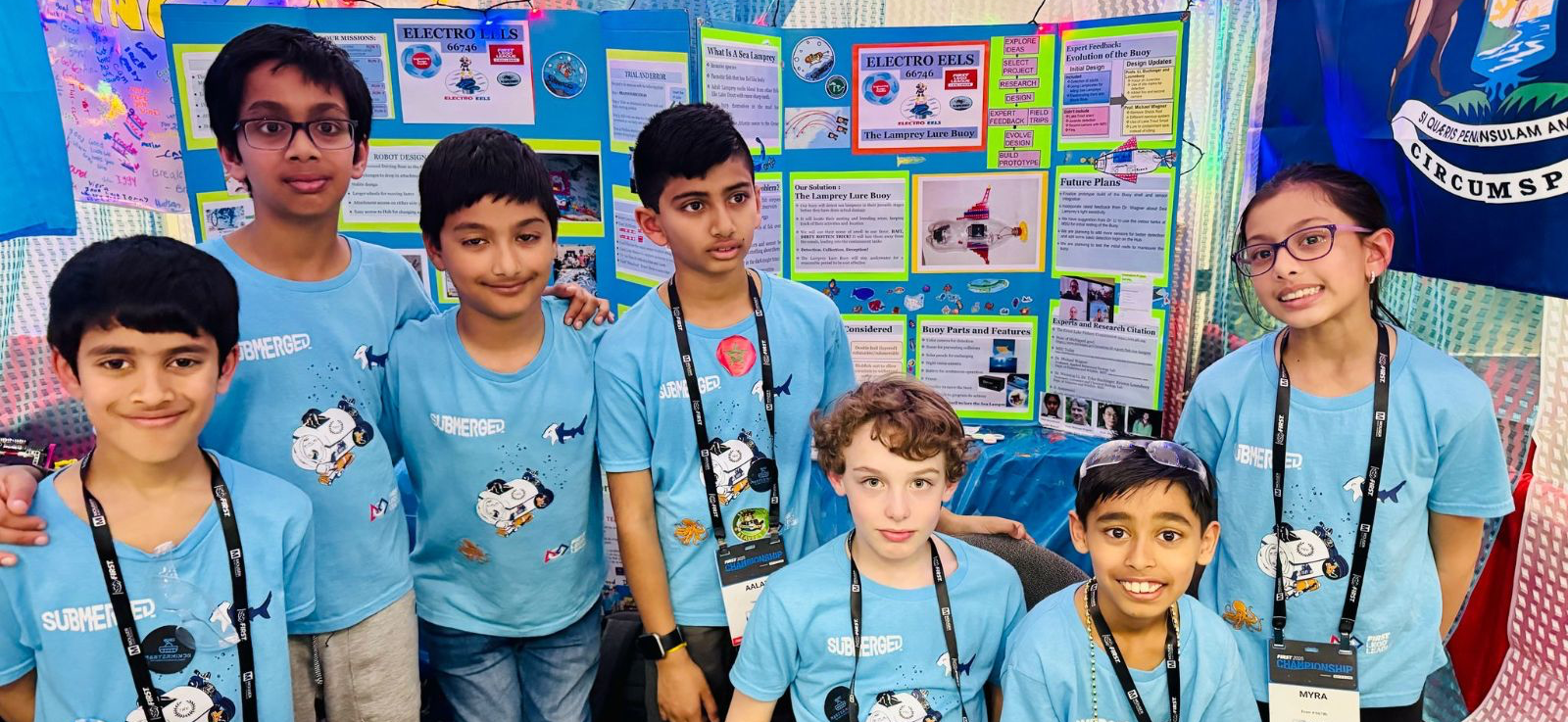
A group of fourth and fifth graders from Wass and Hill Elementary Schools have traded in their backpacks for blueprints. Assisted by MSU Associate Professor Michael Wagner, an expert on aquatic invasive species, the team has designed a buoy to help protect the Great Lakes from a long-standing threat to the region’s ecosystem: the sea lamprey.
The Electro Eels are a rookie FIRST LEGO League, or FLL, Challenge team from Troy, Michigan, who are quickly gaining momentum. FLL, founded by the nonprofit FIRST, or For Inspiration and Recognition of Science and Technology, is a global robotics program that introduces science, technology, engineering and math to children ages 4 to 16.
Each year, students in the FLL’s Challenge division (ages 9 to 14 in the United States and Canada) build and program a LEGO robot to navigate a robot game and complete an IMPACT Innovation Project that addresses a real-world issue. This season’s theme, SUBMERGED, asked teams to combine research, coding and engineering to design a project out of LEGOs that explores the ocean and supports underwater researchers.
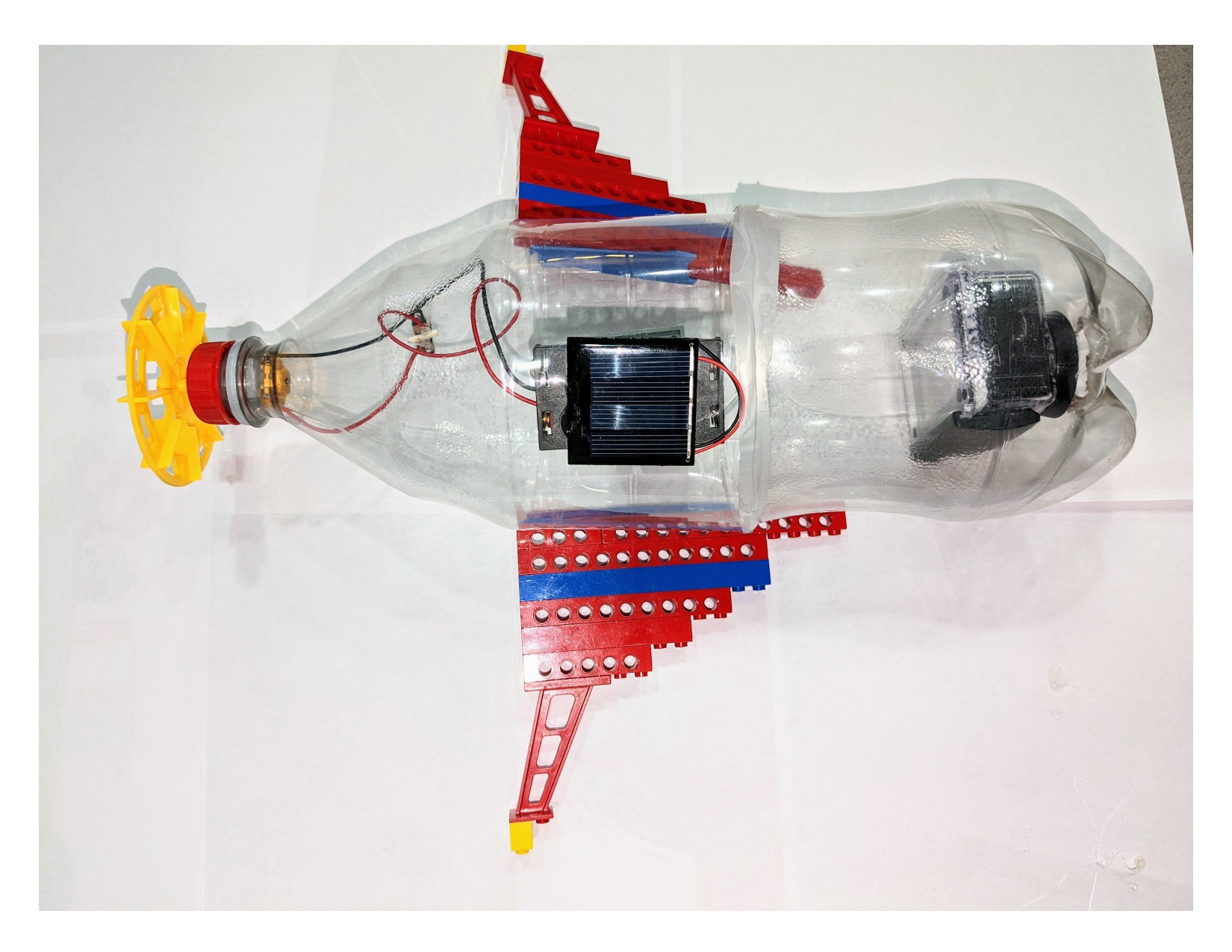
The Electro Eels have found great success with their IMPACT Innovation Project — the Lamprey Lure Buoy — which uses blood scent to attract juveniles, safely luring them away without causing harm.
Nivaan, a fourth grader and member of the Electro Eels, explained, "The buoy will lead sea lamprey to a containment tank, which is where we want them to go."
Trapping invasive juveniles before they reach their predatory stage is important to sea lamprey control and reduces the threat to native fish populations like lake trout and whitefish.
Sea lamprey in the Great Lakes
While native species of lamprey are beneficial to the Great Lakes' ecosystem, helping maintain balance within certain fish populations, invasive sea lamprey, which can destroy up to 40 pounds of fish during their 12- to 20-month parasitic stage, are not. Known as the vampires of the aquatic world, invasive sea lamprey latch onto other fish with their sharp teeth, razor-like tongues and suction cup mouths, weakening — and ultimately killing — a host over time.
Originally from the Atlantic Ocean, invasive sea lamprey entered the Great Lakes during the 1830s through human-made shipping canals, eventually spreading from Lake Ontario in 1835 to Lake Erie in 1921, Lake Michigan in 1936, Lake Huron in 1937 and Lake Superior in 1938.
Wagner explained that, since the 1950s, U.S. and Canadian agencies have worked to control sea lamprey by maintaining dams that block their spawning routes and by applying a targeted pesticide known as lampricide. While these methods have been effective, they also raise concerns.
"For many reasons, communities around the basin and leaders at agencies want to develop new ways of controlling invasive species, and sea lamprey in particular, that don’t exclusively rely on dams and pesticides," Wagner said.
Removing dams would reconnect the rivers to the Great Lakes and allow the free flow of organisms and organic material, he explained. And while lampricides don’t pose an acute toxic threat to humans, some communities remain concerned about their use in local waterways.
"In order for agencies to serve the whole of the communities that are out there, we need alternative approaches," Wagner said. "My lab [Applied Behavioral Ecology Lab] has been leading efforts for the last 20 years trying to develop new techniques to alter their [sea lamprey] migration, capture them when they’re in rivers and guide them away from things like fish passage devices."
Wagner’s lab studies how sea lamprey make decisions — like where to migrate, spawn or find mates — and uses that knowledge to manipulate their behavior, guiding them into traps.
As the innovation project advisor for the Electro Eels, Wagner supported the team by offering feedback and suggestions to improve their buoy’s design, explaining that, to better protect native fish, it’s important to identify which rivers are producing parasitic sea lamprey. Because tracking their movement can be difficult, he recommended adding a camera to the Lamprey Lure Buoy to detect the outmigration, providing a clearer count of sea lamprey passing through the river.
Community recognition and service
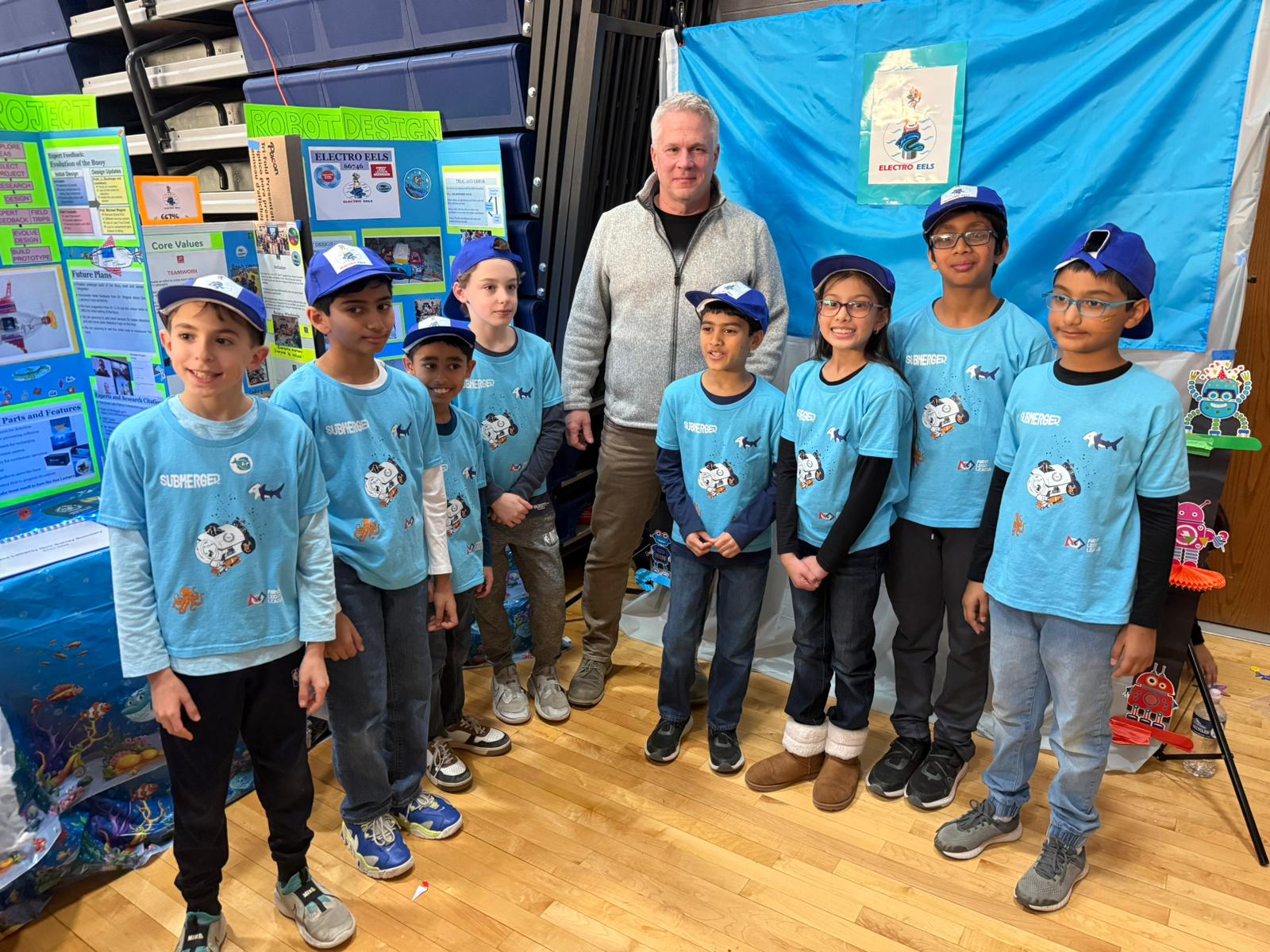
The hard work of this young group of engineers has not gone unnoticed by Wagner or the community of Troy. On March 2, the Electro Eels were recognized by the Great Lakes Fishery Commission at the Troy Public Library after it dominated both the Troy Sharkfest Qualifier and the Michigan State Championship in January, taking home the championship trophy and Best Robot Game award. These victories secured its place at the FIRST World Robotics Championship in Houston, Texas, April 16–19. Troy's mayor, Ethan Baker, who also serves as the Chair of the fishery commission, attended the library event to wish the team luck on its upcoming trip.
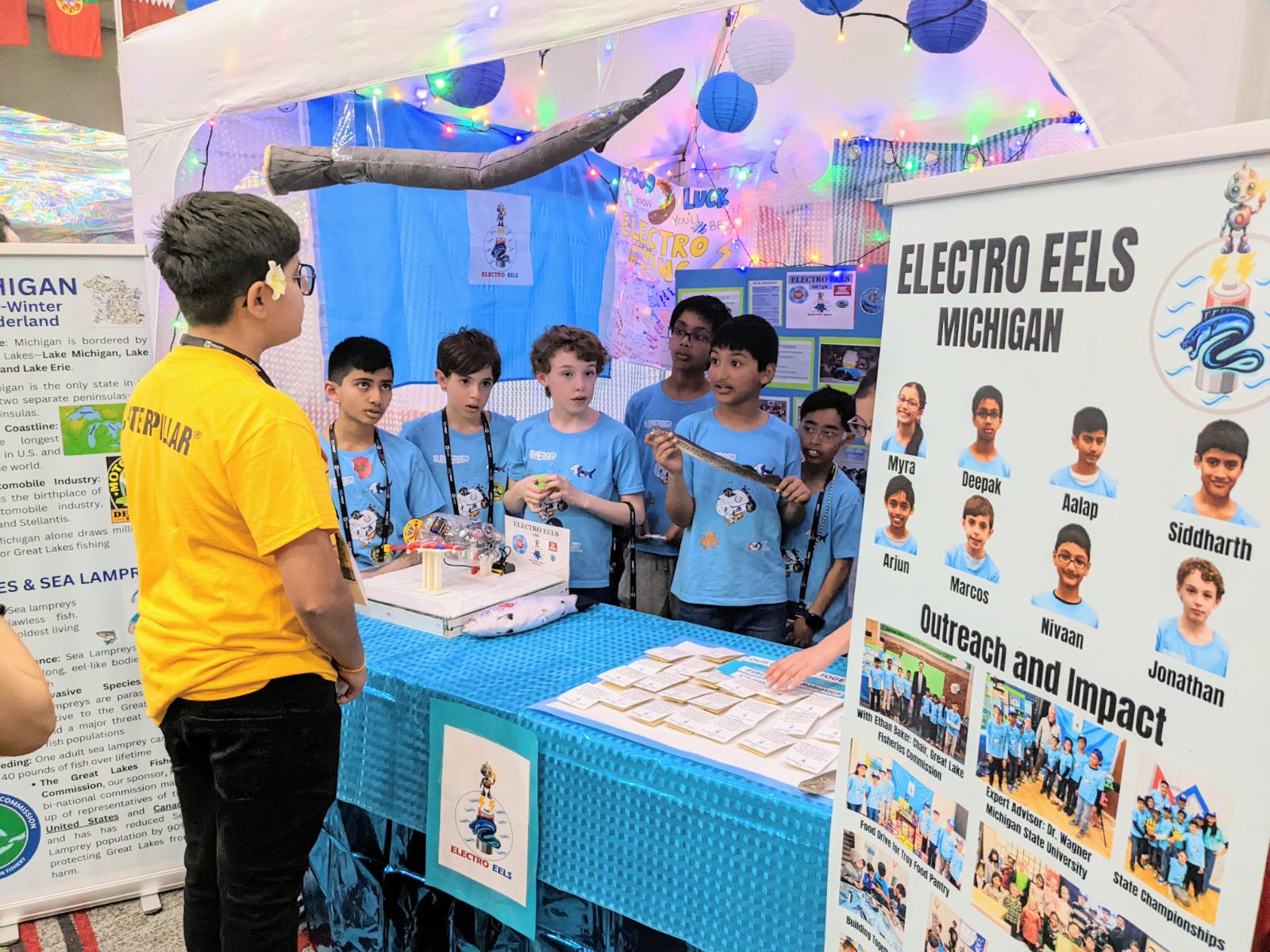
At the FIRST World Robotics Championship, the team confidently presented its IMPACT Innovation Project and received positive feedback from the judges. In the robot game, the team scored 565 points, placing 21st out of 160 teams from around the world. The Electro Eels learned a lot throughout this process and hope to apply it to the next season.
While its accomplishments in Houston were remarkable, the team’s commitment to community service here in Michigan is equally inspiring. Richa, a coordinator for the Electro Eels and Nivaan’s mom, discussed the team’s outreach initiatives, including a food drive, beach cleanup and teaching robotics to younger students.
"We did a beach cleanup, and they collected about 30 pounds of trash," she said. "We decided that every year we’re going to do that, even when they move on to middle school. Every summer, a beach cleanup, Eels will come back and do it together."
The Electro Eels' dedication to service reflects a team culture in which leadership, collaboration and competition go hand in hand. The team's story is more than a feel-good headline — it's a powerful example of what happens when youth innovation, university research and community service come together. It echoes MSU's land-grant mission: bringing university resources and expertise directly to communities, empowering individuals through education to tackle real-world challenges.
This story originally featured on the Water Alliance website.

