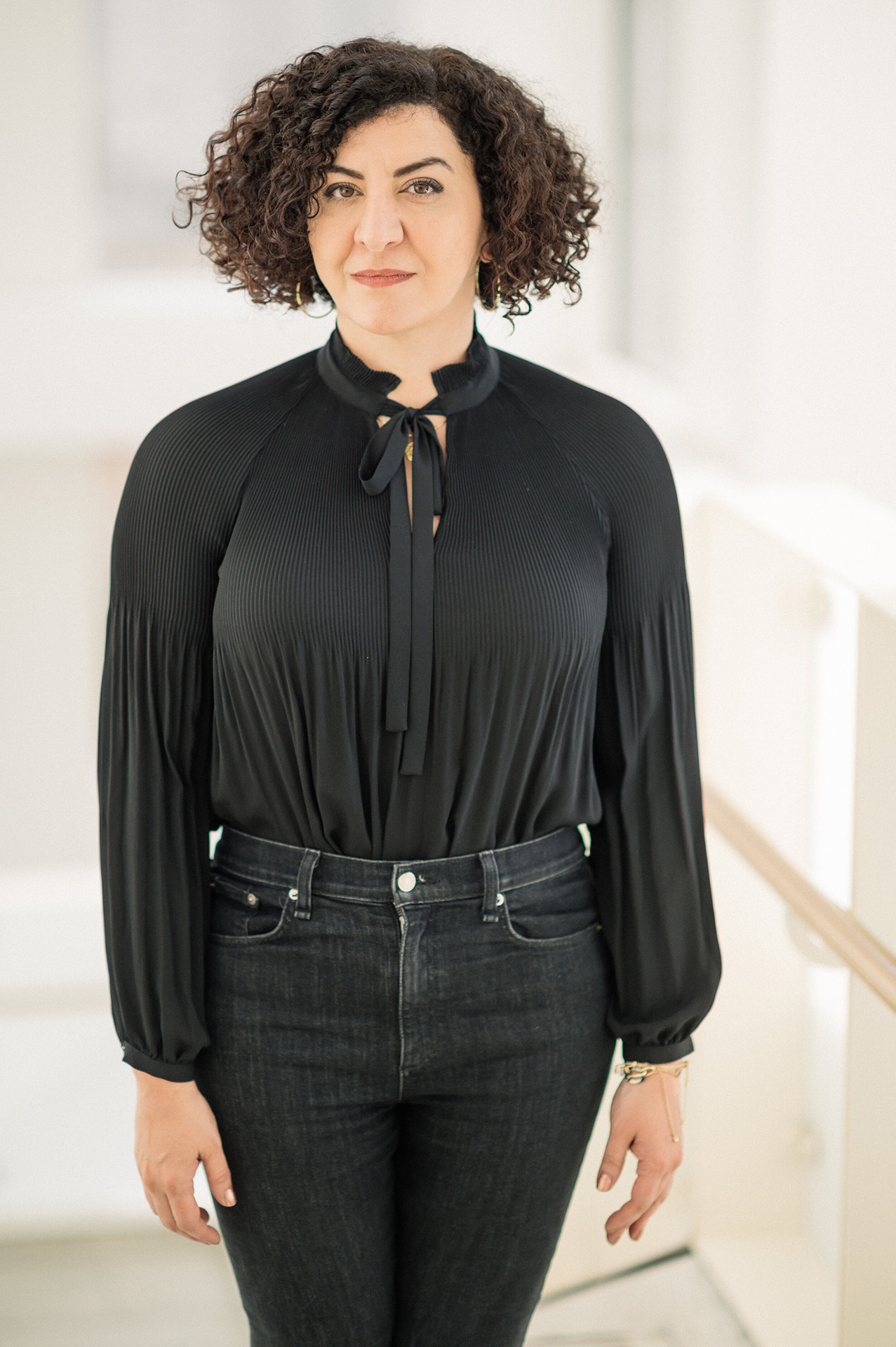
Rola Nashef is a professor of practice in the College of Communication Arts and Sciences in the Department of Journalism. She is an American writer, director, producer and multimedia artist who draws on her extensive experience in the arts and involvement in Michigan’s diverse communities as a catalyst for creative expression and social movement.
Being Arab American is like living in a state of “targeted invisibility.” That’s what I blurted out last week in our Middle Eastern and North African, or MENA, faculty meeting. My dear colleagues and I were supported by thoughtful facilitators who were there to help us process the ongoing trauma that Arabs and Arab Americans have faced this past year and beyond. As U.S. citizens lose their constitutional rights, and student activists face expulsion, deportation and felony charges for protesting against unjust aggression in the Middle East, our workshop leader asked, “What does this feel like?”
It feels like waking up early on Aug. 22, 1977, in Saida, Lebanon — the day my mother wept as she dressed us in our new “American” clothes.
The night before, I was running around as a lively 4-year-old surrounded by the usual chaos of aunts and uncles, grandparents and neighbors, telling stories, sharing food and arguing politics. It was the gathering that my parents hosted on a weekly basis and a common tradition: the Sahra, a Lebanese dinner party that stretches into the morning.
But that night, things were different. There was a sense of sorrow in the atmosphere — or j’owe, as it’s known. The laughter faded into tears and long goodbyes, everyone kissing us a thousand times on each cheek— a fierce gesture from our aunties and all those we loved, as we faced the real possibility of not seeing them again. At that point, we were three years into the Lebanese Civil War, a brutal conflict that would tear our country apart, weaken its people and leave it vulnerable to global forces and their ongoing imperialist plans.
The next day, we boarded a plane and left everything behind, because winning the U.S. immigration lottery wasn’t just luck — it was a means of survival. My parents never intended to leave Lebanon, they were already living their dream; handmade furniture, marbled floors and an ancient Phoenician view just beyond the balcony- they were good! Their days were filled with friends, family, mountains and sea, and they had no plans to leave any of that for another country. But history had other plans for us.
We landed in Lansing, Michigan, where my dad worked at Oldsmobile, building the 1978 Cutlass Supreme. We lived in a working-class neighborhood called Coachlight — a diverse mix of Latino, Black and white Americans, and somewhere in between, me, the Lebanese immigrant girl with wildly curly hair, learning to speak English and navigate my “floating” identity among my newfound friends. Learning how to blend in — to become "beige," to become funny — was how I learned how to become “American.” Yet beneath every surface interaction lived a profound sense of otherness.
That feeling never fully leaves you
Even now, as an educator, filmmaker and artist, I can trace that early memory of belonging and displacement to everything I create, everything I teach.
The term “targeted invisibility” captures the duality Arab Americans live every day. In the U.S. census, we are labeled "white," which means we are excluded from civil rights protections and diversity metrics. Yet in the geopolitical landscape, we are often the first to be labeled terrorists, scapegoated in times of crisis and cast as threats and “human animals” long before we’re ever seen as neighbors, artists, educators or citizens. Our lands are occupied. Our history is erased. Our families left to mourn in silence. And all of it happens without question, without justice and without visibility.
This is why storytelling is not just an art form for me, it is an act of resistance. In my work, I strive to tell Arab American stories that move beyond stereotypes and political messaging and live in a different, deeper space.
My debut feature film, “Detroit Unleaded,” broke ground as the first Arab American romantic comedy in U.S. cinema. Set inside a family-run gas station in Detroit, it explores love, grief and cultural inheritance from behind the bulletproof glass.
My latest project, “Nadia’s House,” set in the 1995 Detroit techno scene, tells the story of Arab American sisterhood and rebellion through a music-driven experience.
My episodic series, “Dreamyard,” follows a Palestinian American artist caught between creative dreams and working-class survival in post-recession Detroit.
Each project asks a simple question: What does it mean to exist fully and unapologetically in a country that struggles to name us?
In my classroom at Michigan State University, I make it a point to address politics just once each semester. It’s when I look at my students, a mosaic of diverse faces — I see the America that shaped me. I also see my students living in a world that tries to categorize them, pulling them apart along political, racial and socioeconomic lines. During this discussion, I remind them: “You are the Americans.” They may feel divided or uncertain about where they belong, but to me, they embody the only America I have ever known — one that is diverse, complex and united. And I remind them that their voices, their culture and their stories matter.
Representation matters, but so does affirmation
As Arab Americans, our existence in this country has never been simple. But it has always been significant. Our voices become acts of visibility in a world that often prefers we stay silent — or invisible — until it’s convenient to notice us.
Targeted invisibility is real.
But so is our persistence and commitment to telling our stories.

