Jump to HeaderJump to Main ContentJump to Footer
Michigan State University
  • Browse Stories By

    Topics

    Explore stories by subject area

    • Arts and Culture
    • Business and Economy
    • Climate and Environment
    • Education and Learning
    • Engineering, Science and Technology
    • Government and Society
    • Health and Medicine
    • Media and Communications
    • MSU Leadership and Impact
    • Sports and Recreation
    • Student and Campus Experience
    View All Stories

    Collections

    Curated story series

    • Turfgrass
    • Ask the Expert
    • Big Ideas
    • Climate solutions
    • Water at MSU
    • Mobility
    • Spartan Perspectives
    • Student views
    • Graduate voices
    • Faculty voices
    View All Collections

    Featured

    Editor's picks

    • The Spartans behind your favorite Michigan golf courses

      July 22, 2026

      The Spartans behind your favorite Michigan golf courses

    • MSU in the 1990s: 10 Spartan milestones

      July 14, 2026

      MSU in the 1990s: 10 Spartan milestones

MSUTODAY
  • Browse Stories By

< Browse Stories By

Topics

Explore stories by subject area

  • Arts and Culture
  • Business and Economy
  • Climate and Environment
  • Education and Learning
  • Engineering, Science and Technology
  • Government and Society
  • Health and Medicine
  • Media and Communications
  • MSU Leadership and Impact
  • Sports and Recreation
  • Student and Campus Experience
  • View All Stories

Collections

Curated story series

  • Turfgrass
  • Ask the Expert
  • Big Ideas
  • Climate solutions
  • Water at MSU
  • Mobility
  • Spartan Perspectives
  • Student views
  • Graduate voices
  • Faculty voices
  • View All Collections

Featured

Editor's picks

  • The Spartans behind your favorite Michigan golf courses

    July 22, 2026

    The Spartans behind your favorite Michigan golf courses

  • MSU in the 1990s: 10 Spartan milestones

    July 14, 2026

    MSU in the 1990s: 10 Spartan milestones

  • For Media
  • Experts
  • Releases and Statements
  • Sign Up
  • Update Information

Resources

  • A to Z Index
  • Find People
  • Maps
  • Email
  • Student Information System (SIS)
  • D2L
  • Libraries
  • Tech Support
  • MSU Misconduct Hotline
  • Social Media Directory
  • Events Calendar
  • For Media
Michigan State University
MSUToday
  • For Media
  • Experts
  • Releases and Statements
  • Sign Up
  • Update Information
MSUTODAY
Natural Sciences

March 14, 2025

Using unique approaches to study plants in future conditions

By: Kara Headley

As major changes continue for our planet’s climate, scientists are concerned about how plants will grow and adapt.

Researchers in the MSU-DOE Plant Research Laboratory, or PRL, Sharkey lab are studying changes in plant metabolism that occur when plants are grown in high light, high CO2 conditions.

They found that under these conditions, plants photosynthesize more, which can lead to larger plants, and potentially larger crop yields. However, there are tradeoffs; scientists also found that plants lose carbon under these conditions, which they need to make food. This study was published in Scientific Reports.

Environmental conditions are predicted to continue changing in two major ways. First, atmospheric carbon dioxide is projected to continue increasing. Second, a phenomenon known as global brightening is changing light levels as more solar radiation makes its way to the ground than in previous decades.

Scientists predict these conditions will impact plant metabolism, or the internal mechanisms in plants that allow them to live and grow.

“Our work demonstrates that it’s very important to study photosynthesis and the carbon metabolism in plants,” said Yuan Xu, postdoctoral researcher in the Sharkey lab and first author on the study. “Especially when we think about conditions for the future based on predictions. If you want to do bioengineering in the future, to make a plant that can better adapt to these future conditions, you need to focus on these areas.”
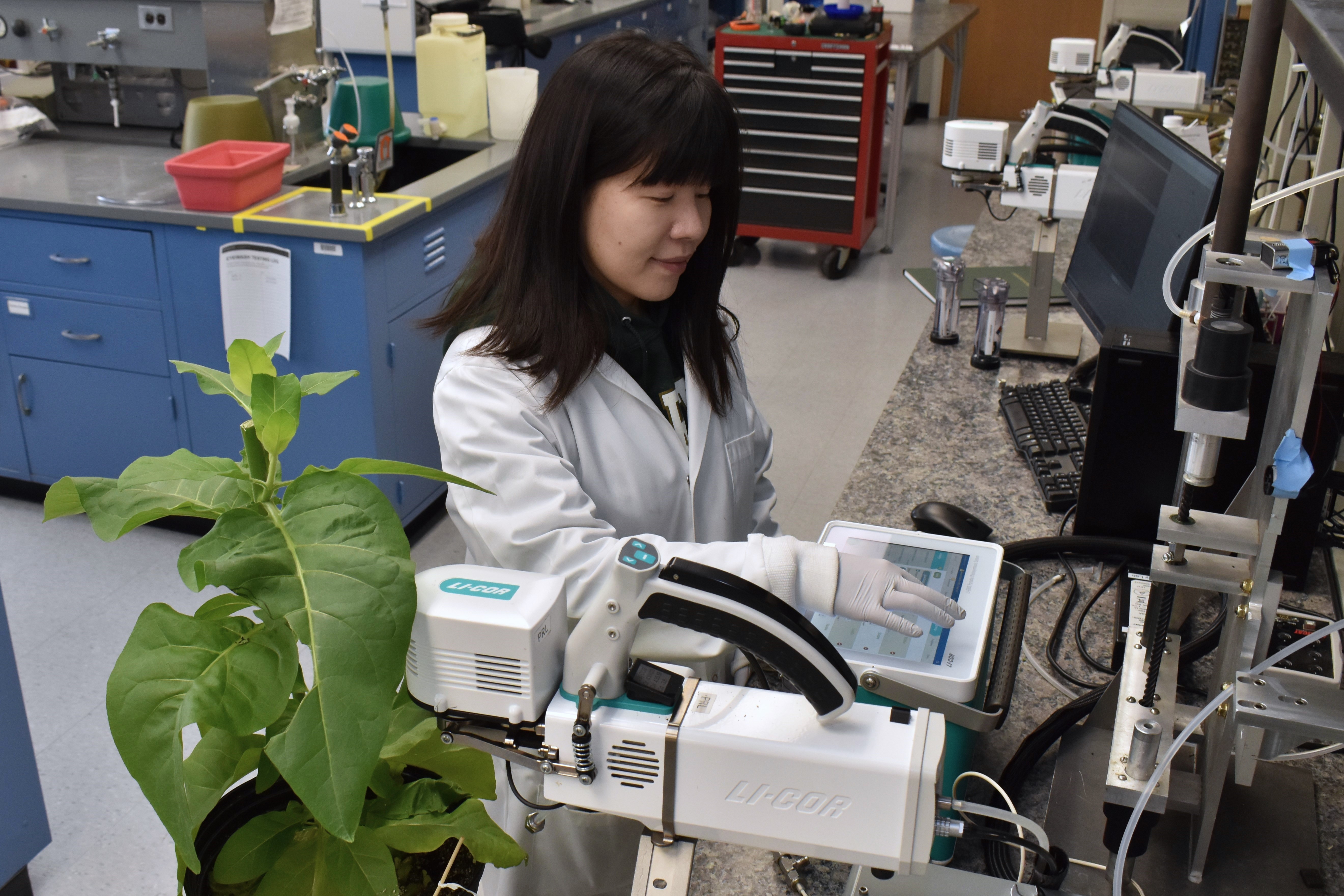
Yuan Xu
Yuan Xu, postdoctoral researcher in the Sharkey lab, uses a LICOR to measure the rate of photosynthesis in a plant. By Kara Headley

This study revealed two major findings: under these future conditions, plants increase their rate of photosynthesis, but their rate of respiration in the light remains consistent with current conditions.

Increasing the rate of photosynthesis means the plant can make more sucrose and starch, the food it needs to survive.

“Most carbon fixed in photosynthesis becomes either starch [to use later] – like putting money in your bank account – or sucrose (table sugar) to use now – like buying an ice cream cone,” said Thomas D. Sharkey, University Distinguished Professor in the PRL. “The most surprising observation was that extra carbon at high light and high carbon dioxide went much more to starch (76% increase) rather than sucrose (41% increase). This may help plants become more resilient because they will have extra carbon for growth or defense.” Sharkey is also in the Department of Biochemistry & Molecular Biology and the Plant Resilience Institute.

Increased rates of photosynthesis may also lead to larger plants, as the plant is making more food for itself. This can potentially lead to larger yields of the crops we eat.

But a remaining issue is that plants also lose some carbon during photosynthesis – carbon which the plant could be using to make food. During a process known as respiration in light, or RL, CO2 is released by the plant.

This study found that RL remains constant in current and future conditions. What this means is the rate at which CO2 is released by the plant through the RL pathway is the same, despite the increase in photosynthesis.

Innovative methods
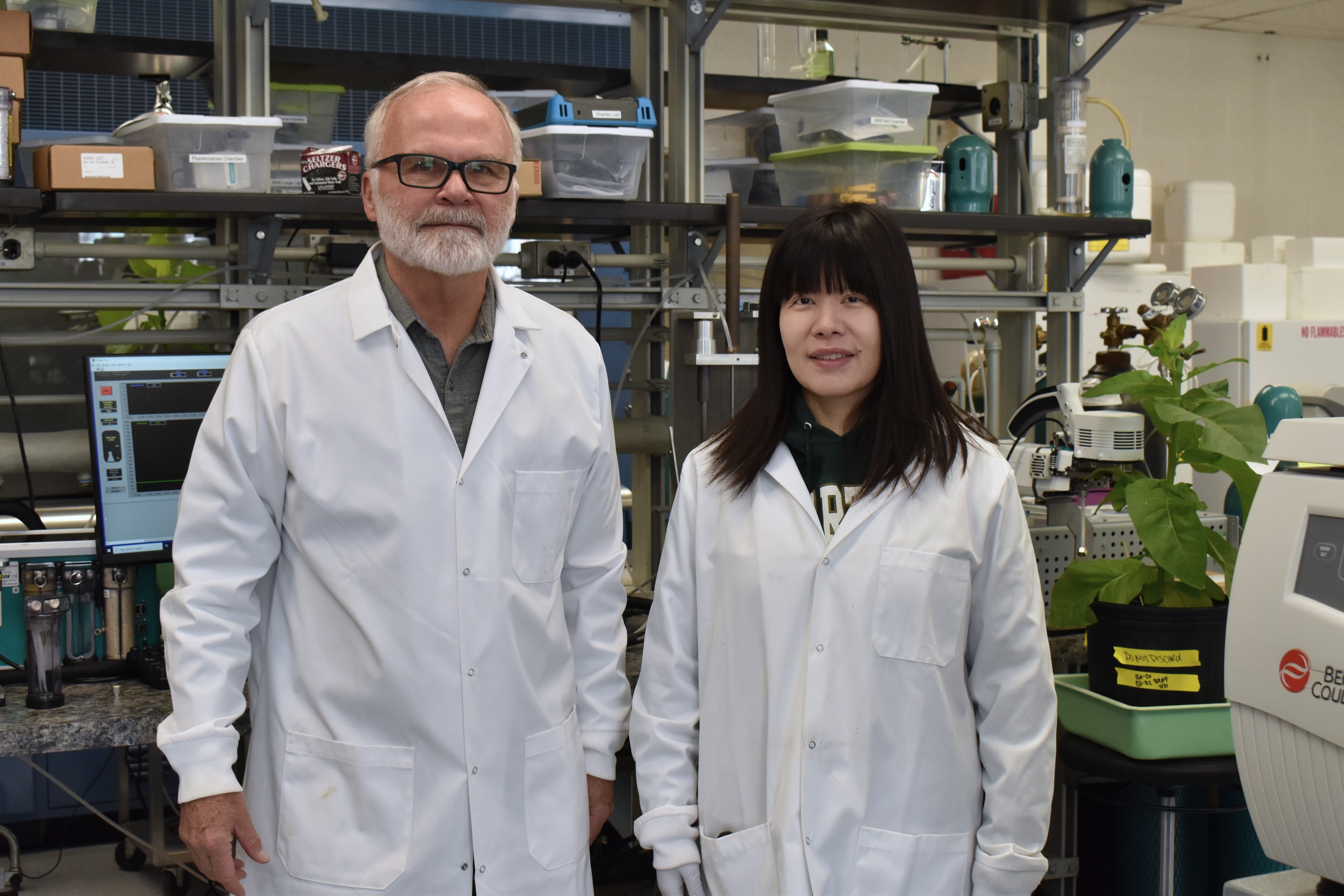
Thomas D. Sharkey and Yuan Xu
Thomas D. Sharkey and Yuan Xu. By Kara Headley

The researchers used a unique technique to measure RL. Typically, RL is measured using gas exchange methods such as the Laisk or Kok methods. However, these methods only work in low light conditions.

“That’s why this study is unique,” Xu explained. “We used a new approach to measure the RL in the high light condition that cannot be measured using the old method.”

Xu used a method known as isotopically nonstationary metabolic flux analysis, or INST-MFA, to look at gas exchange in HLHC conditions. This method is tried and true in bacteria and fungi studies but has only been used in a handful of plant studies over the past decade.

The Sharkey lab will continue to use innovative research methods to study respiration in the light. Understanding this process will allow a better understanding of carbon dioxide uptake and release in the future. 

“We know from this study that many things are changed, under future conditions, including photosynthesis, photorespiration and respiration in the light,” Xu said. “This gave a hint for future work.”

This story originally appeared on the College of Natural Science website.

Natural SciencesEngineering, Science and Technology

Latest News

MSUToday Weekly Update

The MSUToday Weekly Update email showcases how Spartans are making a difference through academic excellence, research impact and community outreach. Get inspired by these stories of innovation, collaboration and determination. Plus, enjoy photos and videos of campus and more MSU content to help keep you connected to the Spartan community.

Sign UpUpdate My Information

Connect With Us

Visit our Facebook pageVisit our page on XVisit our Instagram pageVisit our LinkedIn pageVisit our YouTube pageVisit our TikTok page

Health and Safety

  • MSU Police and Public Safety
  • Olin Health Center
  • Counseling & Psychiatric Services (CAPS)
  • University Health and Wellbeing
  • MSU Health Care
  • Civil Rights and Title IX
  • Our Commitment
  • Center for Survivors
  • Security & Fire Safety Report
  • University Policy on Relationship Violence and Sexual Misconduct
  • Notice of Non-Discrimination, Anti-Harassment and Non-Retaliation
  • Health Care Non-Discrimination Notice

Support Services

  • Disability Resources
  • Supportive Services
  • Learning Resources

Working at MSU

  • Human Resources
  • EBS Login
  • Job Postings
  • Employee Assistance Program

Reports

  • CARES Act Funding
  • Student Achievement and Outcomes

Contact us

517-355-1855

Address

Michigan State University 426 Auditorium Road East Lansing, MI 48824

Follow Us

  • Visit our Facebook page
  • Visit our page on X
  • Visit our Instagram page
  • Visit our TikTok page
  • Visit our LinkedIn page
  • Visit our YouTube page

If you're having accessibility issues, please let us know.

Know More: Campus Safety Information and ResourcesTransparency Reporting: Budget & Salary/Compensation
  • Contact Information|
  • Site Map|
  • Privacy Statement|
  • Site Accessibility|
  • Call MSU: (517) 355-1855|
  • Visit: msu.edu|
  • Notice of Nondiscrimination|

SPARTANS WILL|© Michigan State University|
