On 24 February, the U.S. Department of Energy Office of Science (DOE-SC) approved the start of execution of a $49.7 million instrument at the Facility for Rare Isotope Beams (FRIB). DOE-SC granted Critical Decision 2/3 approval to FRIB at Michigan State University (MSU) for the start of execution of the High Transmission Beam Line (HTBL), one of the two segments of the High Rigidity Spectrometer (HRS). Since 2012, DOE-SC has invested more than $1.5 billion into FRIB and its scientific operations. DOE-SC now furthers its investment in FRIB science with this $49.7 million instrument.
HRS significantly extends FRIB’s scientific reach
HRS is a scientific instrument that will serve as the core of FRIB’s fast-beam program. The HRS user group includes over 500 scientists from 21 U.S. universities, five national laboratories, and laboratories in Canada, Germany, Japan, and the United Kingdom. HRS will significantly extend FRIB’s scientific reach for neutron-rich isotopes. Such isotopes are otherwise only created in exploding and colliding stars. With HRS, the luminosity for experiments with the most neutron-rich and interesting nuclei will increase by a factor of up to 100.
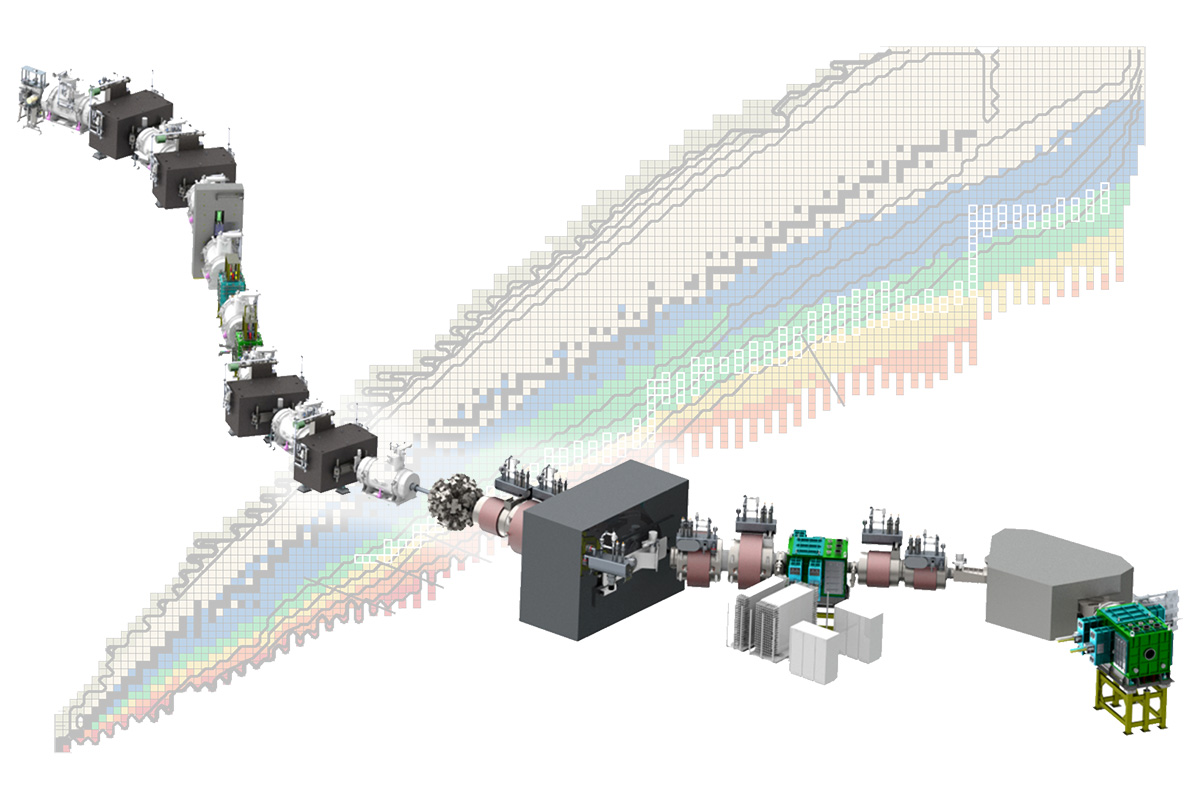
With near 100-percent efficiency, HRS will transmit isotopes that travel at velocities high enough for optimal rare-isotope production rates—around 50 percent of the speed of light. The high-velocity transmissions allow the foils in the rare-isotope production target—where reactions between isotopes take place—to be much thicker, greatly increasing the potential of a desired isotope reaction. HRS will enable scientists to identify the properties of isotopes, such as mass, charge, and velocity, created in these rare-isotope reactions.
HRS consists of two segments: the High Transmission Beam Line (HTBL) and the Spectrometer Section (SPS). HTBL transports rare-isotope beams from FRIB’s Advanced Rare Isotope Separator (ARIS) fragment separator to the reaction target located at the entrance of SPS. ARIS delivers specific rare isotope beams to experimental areas like HRS. HTBL by itself provides impactful scientific opportunities. It can transport rare isotopes from ARIS to a reaction target where gamma-rays emitted from very neutron-rich systems can be studied. HTBL also analyzes the charged particles produced in such reactions. For this purpose, a focal-plane detector system will measure momentum and scattering angle to identify the scattered particles. In these experiments, research will be able to study the properties of these very neutron-rich systems and increase our understanding of the strong nuclear force that binds neutrons and protons into nuclei. HTBL will also transport the rare-isotope beams from ARIS to other experimental user-supplied end stations, for example for studying reactions of importance for understanding reactions that take place in stars.
HRS (including both HTBL and SPS) is over 230 feet long. HTBL consists of 12 magnets of differing magnetic field configurations and functions, weighing 640,000 pounds in total. They transport isotopes travelling at 50 percent of the speed of light with near 100-percent transmission to experiment stations. In addition, SPS contains eight additional magnets, two of which are the largest dipole magnets that FRIB has built to date, weighing 1,320,000 and 740,000 pounds each. The science case for HRS and other details are laid out on the Lawrence Berkeley National Laboratory’s HRS site.
In September 2023, DOE-SC awarded $115 million for HRS. This funding was in addition to the July 2023 $529 million DOE-SC awarded FRIB to support operations after the $730 million FRIB Project was completed, and following the $199 million DOE-SC awarded for early operations. HTBL technical execution is slated to be completed in April 2030, pending annual Congressional appropriations.
“FRIB plays a crucial role in helping MSU work toward its $1 billion research expenditure goal by 2030, as envisioned in the MSU Strategic Plan, embodying a shared vision to foster innovation, enhance collaboration, and create impactful futures that will drive positive change for the world,” said Doug Gage, vice president for research and innovation at MSU.
FRIB research has lasting impact for American competitiveness
MSU operates FRIB as a DOE-SC user facility, with financial assistance from and furthering the mission of the DOE-SC Office of Nuclear Physics. FRIB began operations in May 2022. The 536,000-square-foot facility was completed ahead of schedule and on budget. FRIB operates the world’s most powerful rare isotope accelerator and serves as a world-class research and training center.
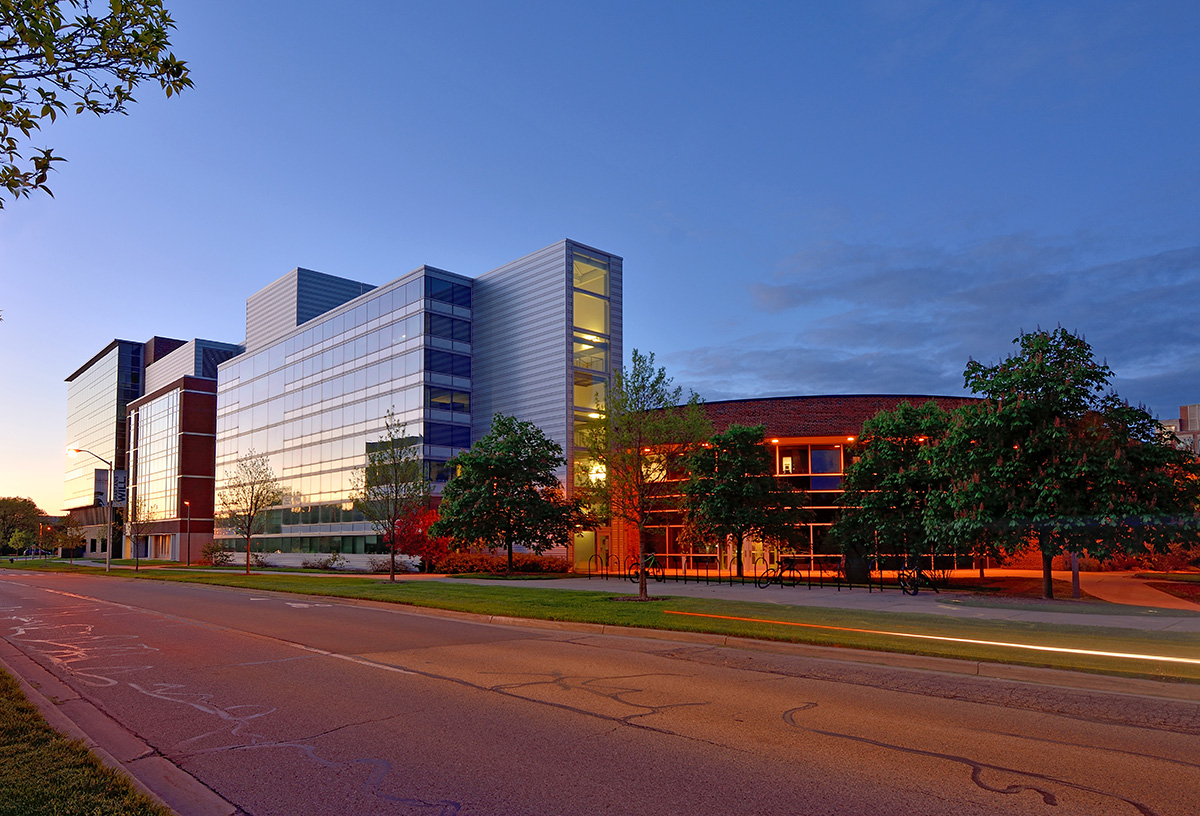
FRIB is a core U.S. research facility with broad benefits to other sciences, medicine, materials science, national security, and industry.
Since 2011, in procurements and labor, FRIB has invested over 94 percent in the United States and 78 percent in Michigan. Currently, FRIB employs 565 employees, 153 graduate students, and 134 undergraduate students.
FRIB’s facilities, including the FRIB Single Event Effects Facility (FSEE) and the in-progress K500 Chip Testing Facility (KSEE), are essential in addressing the national shortage of testing capacity for advanced microelectronics used in industries like spaceflight, wireless technology, and autonomous vehicles. Forty-one companies have used FSEE for their research.
In 2024, the federal government awarded $14 million to MSU to establish KSEE, which supports the refurbishment of the world’s first superconducting cyclotron—the K500 built at MSU in the 1980s—into a heavy-ion chip testing facility. The addition will also provide student opportunities through the MSU Space Electronics Initiative started by FRIB and the MSU College of Engineering. The MSU Space Electronics Initiative—together with FRIB’s SEE facilities—will position MSU as a national leader in chip design and testing, and it will provide additional capacity to educate students in chip design and testing. The SEE facilities are a magnet for attracting high-tech companies to Michigan, increasing the state’s impact to the nation’s semiconductor and aerospace industries.
The groundbreaking research conducted at scientific facilities like FRIB has helped MSU solidify its position as one of 71 American research universities in the Association of American Universities. Additionally, MSU received a Research 1 (Very High Spending and Doctorate Production) designation by the American Council on Education and the Carnegie Foundation for the Advancement of Teaching in 2025. MSU has also been designated as a university with very high research activity, one of only 146 as classified by the Carnegie Foundation. MSU’s nuclear physics graduate program—a cornerstone of FRIB—is a top-ranked program nationally, according to U.S. News & World Report.
"We are excited to advance the High Transmission Beam Line, a key step for experiments in understanding rare isotopes,” said FRIB Laboratory Director Thomas Glasmacher. “HTBL will greatly expand FRIB’s scientific reach, enabling groundbreaking discoveries in nuclear physics. HTBL is made possible by the continued support of the federal government and the American public, whose investment in basic research is vital to advancing knowledge for American competitiveness. We are deeply grateful for their commitment to scientific excellence and the future of discovery science."
The Facility for Rare Isotope Beams (FRIB) Laboratory's primary mission is to operate FRIB as a scientific user facility for the U.S. Department of Energy Office of Science in support of the Office of Nuclear Physics. FRIB’s primary mission is supported by resources provided by the U.S. Department of Energy, Office of Science, Office of Nuclear Physics under Award Number DE-SC0023633. The FRIB Laboratory is a major administrative unit of Michigan State University (MSU) and administers funding instruments from U.S. federal government agencies, MSU, and industry.
HRS is supported by the U.S. Department of Energy, Office of Science, Office of Nuclear Physics under award number DE-SC0024098.

