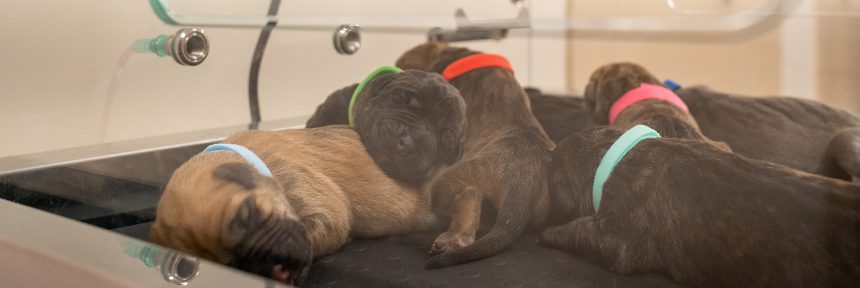
Sometimes, great opportunities present themselves when you least expect them. And sometimes, the opportunity is to save the lives of thousands of puppies.
“We estimate that there are about 60,000 dogs out there that wouldn’t have survived without our units,” says Ken Sunden, a class of 1984 MSU alum and founder of Puppywarmer, a Michigan-based company that designs and develops incubators that help neonatal canines survive and thrive, especially under challenging medical situations.
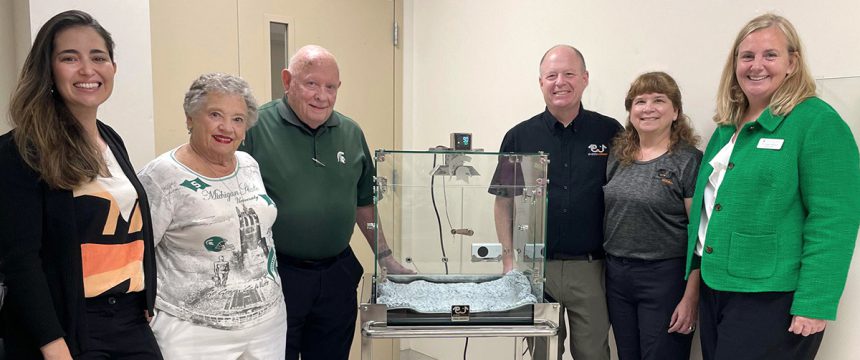
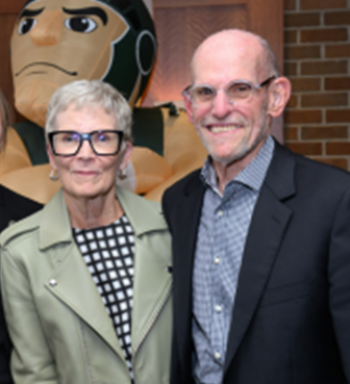
Sunden and his wife, Debbie, donated one of their units to the MSU Veterinary Medical Center’s Companion Animal Theriogenology Service in honor of Debbie’s father, Ed Foster, who is a 1963 alum of the MSU College of Veterinary Medicine. They made the donation in recognition of Foster’s long career as a Michigan veterinarian; one who supported community animals as well as the College itself with his efforts.
The Companion Animal Theriogenology Service is relatively new to the hospital. Opening in 2024 and headed by Viviane Gomes, the service cares for small animals at all points of the reproductive journey, including pre-breeding health screenings, breeding management, artificial insemination, pregnancy monitoring, and management of reproductive diseases.
“Providing the highest level of care for small animal neonates Is one of our top priorities, and having a reliable incubator is essential to our success,” says Gomes.
Gomes had worked with Puppywarmer incubators previously, and was delighted upon receiving one for the newly-established service.
“What a wonderful surprise to receive this generous gift from fellow Spartans in honor of Dr. Foster,” she says. “Dr. Foster’s dedication to veterinary medicine is inspiring—as is the story of Puppywarmer. We are deeply grateful to Ken and Debbie for their generous support of our mission!”
For the Sundens, the gift goes beyond enacting their mission to give animals a strong start in life. “Not only do we get to recognize a man we admire, but the donation will help a school that we love,” says Sunden. “We’re excited about it.”
A job with purpose
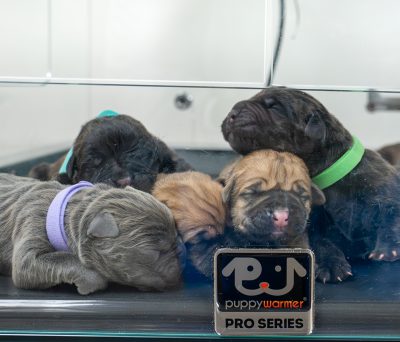
After adopting their dog, Chaos, the Sundens learned that two other puppies in Chaos’s litter were small for their gestational age, and had passed within the first three days of life. Interested in a challenge, Ken Sunden used his background in industrial heaters to design and build an incubator optimized for puppies, which a breeder would test out. The very first unit utilized repurposed equipment that included heaters, controllers, a sensor from a DNA amplifier, and a fast-acting thermocouple.
It evolved into a career move he didn’t expect. That first incubator was hugely successful.
The breeder Sunden would work with reported that 90 percent of small-for-gestational-age puppies didn’t survive infancy. “I thought maybe we could get it up to a 50 percent survival with the first incubator we built—which looked more like a Junior Achievement project,” he explains. “But we saved 17 of the next 18 [at-risk] puppies with it.”
The breeder sent Sunden photos of the puppies his incubator had helped: snapshots from when they were small and at risk, and when they had gone home to adoptive families.
“She told me to start a company,” he says. He explained that he was looking at retirement soon—not embarking on a new venture. “But she said there’s nothing like this incubator out there. ‘You owe it to the world.’ And I realized that when you get a photo of a puppy that otherwise had a low chance of survival going home to have a full life with a family—that makes for a better day than selling industrial heaters that seal potato chip bags. In my late 50s, I found the most purposeful job I may be able to do.”
“Randy [Carpenter, a veterinarian] used the incubator in a C-section and sent me a note that said, ‘In 30 years of being a veterinarian, I’ve never seen puppies feed like this after a C-section. Invoice me now; I never want to see this incubator leave my building,’” Sunden recounts.
To develop the incubator further, Sunden observed C-sections performed by Carpenter using a thermal imaging camera (“I am squeamish by nature, so this prevented me from passing out,” laughs Sunden). The camera provided valuable insights.
Designing a puppy incubator
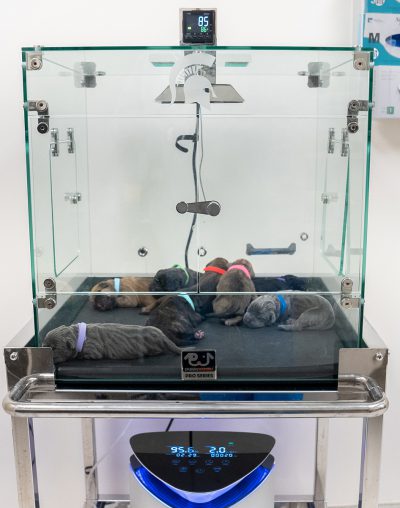
The incubator model that was donated to MSU comprises 22 by 22 inches of space within a glass enclosure, and uses one of the company’s Pro Series oxygen concentrators and a number of accessories, including a nebulizer and syringe-feeding nipples. The concentrator outputs the room air to 90 percent oxygen at a rate of 2 liters per minute; a partner company helped to fine-tune the machine to have puppy-friendly flow rates.
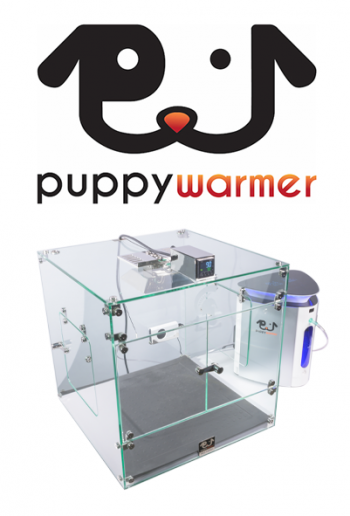
“The basic operating principle of this incubator, unlike some others, is that it uses a ceramic infrared heater,” explains Sunden. “It was originally developed for hog farming in Germany, though it now has many applications.”
The heater warms about an inch into occupant puppies’ bodies comfortably while they rest on a warmth-absorbing black mat.
When developing the incubator series, Sunden partnered closely with Carpenter, known for his work with dog breeders — who had in turn previously worked with Sunden’s father-in-law. Carpenter worked with Sunden in Puppywarmer’s early days by testing the product.
“What we could see from the thermal imaging is that there are a lot of places in the process where puppies lose body temperature,” he says. “For example, if a tech sets a puppy on a room-temperature stainless steel table, you may not realize how much the heat signature of the puppy transfers to the table. The body temperature is key to their survival, yet they may lose 2 degrees just being placed on that table for a moment.”
Informed by this, Sunden and partners devised a unit with inward-pushing doors on both sides, enabling technicians to efficiently place multiple puppies inside mid-procedure, not wasting a second of time or a degree of body temperature. The entire unit sits atop a stainless steel, wheeled cart that was designed specifically for the unit to be easily portable and space-efficient, especially for use during procedures.
“A lot of veterinary facilities are very space-constrained,” says Sunden. “There’s a high demand for procedures, and you have to be able to use the space as efficiently as you can.”
The incubator’s applications extend beyond post-C-section puppy housing. The units have also been used for hypothermic cats and small dogs, reptile surgery, raising immunocompromised research pigs, growing mushrooms, and Sunden has even used one to warm chocolate chip cookies to the perfect degree of chip-meltitude at dog shows.
Both the Puppywarmer incubator and the college’s Theriogenology service represent the cutting edge in companion animal reproductive health, a specialty that has seen drastic advancements in a relatively short period of time. Foster, the man whom the incubator donation honors, can recall.
“I used a human incubator for animals back when I started practicing, and every time I opened the door would lose some heat; it didn’t have oxygen,” he describes. “I would have loved Ken’s incubator.”
This story originally appeared on the College of Veterinary Medicine website.

