From helping catalyze interstellar reactions and fueling the birth of stars to its presence in neighborhood gas giants like Saturn and Jupiter, trihydrogen, or H3+, is best known as the “the molecule that made the universe.”
While we have a clear picture of how the majority of H3+is formed — a hydrogen molecule, or H2, colliding with its ionized counterpart, H2+ — scientists are keen to understand alternative sources of H3+ and to better measure its abundance throughout the cosmos.
Now, in a new paper appearing in Nature Communications, Michigan State researchers Piotr Piecuch and Marcos Dantus and their groups and collaborators have provided unprecedented insights into the formation of H3+ in compounds known as methyl halogens and pseudohalogens.
These findings follow previous breakthrough discoveries at MSU, including the formation of H3+ through a unique “roaming mechanism” in doubly ionized organic molecules.
Double ionization occurs when an atom or molecule is subjected to enough energy, say from a cosmic ray or laser, that it loses two electrons.
In their latest paper, the team observed a similar roaming mechanism in doubly ionized methyl halogens and pseudohalogens, uncovering an array of factors that govern the formation — or absence — of H3+ in these particular compounds.
These formation factors can be applied to a wide variety of other molecules, broadening the horizon for researchers looking to study the origins and formation of the molecules in the universe.
“H3+ is a small molecule that might not be as important to us on Earth as water or proteins, but it’s a molecule we truly want to understand in terms of its abundance in the universe, how it is produced, and how fast its chemical reactions are,” Piecuch said, a University Distinguished Professor and MSU Research Foundation Professor in the Department of Chemistry.
“With our findings, we can communicate with others who are looking for sources of H3+ and the molecules that can form it.”
Roaming the cosmos
Being “the molecule that made the universe” comes with high expectations, and H3+ certainly lives up to the name.
“H3+ is essential for astrochemistry, from the birth of stars to the formation of many organic molecules,” said Dantus, an MSU Research Foundation Professor in MSU’s Department of Chemistry.
With these crucial roles in mind, the Dantus Research Group had previously looked beyond the H2-meets-H2+ formation pathway in search of alternative sources of H3+. This earlier research led them to doubly ionize certain organic molecules, resulting in a surprising outcome.
Rather than immediately breaking apart, as might be expected when putting two positive charges in a small enough molecular space, a neutral hydrogen — H2 — was instead ejected from the molecule.
Like a dancer searching a ballroom for a partner, this H2 then “roamed” around the molecule until it plucked out an extra proton, forming H3+.
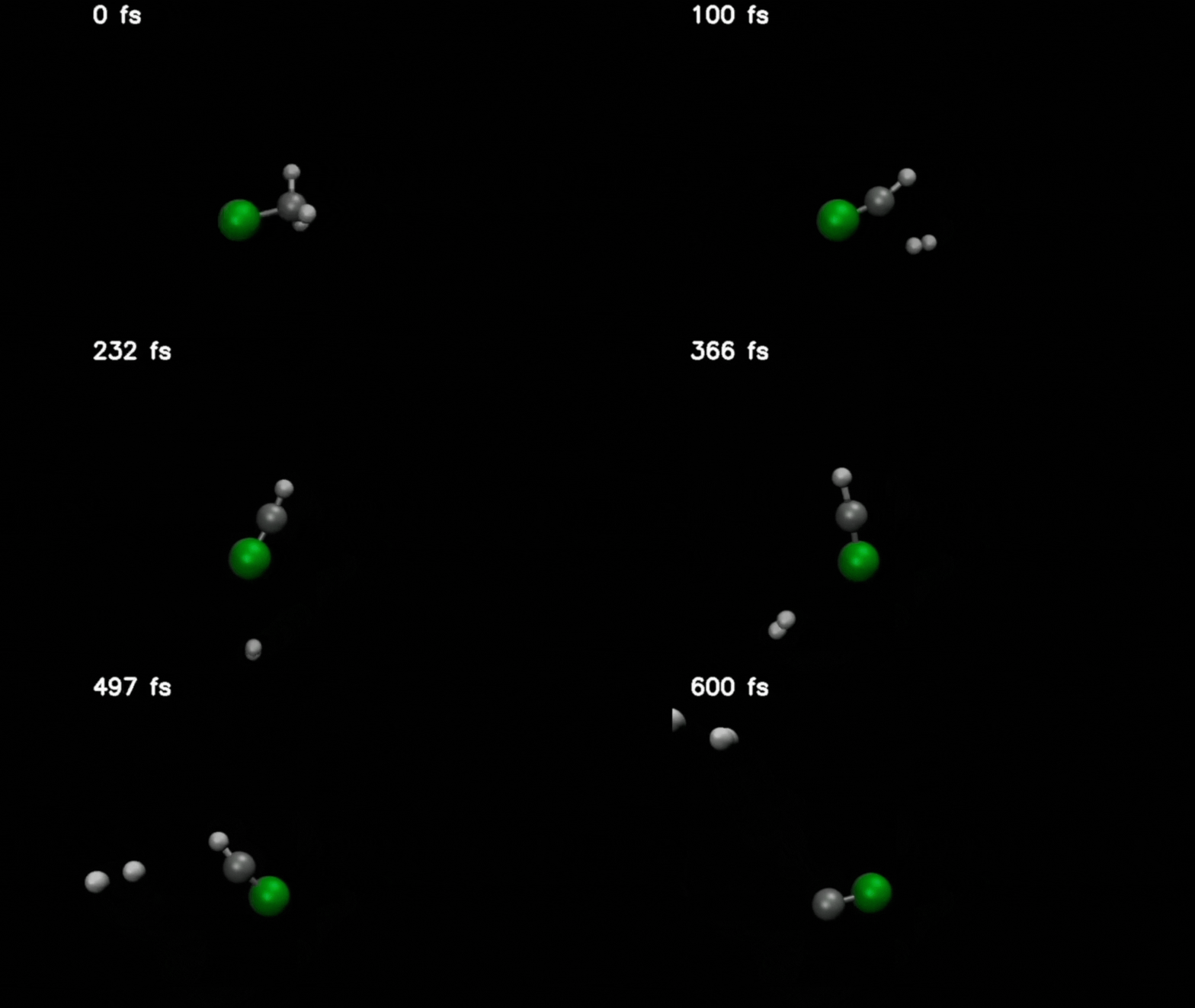
“We demonstrated that the hydrogen didn’t simply fly away, but it stuck around, sometimes for quite a long time,” Dantus added, who is also a University Distinguished Professor. “This was highly unusual.”
“It’s not the usual way of thinking about the behavior of doubly ionized molecules, but a much trickier process,” Piecuch said, comparing the roaming mechanism followed by proton abstraction by H2 to the traditional image of a doubly ionized molecule blowing apart due to repulsion of two positive charges — a process better known as a Coulomb explosion.
Turning their attention to halogens and pseudohalogens in their latest publication, Piecuch, Dantus and their colleagues have confirmed several more molecules that form H3+ through double ionization and, just as crucially, identified those that don’t.
The publication includes several movies showing how H3+ is formed in particular instances. These were prepared in collaboration with Professor Benjamin Levine at Stony Brook University and can be viewed by visiting the publication’s supplementary material.
These findings were achieved through a combination of ultrafast laser spectroscopy and cutting-edge computational chemistry, a balancing act of expertise between the two groups of Spartan scientists.
“What was quite special about this project — to bring it to fruition — was the use of state-of-the-art techniques from each side, including high-level theory and experimentation,” Piecuch added.
The hunt for H3+
In cracking the code on H3+ formation in halogens and pseudohalogens, the researchers have successfully created a set of governing factors allowing them to predict which organic compounds can produce H3+ through doubly ionized roaming — factors that Dantus and Piecuch say can be applied to a diverse array of other molecules, including many they did not study.
These guidelines are a powerful tool for fellow scientists who continue the search for alternative and perhaps surprising sources of H3+, such as molecular clouds in interstellar space.
“Hydrogen is the most common element in the universe, so H2 meeting H2+ is still the key,” Dantus explained. “However, there are so many organic molecules in these diffuse molecular clouds that it’s possible a lot of H3+ is still being formed by the processes we’ve studied.”
When dealing with a molecule as ubiquitous as H3+, the discovery of its new sources can ultimately deepen our understanding of cosmic chemistry at all levels.
“Even if there are only a few percent more H3+ molecules in the universe because of the small organic compounds we and others have studied, the models that scientists use to study processes such as star formation may have to be revisited,” Piecuch concluded.

