Jump to HeaderJump to Main ContentJump to Footer
Michigan State University
MSUTODAY
  • Browse Stories By

    Topics

    Explore stories by subject area

    • Arts and Culture
    • Business and Economy
    • Climate and Environment
    • Education and Learning
    • Engineering, Science and Technology
    • Government and Society
    • Health and Medicine
    • Media and Communications
    • MSU Leadership and Impact
    • Sports and Recreation
    • Student and Campus Experience
    View All Stories

    Collections

    Curated story series

    • Turfgrass
    • Ask the Expert
    • Big Ideas
    • Climate solutions
    • Water at MSU
    • Mobility
    • Spartan Perspectives
    • Student views
    • Graduate voices
    • Faculty voices
    View All Collections

    Featured

    Editor's picks

    • 9 reasons to love being a Spartan

      Aug. 28, 2026

      9 reasons to love being a Spartan

    • NIH awards multi-university team over $4M to improve women’s health

      Sept. 15, 2026

      NIH awards multi-university team over $4M to improve women’s health

MSUTODAY
  • Browse Stories By

< Browse Stories By

Topics

Explore stories by subject area

  • Arts and Culture
  • Business and Economy
  • Climate and Environment
  • Education and Learning
  • Engineering, Science and Technology
  • Government and Society
  • Health and Medicine
  • Media and Communications
  • MSU Leadership and Impact
  • Sports and Recreation
  • Student and Campus Experience
  • View All Stories

Collections

Curated story series

  • Turfgrass
  • Ask the Expert
  • Big Ideas
  • Climate solutions
  • Water at MSU
  • Mobility
  • Spartan Perspectives
  • Student views
  • Graduate voices
  • Faculty voices
  • View All Collections

Featured

Editor's picks

  • 9 reasons to love being a Spartan

    Aug. 28, 2026

    9 reasons to love being a Spartan

  • NIH awards multi-university team over $4M to improve women’s health

    Sept. 15, 2026

    NIH awards multi-university team over $4M to improve women’s health

  • For Media
  • Experts
  • Releases and Statements
  • Sign Up
  • Update Information

Resources

  • A to Z Index
  • Find People
  • Maps
  • Email
  • Student Information System (SIS)
  • D2L
  • Libraries
  • Tech Support
  • MSU Misconduct Hotline
  • Social Media Directory
  • Events Calendar
  • For Media
Michigan State University
MSUToday
  • For Media
  • Experts
  • Releases and Statements
  • Sign Up
  • Update Information
Natural Sciences

June 25, 2024

Transforming drug discovery with AI

By: Jude Coleman

A new AI-powered program will allow researchers to level up their drug discovery efforts. 

The program, called TopoFormer, was developed by an interdisciplinary team led by Guowei Wei, a Michigan State University Research Foundation Professor in the Department of Mathematics. TopoFormer translates three-dimensional information about molecules into data that typical AI-based drug-interaction models can use, expanding those models’ abilities to predict how effective a drug might be. 

“With AI, you could make drug discovery faster, more efficient and cheaper,” said Wei, who also holds appointments in the Department of Biochemistry and Molecular Biology and the Department of Electrical and Computer Engineering.

Wei and his team published a paper about their work in the journal Nature Machine Intelligence.

Instructions for structure

In the United States, developing a single drug is roughly a decade-long process that costs around $2 billion, Wei said. Testing the drug with trials eats up roughly half of that time, he added, but the other half goes into discovering a new therapeutic candidate to test.
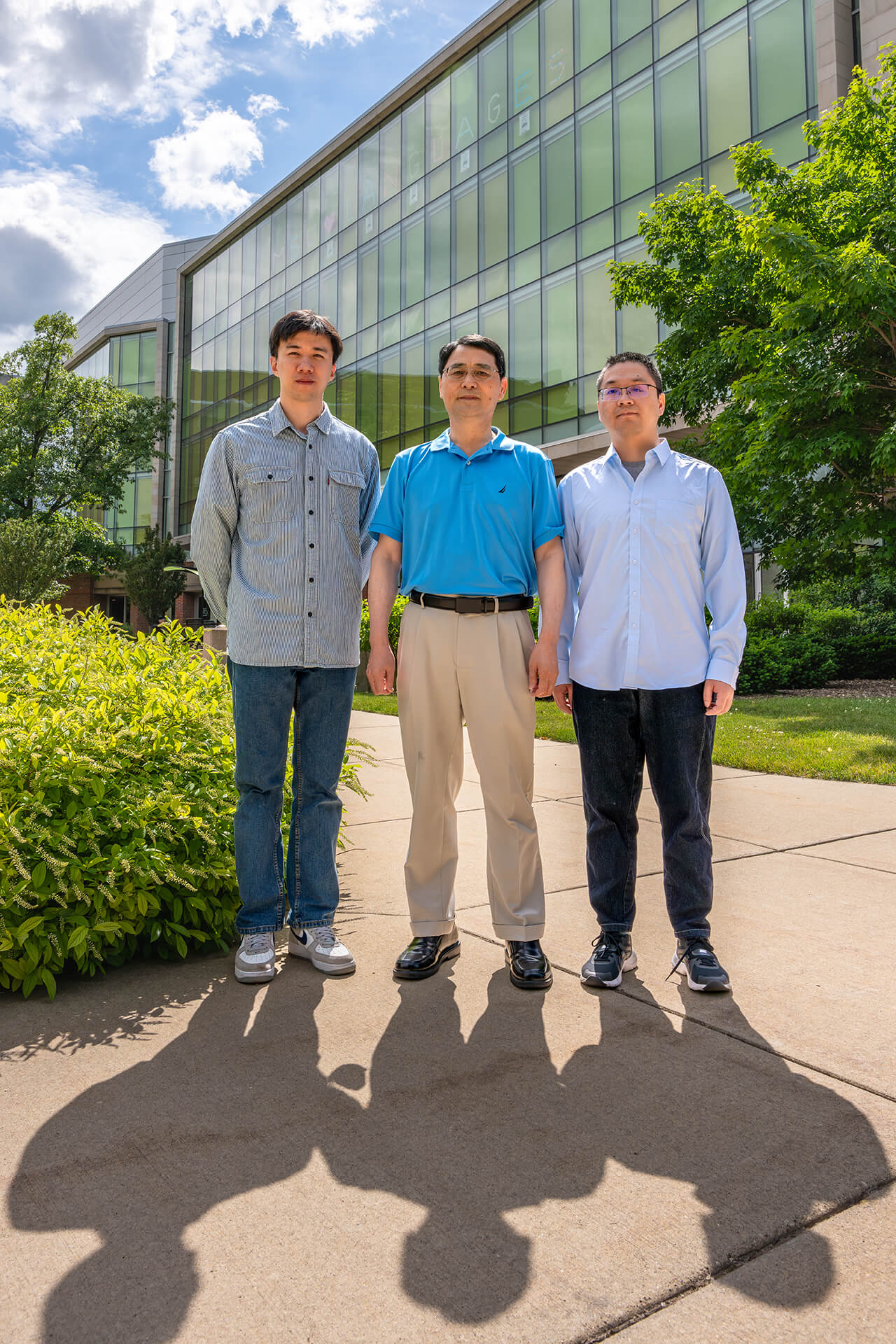
Guowei Wei, Dong Chen, and Jian Liu
The team behind the new TopoFormer program was led by Guowei Wei (center) of Michigan State University and included Dong Chen (left), also of MSU, and Jian Liu, a visiting scholar from the Chongqing University of Technology in China. Finn Gomez/MSU College of Natural Science

TopoFormer has the potential to shrink development time. In doing so, it can reduce development costs, which could lower the price of the drug for consumers downstream. That could be particularly useful for rare diseases, because the limited number of patients means drug companies need to charge more to recoup costs. 

Although researchers currently use computer models to aid in drug discovery, there are limitations, stemming from the myriad variables of the problem.

“In our body we have over 20,000 proteins,” Wei said. “When a disease comes up, some or one of those is targeted.”

The first step, then, is learning which protein or proteins a disease affects. Those proteins also become the targets for researchers, who want to find molecules that can prevent, minimize or counteract the effects of the disease.

“When I have a target, I try to find a lot of potential drugs for that particular target,” Wei said.

Once scientists know which proteins to target with a drug, they can input molecular sequences from the protein and potential drugs into conventional computer models. The models predict how the drugs and target will interact, guiding decisions on which drugs to develop and test in clinical trials.

While these models can predict some interactions based on the drug and protein’s chemical makeup alone, they also miss vital interactions that come from molecular shape and three-dimensional, or 3D, structure.

Ibuprofen, discovered by chemists in the 1960s, is one example of this. There are two different ibuprofen molecules that share the exact same chemical sequence but have slightly different 3D structures. Only one arrangement is shaped in a way that can bind to pain-related proteins and erase a headache. 

“Current deep learning models can’t account for the shape of drugs or proteins when predicting how they’ll work together,” Wei said. 

That’s where TopoFormer comes in. It’s a transformer model, the same type of artificial intelligence used by Open AI’s chatbot, ChatGPT (the GPT stands for “generative pre-trained transformer”).

That means that TopoFormer is trained to read information in one form and turn it into another form. In this case, it takes three-dimensional information about how proteins and drugs interact based on their shapes and recreates it as one-dimensional information that current models can understand. 

In fact, “Topo” stands for “topological Laplacian,” which refers to mathematical tools Wei and his team invented to convert 3D structures into 1D sequences.   

The new model is trained on tens of thousands of protein-drug interactions, where each interaction between two molecules is recorded as a piece of code, or a “word.” The words are strung together to create a description of the drug-protein complex, creating a record of its shape. 

“In such a way, you have many, many words knitted together like a sentence,” Wei said.  

Those sentences can then be read by other models that predict new drug interactions, and give them more context. If a new drug is a book, TopoFormer can take a rough story idea and turn it into a fully-fledged plotline, ready to be written. 

This story originally appeared on the College of Natural Science website.

MEDIA CONTACTS

Matt Davenport
Natural SciencesEngineering, Science and Technology

Latest News

MSUToday Weekly Update

The MSUToday Weekly Update email showcases how Spartans are making a difference through academic excellence, research impact and community outreach. Get inspired by these stories of innovation, collaboration and determination. Plus, enjoy photos and videos of campus and more MSU content to help keep you connected to the Spartan community.

Sign UpUpdate My Information

Connect With Us

Visit our Facebook pageVisit our page on XVisit our Instagram pageVisit our LinkedIn pageVisit our YouTube pageVisit our TikTok page

Health and Safety

  • MSU Police and Public Safety
  • Olin Health Center
  • Counseling & Psychiatric Services (CAPS)
  • University Health and Wellbeing
  • MSU Health Care
  • Civil Rights and Title IX
  • Our Commitment
  • Center for Survivors
  • Security & Fire Safety Report
  • University Policy on Relationship Violence and Sexual Misconduct
  • Notice of Non-Discrimination, Anti-Harassment and Non-Retaliation
  • Health Care Non-Discrimination Notice

Support Services

  • Disability Resources
  • Supportive Services
  • Learning Resources

Working at MSU

  • Human Resources
  • EBS Login
  • Job Postings
  • Employee Assistance Program

Reports

  • CARES Act Funding
  • Student Achievement and Outcomes

Contact us

517-355-1855

Address

Michigan State University 426 Auditorium Road East Lansing, MI 48824

Follow Us

  • Visit our Facebook page
  • Visit our page on X
  • Visit our Instagram page
  • Visit our TikTok page
  • Visit our LinkedIn page
  • Visit our YouTube page

If you're having accessibility issues, please let us know.

Know More: Campus Safety Information and ResourcesTransparency Reporting: Budget & Salary/Compensation
  • Contact Information|
  • Site Map|
  • Privacy Statement|
  • Site Accessibility|
  • Call MSU: (517) 355-1855|
  • Visit: msu.edu|
  • Notice of Nondiscrimination|

SPARTANS WILL|© Michigan State University|
