
In May 2022, the Facility for Rare Isotope Beams at Michigan State University, launched its precision measurement program. Staff from FRIB’s Low Energy Beam and Ion Trap facility take high-energy, rare-isotope beams generated at FRIB and cool them to a lower energy state. Afterward, the researchers measure specific particles’ masses at high precision.

The LEBIT team, led by Ryan Ringle, adjunct professor of physics at FRIB and in the MSU Department of Physics and Astronomy and senior scientist at FRIB, and Georg Bollen, University Distinguished Professor of Physics and FRIB Experimental Systems Division director, recently published a research paper that used the facility to take a step in verifying the mass of aluminum-22. Researchers think this exotic isotope demonstrates a rare but interesting property—specifically, that the nucleus is surrounded by a “halo” of protons that loosely orbit the nucleus. This halo structure reveals distinctive physical properties during its fleeting existence.

“This program requires a lot of extra beam preparation to perform experiments, and this is the first measurement in FRIB’s science program,” Ringle said. “This measurement could not have been done in a reasonable time at FRIB’s predecessor, the National Superconducting Cyclotron Laboratory, and it highlights our facility’s potential moving forward. Considering this was done with one-eightieth of FRIB’s power specification, this was like a warm-up before exercising.”
The team published its results in Physical Review Letters (“Precision Mass Measurement of the Proton Dripline Halo Candidate 22Al”).
Capturing elusive proton halos
While most atoms have electrons tightly orbiting the nucleus, protons and neutrons are part of the nucleus itself. However, when atoms encounter many of the same charged particles under certain conditions, they can create halos that orbit the nucleus beyond the pull of the strong nuclear force—the force that would normally keep these particles within the nucleus. While all halo structures are rare fleeting phenomena, neutrons are usually observed as halo particles. A nucleus’s positive charge usually repels protons’ positive charges, meaning that halos made of protons are even rarer. Measurements on nearby isotopes suggested that aluminum-22 might be an isotope that could form a proton halo, but researchers needed to verify this directly in other experiments.
To achieve this, the team creates a high-energy isotope beam of aluminum-22 using a process called “projectile fragmentation” at FRIB. The researchers create a beam from a heavy, stable atomic nucleus of a given element—in this case, an isotope of argon—then accelerate the beam to half the speed of light. The beam then hits a target with these ultra-fast-moving particle projectiles. This violent collision creates rare, short-lived isotopes that the researchers can shepherd into an instrument to filter out the particle of interest. They then lower the temperature to slow them down into a uniform beam and measure particle mass accurately.
While the team was able to accurately measure the mass of aluminum-22, it is only part of verifying the isotope’s proton halo structure. The LEBIT researchers’ colleagues in the Beam Cooler and Laser Spectroscopy (BECOLA) facility at FRIB now plan to take the next step in verifying the proton halo by measuring the charge radius—the distribution of protons around the nucleus—as well as how much the nucleus may be deformed from its traditional, spherical shape. Taken together, these measurements can unequivocally confirm the existence of a proton halo structure around aluminum-22.
Ringle pointed out that the collaboration between theoretical physicists and experimentalists at FRIB plays an essential role for research like determining the existence of a proton halo around a rare isotope such as aluminum-22.
FRIB provides research opportunities to graduate students
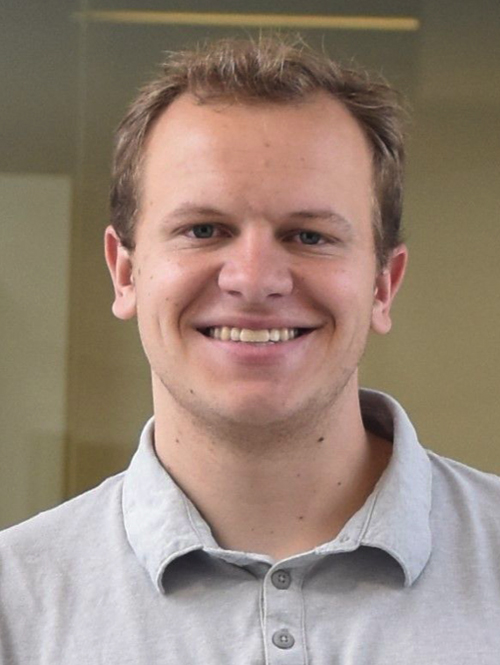
Ringle credited students on the team for playing a key role in advancing this research. One of LEBIT’s graduate students, Scott Campbell, took this project on as part of his dissertation.
“He really took charge of running this experiment from start to finish,” Ringle said. “The students who work with us really benefit from the wealth of expertise we have at this facility. Nowhere else is a facility like this located in the middle of a university campus. It allows students to come in for an hour or two between their classes or before they go home for the day. They can work at the lab part-time and easily pair that with taking classes. But our facility gets benefit as well; we have increased access to talented, motivated students.”
Campbell studied physics and computer science at Gonzaga University as an undergraduate. He was excited by the prospect of coming to MSU for graduate school in large part to FRIB being on campus and being a major resource for physics students. “I was very excited by the prospect of doing nuclear physics research at MSU, especially with FRIB ramping up during my studies,” he said. “We have access to these great facilities and a great community, and we get to participate in groundbreaking advances in nuclear science.”
Campbell also noted that FRIB not only offers world-class facilities, but also networking opportunities and mentors like Ringle. “We are surrounded by colleagues who are interested in your research and want to help you push science forward,” he said.
This story originally appeared on the Facility for Rare Isotope Beams website.

