Unpredictable precipitation is one of the most challenging elements of being a farmer. Not enough moisture, and plant growth is hindered. Too much can saturate the soil while setting the stage for diseases to thrive.
Recently, Michigan growers have experienced both extremes. Some of the driest and wettest months on record have occurred in the last few years. For plant diseases such as tar spot in corn and white mold in soybeans, periods of high moisture are particularly problematic.
Both tar spot and white mold can go from a few infected plants to entire fields in a short timeframe. Once they’re present, growers are mostly relegated to mitigation rather than eradication.
In drier times, when diseases may be less prevalent, farmers often look to irrigation to supplement lagging rainfall. But fine-tuning these systems can be tricky, and too much added water can lead to unintended disease consequences.

To address this, MSU researchers have developed and are testing an irrigation technology called Low-Cost Monitoring System, or LOCOMOS. The work is led by Younsuk Dong, an assistant professor and irrigation specialist in the Department of Biosystems and Agricultural Engineering.
With LOCOMOS, the in-field sensors measure soil moisture, leaf wetness and other environmental conditions. The data is then analyzed by software that generates precise irrigation recommendations and delivers them to growers via an easy-to-use smartphone app. The development of the system and app was facilitated through a partnership with the MSU Innovation Center.
“The commercial-grade monitoring systems are expensive and thus not accessible to most farmers,” Dong said. “The data they generate can also be difficult to interpret. A simpler system that uses low-cost sensors was needed, and LOCOMOS can be used with a smartphone, which almost all farmers can easily access today.”
In 2021, Dong and his team — which includes Martin Chilvers, a professor and field crops pathologist in the Department of Plant, Soil and Microbial Sciences — received a three-year, $426,000 grant from the U.S. Department of Agriculture’s Natural Resources Conservation Service.
Other projects have utilized LOCOMOS, including some funded by Project GREEEN, the Michigan Soybean Committee, the Corn Marketing Program of Michigan, the Michigan Bean Commission and the Michigan Potato Industry Commission.
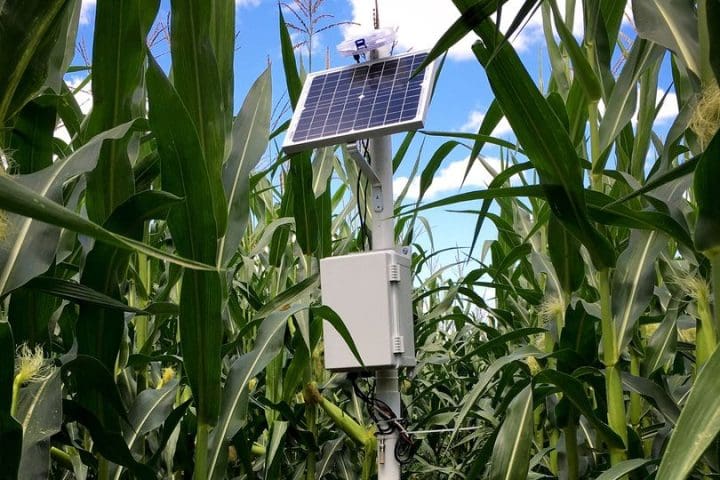
“If folks over-irrigate, particularly with frequent irrigation, they are likely to drive disease development, which is the part of this work I’m most interested in as a pathologist,” said Chilvers, whose work is supported in part by MSU AgBioResearch. “Additionally, using more water than necessary is costly with respect to water use, labor and equipment. There are a lot of considerations to be made with irrigation, so what we’re seeing is how these sensors can help make that process easier.”
LOCOMOS has been tested in a variety of cropping systems, including multiple field crops, blueberries and potatoes, while others are forthcoming.
For the NRCS project, researchers are partnering with five farms across Michigan to evaluate LOCOMOS in corn, soybean and tomato fields. The study is ongoing, but based on the first three years of on-farm demonstration data, sensor-based irrigation scheduling has improved water use efficiency at each of the five farms.
In the corn and soybean fields, Dong said LOCOMOS has enhanced irrigation water use efficiency while not increasing disease incidence. Compared to the growers’ typical irrigation schedule, LOCOMOS boosted profits for a 100-acre field by $7,700 for corn and $1,300 for soybeans each year. The profits included improved yields and reduced energy costs associated with pumping water.
In the tomato field, sensor-based scheduling saved 30% on water use versus the grower’s typical irrigation method.
“Initial results look promising in using these tools in commercial fields,” said Mark Seamon, research director for the Michigan Soybean Committee. “The responsible use of water and the cost of irrigation are both critical in irrigating any crop. Soybeans’ response to irrigation can be more complex than some other crops, so stewardship of resources and finances is especially relevant.”
On top of the water savings, the team also found that LOCOMOS has potential in other areas, such as informing timings for fungicides or other sprays.

Results from the project have been shared at several meetings and conferences, with participants ranging from farmers and NRCS staff to crop consultants and soil and water conservation professionals.
Dong said the next major step in the research and development process is automation, in particular for irrigation. Once data is collected, an algorithm would create the optimal irrigation strategy and trigger the system to implement it.
“The nature of the data from LOCOMOS allows it to be a holistic tool that helps farmers deal with the entirety of plant health,” Dong said. “If we can move the system from simply delivering data to automatically making the adjustments for farmers while keeping the system cost-effective, it would be a great thing.”
Seamon believes the recent findings and future research are sure to change the way growers approach irrigation and disease challenges.
“The expertise of MSU and MSU Extension through researchers, field staff and connections to Michigan soybean growers make the success of these efforts nearly guaranteed,” he said. “The applied research uses practical approaches to real-world problems and cost-effective management adjustments, so the adoption of this management is likely because of the practical approach to the issues.”
This story originally appeared on the AgBioResearch website.

