A Michigan State University researcher has received a $394,600 grant from the U.S. Department of Agriculture’s Natural Resources Conservation Service to develop a solar power-based irrigation technology that improves energy- and water-use efficiency.

Younsuk Dong, an assistant professor in the MSU Department of Biosystems and Agricultural Engineering, leads the three-year project.
Agriculture is responsible for more than 80% of all water consumption in the U.S., according to USDA’s Economic Research Service. A report from the U.S. Geological Survey indicates that irrigation alone accounts for roughly 42% of water use.
Dong said that while irrigation is an essential tool, it must be deployed efficiently. Over-irrigation, in particular, can cause a multitude of unintended consequences, such as unneeded expenses on energy and water, as well as increasing disease activity.
According to the Michigan Farm Energy Audit Program, irrigation operations consume 95% of the electricity used on an irrigated Michigan farm. USDA’s 2019 Census of Agriculture showed that energy expenses for irrigation pumps exceeded $2.4 billion.
To make farming more sustainable for growers and the environment, an increased emphasis has been placed on research generating technologies that save on input costs and resource use.
“Some electric utilities have deactivated coal-powered plants to fight climate change, which has caused a reduction in power capacity and reserve availability despite the push toward renewable energy,” Dong said. “About 85% of Michigan farms are on single-phase electrical networks, which limit the size of motors you can have connected to the network. Irrigation requires large motors, so if we can make these motors more efficient and reduce stress on the grid, we can increase sustainability of the operations.”
Dong is an expert in accessible irrigation technology development, having already created and field tested the Low-Cost Monitoring System. LOCOMOS significantly lowers the initial cost of in-field irrigation sensors and is usable with a smartphone app.
The sensors collect data on soil moisture, leaf wetness and other environmental conditions, which is then analyzed by software that sends growers precise irrigation recommendations.
For the new project, Dong and Woongkul (Matt) Lee, an assistant professor at Purdue University who was previously at MSU, are designing a solar-powered microinverter. The small device is connected to a solar panel and allows electricity to be used for tasks such as soft-starting induction motors for irrigation or sent back to the grid for energy credits.
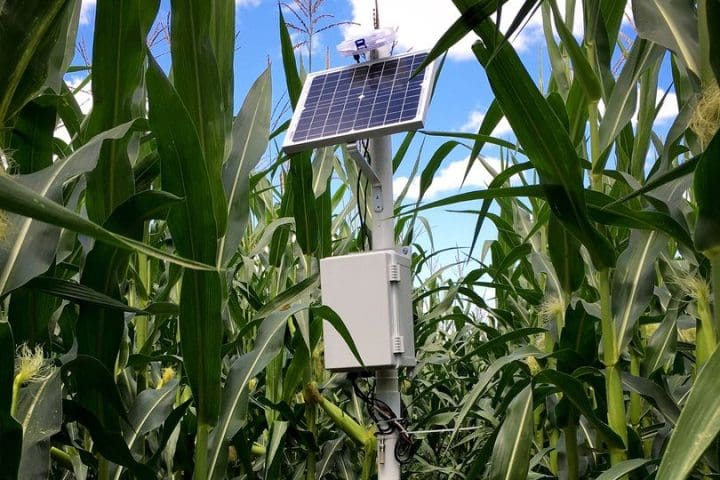
The microinverters will be connected with irrigation sensors via the Internet of Things — a system that promotes the exchange of data throughout a network — to increase efficiency of grid-connected irrigation.
“The cost of the solar panel and microinverter are continually decreasing,” Lee said. “The energy savings can be significant, and there are tax benefits to the solar panels as well. We think this could be a viable, cost-effective solution for many Michigan and Indiana farms and beyond.”
The first objective involves scaling up a working solar-powered microinverter prototype that has already been manufactured and tested in the lab. The system will be installed for a year-long test at MSU research farms.
For the second objective, in the project’s second and third years, on-farm research will be conducted at partner farms in Michigan and Indiana. Some fields will be fitted with solar-powered microinverters, while others will serve as controls without the technology.
Researchers will collaborate with utility companies in Michigan and Indiana to connect the microinverters to the grid, a process that will be assisted by Truman Surbrook, a professor in the MSU Department of Biosystems and Agricultural Engineering.
The team will evaluate energy-use efficiency and irrigation scheduling effectiveness of the system. They will also estimate cost savings from less overall and peak-time power usage. Using this information, a more refined prototype will be developed and tested in the third year of the project.
For the third objective, a decision support tool that considers in-field conditions, crop type, irrigation pump size and more will be created. Feedback from users will be continually collected, helping researchers optimize the system’s performance.
Finally, outreach will play a significant role, including presenting at conferences, conducting webinars, creating extension bulletins and fact sheets, and interacting directly with farmers.
“Along with farmers we’re working with directly, the industries and commodity groups will be important partners in this effort,” Dong said. “Sharing this information as widely as possible to encourage these practices that are cost-effective and accessible will help a variety of farmers and crop systems moving forward.”
The new project builds on previous work supported by the MSU Office of Research and Innovation’s Climate Change Research Support Program and the MSU Innovation Center’s Michigan Translational Research and Commercialization AgBio Starter and Full Awards.
This story originally appeared on the Agbioresearch website.

