Sid Choubey, an international student from India double-majoring in Journalism and Communication, shares her experience as a student journalist covering the 2024 election for the Detroit Free Press.
If you had told me a year ago that I’d be covering the 2024 elections, I would have scoffed at the idea. Politics was never something I was really interested in. It always seemed distant and unnecessarily complicated. But this year, I found that when you take the time to really comprehend it on a deeper level, politics, like so many other things in life, begins to make sense. If you approach it with curiosity and an open mind, you will realize that it is not as complicated as it appears.
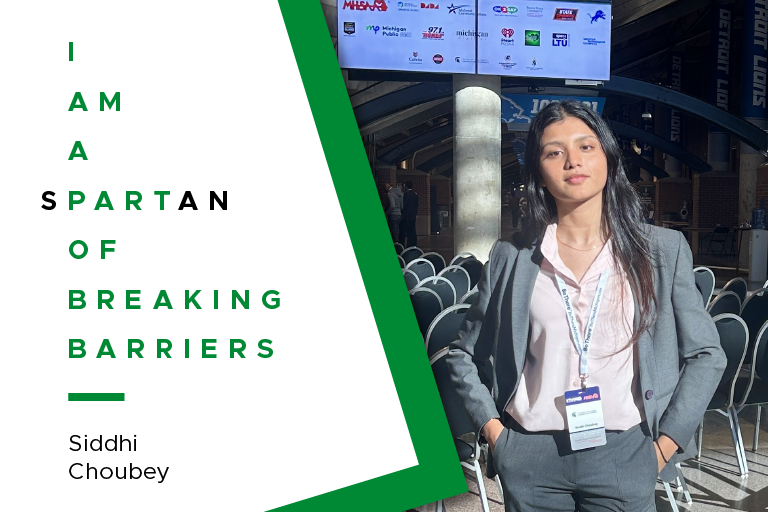
What really sparked my interest in taking on this assignment was a simple question: When will I ever get the opportunity to cover a presidential election as a student? The notion alone motivated me to volunteer to cover the elections for the Detroit Free Press. As an international student, I already work 20 hours a week, so I took this opportunity unpaid. Some may argue that getting “paid in experience” is a foolish concept, but in this case, “some” would be proven wrong.
I’ll admit that I was afraid at first. Yes, I am a journalism student, but reporting outside of East Lansing in a conservative suburban neighborhood was an entirely new experience for me. Speaking with farmers and small business owners — individuals I’d never met before — seemed intimidating. I was concerned about feeling disregarded or misunderstood, especially since I come from a very different environment than they do. I look and sound different, I may have different values, and I am from a different generation. The list of disparities seemed unending, and I wasn’t sure how I’d bridge the gap.
But before I knew it, I was sitting in a car with my co-journalist, Sonja, at 8 a.m., driving to Livingston County, Michigan. The nerves were still there but so was an increasing sense of excitement.
Coming to university for the first time is the closest thing I can compare to this feeling. Except in real life, outside the university bubble, instead of people welcoming you and wanting to help, many run the other way at the sight of a journalist. Rejection became a huge part of this experience. Many people refused to discuss their political opinions, which I completely understood. Politics can be extremely personal, and given the current atmosphere, it feels like a fight that has divided the nation.
At one point, I even began to anticipate that this trip would end up being boring, but what I didn’t realize was that...
It’s the people. The people made it easy to cover this difficult race. From both sides of the political spectrum, I met people who were terrified about the results and deeply worried about the future of the country they’ve dedicated years — sometimes their whole lives — to. My perspective was drastically altered after hearing about their struggles, anxieties, and disappointments.
Initially, I approached interviews as part of the job, something I was doing for my own learning. However, I became aware that I was no longer conducting interviews for myself as I heard more stories. I was doing interviews for people to read, to listen to them. To help share their voice. Politics was no longer about two diametrically opposed ideologies and points of view. It became, in my opinion, about everything that happens after the president is elected, including how it impacts people’s lives, communities, and futures.
Everything about the coverage felt easier after that. It was not because the work itself had changed, but rather because I had changed my perspective. Naturally, I still encountered challenges — rude and obnoxious people who didn’t respect me. Maybe it was because I was a woman, a young journalist, or an international student. Maybe they just didn’t like the questions I asked. At first, it stung. Every harsh remark and critical glance felt personal. But over time, I learned to tune it out. I realized their reactions said more about them than about me, and I stayed focused on what truly mattered — the stories I was there to tell.
It is simpler to navigate challenging situations if you remain committed to your story and keep your eyes on the ultimate goal. Maintaining objectivity wasn’t difficult for me. Yes, there were people with whom I disagreed, but I wasn’t there to argue with them; that wasn’t my job. It has never been.
Being objective feels like an inherent aspect of my identity as a journalist. However, I’ve also realized that bias is a natural element of being human and that everyone has it. The key is not letting that bias seep into your reporting. You have to consciously separate your personal feelings from the story you’re telling, ensuring that your work remains fair, accurate, and true to the people you’re covering.
This journey had two standout moments for me — well, actually more than two. But the ones that defined this experience were:
The day the Detroit Free Press published our first piece. The sight of our work printed was unreal. I realized that so many people, with views both similar to and different from mine, would be reading what we had written. But knowing that I could be someone’s voice was more important than agreement or disagreement. That our efforts could raise awareness of stories that might not otherwise be heard.
On Election Day, I began talking to people and capturing the atmosphere outside a voting center early in the morning with my co-journalist. We summarized what we heard and witnessed in a short story by election night. What struck me that day was the nervous energy — people from all walks of life, all with different beliefs and backgrounds, coming together because they care about the country and its future. It was chaotic and also inspiring. It reminded me of the strength of community and collaboration, especially in times of division.
A career in journalism is difficult, and not everyone is cut out for it. There are days when you confront difficult people, when you’re constantly discovering new things, and when you can’t come up with a story at all. You must rework every draft, walk a tightrope between bias and false sources, and occasionally, despite all of that work, you may still despise your piece. The salary is not the highest, and you may occasionally find yourself in dangerous situations. But when you commit to a bigger purpose — when you realize that if you don’t tell the world about a story, some people might never have a voice — everything changes. This career isn’t easy, but it’s worth it when you know you’re making an impact.
You report with intention, strive to do better every single day, and grow with every story you tell.
Today, I stand here, proud to say that at the age of 19, I covered the presidential election for the Detroit Free Press.
This story originally appeared on the College of Communication Arts and Sciences website.

