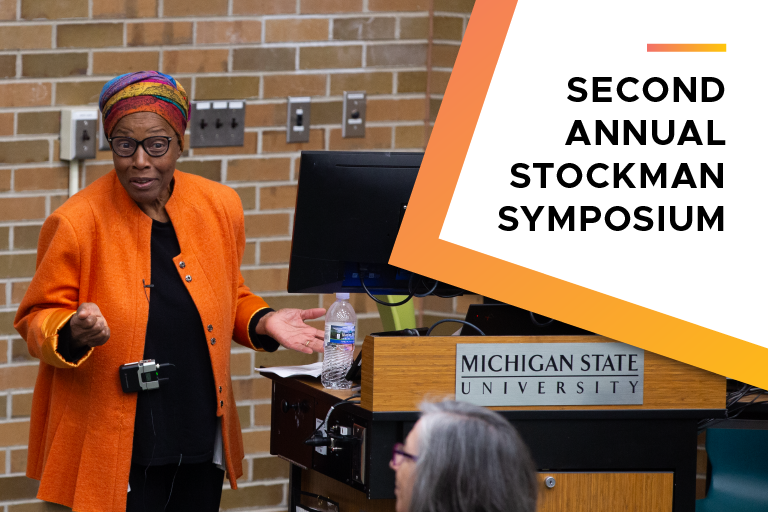
In November, the Department of Communicative Sciences and Disorders hosted the Second Annual Stockman Symposium. The event is named in honor of Ida Stockman, Ph.D., a professor emeritus of speech language pathology who dedicated nearly 25 years to teaching courses on communication disorders, human development, phonetics and especially multicultural issues within the department.
The theme of this year’s symposium was “Beyond Differences: Bilingualism and Dialect in Speech-Language.” The keynote address was given by Elizabeth Peña, Ph.D., a speech language pathologist and professor in the School of Education at the University of California-Irvine, and author of the Bilingual English-Spanish Assessment. Peña’s research focuses mainly on the differentiation between language impairment and language difference.
In her presentation, Peña spoke of the challenges facing bilingual children, with emphasis on those who speak Spanish and English. She noted that the field of speech language pathology has largely been influenced by IQ testing, starting in the early 20th century. Peña said in those early years, test results for people who didn’t speak English revealed “low abilities.”
“Nobody thought that maybe it had to do with them not knowing the language,” Peña said. “These consistent findings about low language performance in bilinguals led to statements about the negative effects of bilingualism. We see things like, bilingualism is a ‘social plague,’ or a hardship. I think these kinds of attitudes and perceptions still affect the kinds of interpretations we make about how kids are performing today.”
Over time, Peña said, school desegregation policies and the Bilingual Education Act of 1967 began to change how children are assessed in their primary language.
Peña began her career as a speech language pathologist in the Bay Area in 1984. At the time, she notes there were few methods to detect language impairment in bilingual children and little evidence to help guide professional intervention. Much of Peña’s work is devoted to studying what she says is a common childhood disorder: developmental language disorder.
“It’s often invisible,” Peña said. “It affects (things like) grammar, vocabulary, social skills, learning and memory. It’s not a thing that a child would have DLD in only one language and not in the other language. If they have normal learning capacity in one language but weaker in another, (it) may be because they don't have enough exposure or opportunities to practice in that language.”
Peña has conducted language tests with both English and Spanish primary speakers. In a 2018 study, she and a small team of researchers compared the performance of 100 bilingual children with language impairment with 500 typical bilingual children. Peña found those with impairments were not further delayed in their developmental process by dividing their focus across two languages. She said those findings should reassure parents who speak one language in the home as their children continue to learn a second language in school or other environments.
This year’s symposium also featured two panelists who shared their perspectives on bilingualism in the academic and healthcare spaces, Jessica Palumbo and Rosalind Davis, Ph.D.
Palumbo is a bilingual speech language pathologist in the Lansing School District. She reiterated Peña’s comments by affirming that bilingualism does not cause a delay in speech or language development.
“I’ll catch people actually saying that directly to the parent or the child and try to correct them politely,” Palumbo said. “If you're learning two languages from birth; if your brain is working like that from the beginning, it shouldn’t cause a delay at all…it should actually help your language development.”
Speech language pathologist Rosalind Davis, Ph.D. is a staff member of Detroit Medical Center. She’s also the current president of the Michigan Speech Language Hearing Association. She said interacting with patients with various medical conditions sometimes makes navigating the language barrier that much more difficult.
“I work in a pediatric hospital in the heart of Detroit where we have Arabic speaking patients, Spanish speaking patients, Black patients and English standard language (patients),” Davis said. “So, my role gets complicated really quickly, especially when our children come in with neurological insults (cause of an injury). Now I’m balancing the developmental language disorder on top of an acquired language disorder.”
In her conclusion, Peña said researchers must continue to develop tools that focus on the sources of language impairment and ensure their equitable use.
“We want to select measures that actually work to identify DLD in bilingual kids, and we have to find a way of making them accessible so that kids who come from minoritized backgrounds have access to the supports that they need to be successful. Bilingualism is a superpower.”
The Second Annual Stockman Symposium successfully brought together experts and practitioners to address the challenges and opportunities in bilingualism and speech-language pathology. The more than 200 in-person and online attendees left with a deeper understanding of the critical role research and equitable tools play in supporting bilingual children. Plans for the Third Annual Stockman Symposium are already underway, with more information to be shared next fall. Stay tuned for another enriching opportunity to engage with thought leaders in the field!
This story originally appeared on the ComArtSci website.

