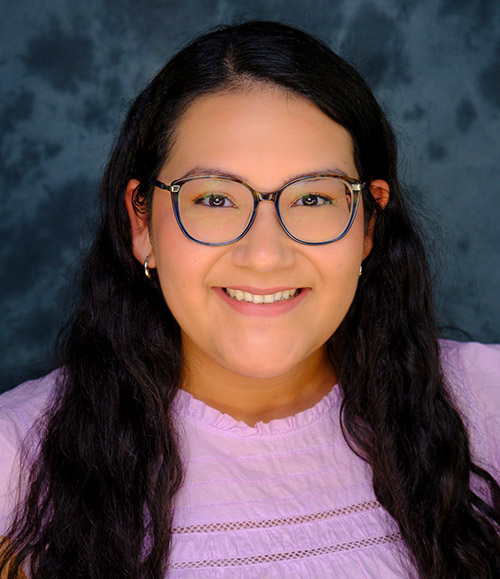
Jessica Saucedo is an ecological/community psychology graduate student in the MSU Department of Psychology whose research focuses on how cultural and language experiences support the well-being and development of three to five year-old Indigenous children. She applies Indigenous, community-engaged and strengths-based approaches to discover new ways to improve early childhood development and connect children and their families back to their culture.
Much of Saucedo’s work supports Indigenous children and families right here in Michigan. She is a Native Children’s Research Exchange Scholar through the Tribal Early Childhood Research Center, a collaborative effort between the University of Colorado, Michigan State University, and Johns Hopkins University that seeks to address the unique research needs of American Indian and Alaska Native Head Start and Early Head Start; Maternal, Infant, and Early Childhood Home Visiting; and child care programs. She also works extensively with Wiba Anung (meaning “early star” in Anishinaabemowin), a partnership between MSU researchers and the Inter-Tribal Council of Michigan, has been supported by the Michigan Health Endowment Fund, the Robert Wood Johnson Foundation, and the Administration for Children and Families.
Saucedo hails from Southern California and earned her undergraduate degree in psychology from Cal Poly Pomona. Since her youth, she has held an interest in her own as well as the collective Indigenous community’s relationship with the environment and culture. Her father is of Yaqui descent, and her mother Cora, two Mexican Indigenous tribes, but growing up, her family rarely talked about that area of their history, which further led Saucedo to want to understand her roots and culture and help others stay connected to their own cultures.
“That’s what led me to want to study at Michigan State,” she explained. “I wanted to learn more about myself and my family, community psychology and how it impacts large groups of people, and MSU had established the first community psychology program in the nation.”
Saucedo arrived on campus and was connected with Jessica Barnes-Najor, whom she credits as one of her greatest mentors at Michigan State and the person who first sparked her interest in early childhood education. Barnes-Najor is the Director for Community Partnerships in the Office for Public Engagement and Scholarship, and a developmental psychologist whose work greatly involves community-engaged research. She is also connected to the Tribal Early Childhood Research Center and Wiba Anung. This work is a multidisciplinary effort involving several departments and colleges at MSU in addition to community partners like the Inter-Tribal Council of Michigan.
Saucedo joined Wiba Anung and has taken her research in a similar direction.
“There’s not as much research around preschool age children, even though the three to five-year age is when kids really start watching other people and following what they do,” she said. “In Wiba Anung, we focus on how cultural and language experiences support the well-being and development of preschoolers. Our goal is to really show evidence that culture and language can support childhood and lifespan development.”
For various reasons, these children may have lost or become distanced from their Native cultures and languages connections, and Saucedo and Wiba Anung partner with Tribal Head Start centers and home visitation programs to create curriculum that centers around Anishinaabe culture. The lessons follow the 13 moons of the Anishinaabe calendar. Anishinaabe refers to the collective group of Indigenous peoples from the Great Lakes region.
“There are 13 sheets that we’ve created for the Michigan Tribal Home Visiting programs, one focused on each moon,” Saucedo said. “Lately, we’ve been working around food, healthy movement, foraging, growing … there’s so much intertwined in the [cultural] relationship with food and traditional food practices.”
The group of researchers worked with mothers, Elders, and food sovereignty activists to learn more about what food means to them, both in individual wellbeing and community health. They created a PhotoVoice project which combined art, pictures, and traditional recipes with explanations from the interviewees themselves on how it relates to their culture. With this, they also added lessons on culturally grounded healthy eating to a curriculum book known as Gikinawaabi in Tribal Home Visiting programs in Michigan. Tribal Head Start director Ann Cameron took note. “So now the team has been working to create lesson guides for teachers to implement the same kind of concepts, but within the classroom rather than at home,” Saucedo explained.
Saucedo stresses the importance of this work being done collaboratively, both within the community and alongside students and faculty at Michigan State. She credits her research partner Beedoskah Stonefish, a master’s student in Epidemiology at MSU, for her help in the creation of the Tribal Home Visiting programs. The positive angle to this community-centered work as well as the relationships she has formed have been two of Saucedo’s favorite parts about her experience.
“The heart of this work is the relationships established with people with so much wisdom and knowledge, who have so much to share,” she said. “I view myself as a liaison translating that knowledge for different age groups. I also really like that everything we do is strengths-based. We highlight not the deficits, but what communities have already been doing for so long to survive and thrive.”
Another project Saucedo recently contributed to was a display at the MSU Museum as part of an exhibition titled ‘Food Fight!,” which centers around the social, environmental, political and economic relationships humans have with food. They worked with a native artist, Eva Oldman, to translate their work to a visual medium.
“I think it was a great way to spread the word and to see MSU supporting our team and our work,” she said.
“I’m so glad I can be a part of sharing the constant narrative that Native people are still here. It’s a good reminder that Native and Indigenous people aren’t something of the past. We are present, we are here, and this is just the beginning.”
This story originally appeared on the Department of Psychology website.

