A Michigan State University researcher’s new model for studying breast cancer could help scientists better understand why and where cancer metastasizes.
Professor Eran Andrechek who teaches in the MSU Department of Physiology, has been researching the E2F5 gene, of which little is known, and its role in the development of breast cancer. Based on findings from Andrechek’s lab, the loss of E2F5 results in altered regulation of Cyclin D1, a protein linked to metastatic breast tumors after long latency.
The study also demonstrates that the removal of E2F5 in the mammary gland leads to tumor formation. As scientists better understand how genes impact breast cancer, they could also learn why cancers metastasize and where cancers are likely to spread.
The research was published in one of the most recent issues of Oncogene, a leading cancer journal. Andrechek also received a two-year $300,000 American Cancer Society grant to support the next phase of his work.
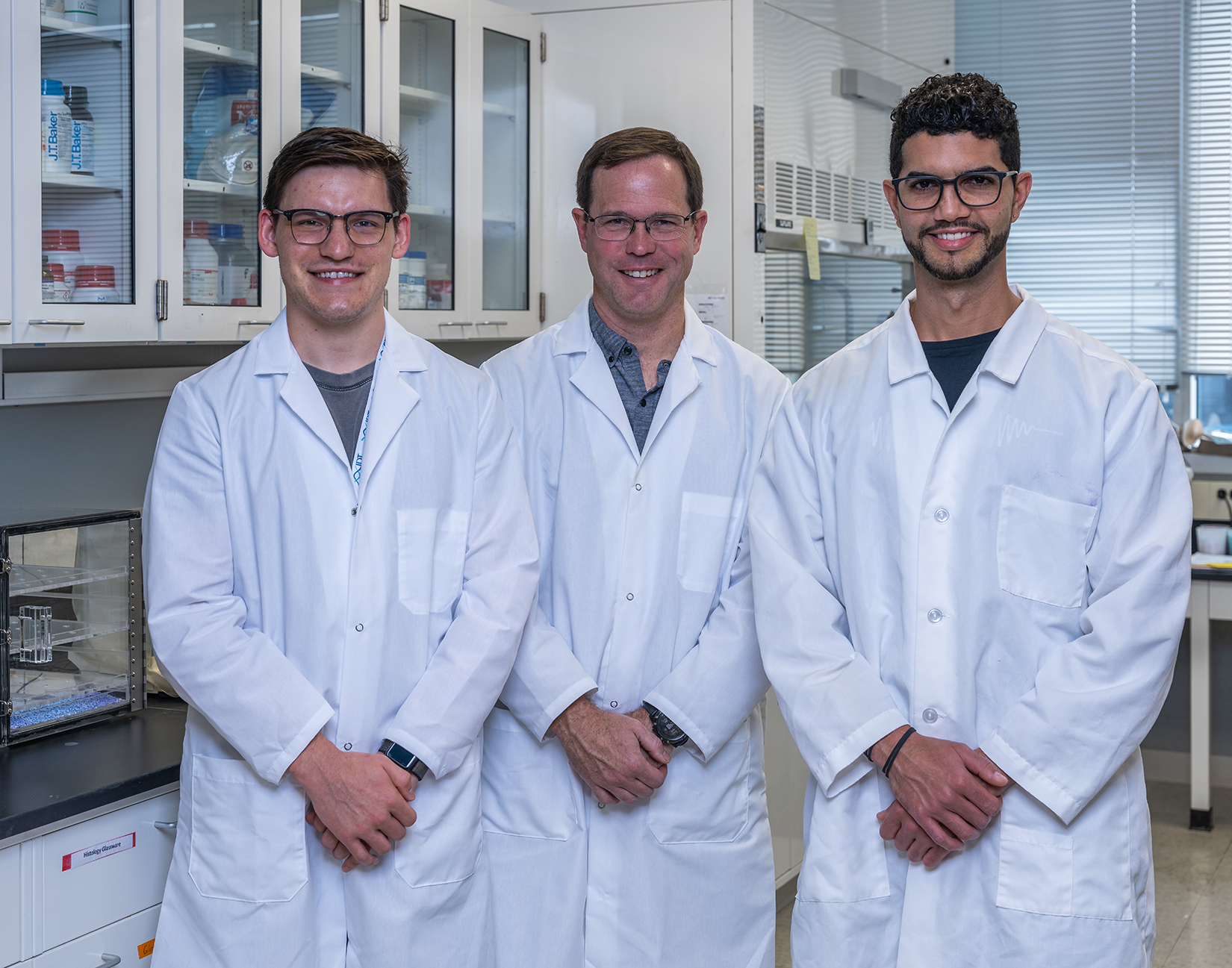
In addition, the lead graduate student on the breast cancer metastasis research project, Jesus Garcia Lerena, won a fellowship through the Susan G. Komen ASPIRE grant program earlier this year. ASPIRE, or A Supplement to Promote Inclusion for Research Excellence, supports research trainees from historically underrepresented communities. Lerena, who is from Cuba, joined the Andrechek lab in 2022.
According to Andrechek, while a genetically engineered mouse model can be artificially tweaked through injection to force cancer cells to go to organs like the liver or brain, his lab’s newly generated mouse model makes that unnecessary.
“One of the reasons that we’re really excited about this model is that it does something that most genetically engineered mouse models have not done in the past,” Andrechek said. “It’s metastasizing and, when it spreads, it’s going to places that human breast cancer goes to. Most models of breast cancer go straight to the lungs, but that’s not where most human breast cancer goes. And so, we’re really excited about this model because it’s going to other places and making it more relevant to look at human cancer.”
According to Andrechek, breast cancer most often spreads to the lymph nodes, bones or liver.
Zeroing in on hundreds of genes
Andrechek’s lab uses bioinformatics (using computer technology to capture and interpret biological data) along with genetic models to examine the mechanisms involved in the development and progression of breast cancer. Its research centers on understanding mammary tumor development and uses several methods ranging from animal models to computational analysis of gene expression data.
For several years, Andrechek and his team have specifically zeroed in on the E2F family, a particular group of genes that control cell cycle progression. E2F5 is a transcription factor, which means that it regulates the expression — whether on or off — of many other genes.
Trying to pinpoint exactly which genes induce breast cancer and drive metastasis is what Andrechek’s lab will focus on during its next phase of research.
“We don’t think it’s E2F5 that is directly causing these effects,” Andrechek explained. “We think it’s some of the genes that it regulates that cause these effects. We’re seeing hundreds of genes. So, the part that gets tricky is to dissect out exactly which ones are causing the effects.”
From ‘knockout’ models to targeted therapies
For the research, the lab uses a laboratory mouse in which one or more genes have been turned off or “knocked out” to study the role of specific genes. Mice models are highly accurate, Andrechek said, because the same sort of mutations occur in mice as in human cancer.
While breast cancer can happen at any age, most women are in their 60s or 70s when they are first diagnosed with the disease. Andrechek’s research is physiologically relevant since it takes about two years for the mice in Andrechek’s study to develop a tumor, which means the mice are getting breast cancer at an equivalent age as women.
However, breast cancer is not just one disease. According to Andrechek, there are many different subtypes of breast cancer, depending on factors like whether the tumor is estrogen positive or negative, progesterone positive or negative, and various forms of gene expression.
Once scientists know the genetic programs that are off or on in a specific tumor, they can start to develop targeted therapies with fewer side effects.
“We are nowhere close with this model to developing a targeted therapy,” Andrechek said. “That is years down the road. But if we can start to understand the genetics behind this and find a similar subtype in humans, then we can start tailoring therapy. Because what we don’t want to do is just rely on traditional chemotherapy. The side effects that people suffer from are terrible. Understanding the genetics behind how a breast cancer is developing holds a lot of promise for developing therapies that are less toxic.”

