Jump to HeaderJump to Main ContentJump to Footer
Michigan State University
MSUToday
  • For Media
  • Experts
  • Releases and Statements
  • Sign Up
  • Update Information
MSUTODAY
  • Browse Stories By

    Topics

    Explore stories by subject area

    • Arts and Culture
    • Business and Economy
    • Climate and Environment
    • Education and Learning
    • Engineering, Science and Technology
    • Government and Society
    • Health and Medicine
    • Media and Communications
    • MSU Leadership and Impact
    • Sports and Recreation
    • Student and Campus Experience
    View All Stories

    Collections

    Curated story series

    • Alumni stories
    • Turfgrass
    • Ask the Expert
    • Big Ideas
    • Climate solutions
    • Water at MSU
    • Mobility
    • Spartan Perspectives
    • Student views
    • Graduate voices
    • Faculty voices
    View All Collections

    Featured

    Editor's picks

    • MSU earns top 100 ranking by Times Higher Education

      Oct. 12, 2026

      MSU earns top 100 ranking by Times Higher Education

    • New spaces, new opportunities at MSU 

      Oct. 14, 2026

      New spaces, new opportunities at MSU 

MSUTODAY
  • Browse Stories By

< Browse Stories By

Topics

Explore stories by subject area

  • Arts and Culture
  • Business and Economy
  • Climate and Environment
  • Education and Learning
  • Engineering, Science and Technology
  • Government and Society
  • Health and Medicine
  • Media and Communications
  • MSU Leadership and Impact
  • Sports and Recreation
  • Student and Campus Experience
  • View All Stories

Collections

Curated story series

  • Alumni stories
  • Turfgrass
  • Ask the Expert
  • Big Ideas
  • Climate solutions
  • Water at MSU
  • Mobility
  • Spartan Perspectives
  • Student views
  • Graduate voices
  • Faculty voices
  • View All Collections

Featured

Editor's picks

  • MSU earns top 100 ranking by Times Higher Education

    Oct. 12, 2026

    MSU earns top 100 ranking by Times Higher Education

  • New spaces, new opportunities at MSU 

    Oct. 14, 2026

    New spaces, new opportunities at MSU 

  • For Media
  • Experts
  • Releases and Statements
  • Sign Up
  • Update Information

Natural Sciences

Nov. 22, 2024

SHARE

Diamonds and anvils: MSU, UM use high-pressure chemistry in search for quantum materials

By: Connor Yeck

Michigan State University chemist Weiwei Xie knows a thing or two about working under pressure. Leveraging extreme forces similar to those found deep within our planet, her lab is pioneering the discovery of novel quantum materials with exciting electronic and magnetic properties.

Now, with the help of a collaborative grant from the National Science Foundation, Xie will continue to push the boundaries of high-pressure science with partners from MSU and the University of Michigan.
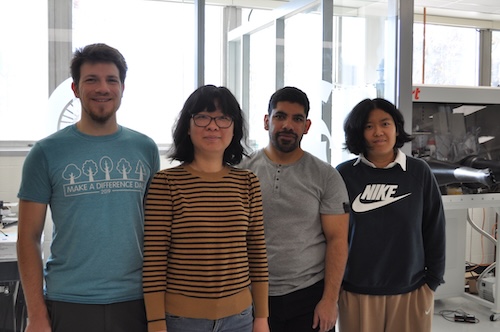
The Xie Group at Michigan State University explores novel quantum materials through chemistry perspectives, examining phenomena such as phase transitions, magnetism, and superconductivity.   Credit: Connor Yeck
The Xie Group at Michigan State University explores novel quantum materials through chemistry perspectives, examining phenomena such as phase transitions, magnetism, and superconductivity. Credit: Connor Yeck

Working alongside Susannah Dorfman, associate professor in MSU’s Department of Earth and Environmental Sciences, and Jie “Jackie” Li, professor of Earth and Environmental Sciences at the University of Michigan, the team will focus its efforts on iridium oxide — a highly stable compound with excellent electrical conductivity.

By applying intense heat and pressure to these promising chemical compounds and studying changes to their physical properties, the project will contribute to the search for next-generation quantum materials and, in particular, high-temperature superconductors. 

“There are many unique chemical properties we simply can’t glimpse under regular conditions,” Xie said, who’s an associate professor in the College of Natural Science’s Department of Chemistry.

“If you want to clearly see how electrons behave, sometimes you might need to give them a little push,” Xie added, referencing the crushing forces that can alter a substance’s chemical bonds, crystal structure and magnetism.

The grant will also work to establish hands-on workshops and a visiting scholar series at both MSU and UM, with the goal of introducing researchers to these unique methods of chemistry.

“High-pressure chemistry can be very tricky to work on, and it can take a long time to get into the field,” Xie said. “I think it’s great to open your mind, meet new people and form connections.”

“This is a great group of strong women scientists,” Dorfman added. “Being able to share our equipment and knowledge between the three labs has been great synergy.”

Diamonds and anvils
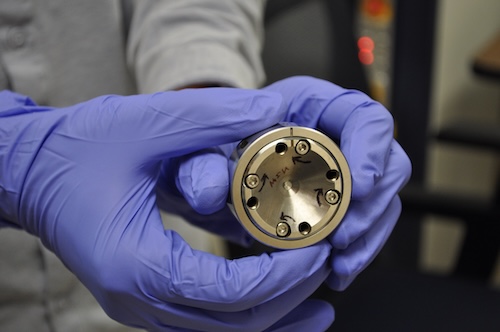
Xie Group graduate student Haozhe Wang holds a diamond anvil cell, or DAC. Using two perfectly matched diamonds, the high-pressure instrument allows researchers to exert immense force on their chosen sample. Credit: Connor Yeck

When talking about high-pressure chemistry, a “little push” is anything but.

To gauge the immense forces at play, researchers work at the scale of a gigapascal, or GPa.

To put it in perspective, we experience a single atmosphere of pressure at sea level, while at the deepest point on the Earth’s surface — the Mariana Trench — you’d find around 1,000.

One GPa is equivalent to roughly 10,000 atmospheres, with experiments often applying dozens of GPas at a time.

The exact analytical method that Xie and her colleagues are using to investigate iridium oxides is known as high-pressure X-ray diffraction, which uses an instrument called a diamond anvil cell, or DAC.

“Sometimes, the material you’re working with is harder than the instrument that’s adding pressure,” Xie explained, “So, we use the hardest material around.”

Wedged between two perfectly matched diamonds, a sample is squeezed, and at the same instant struck by a beam of X-rays. Upon interacting with the sample, these X-rays produce a unique diffraction pattern that can be studied by researchers to get a glimpse of a sample’s atomic structure. As pressure increases and the properties of a sample change, so do the diffraction patterns.

To push their experiments even further, the team is also adding external heating through what’s known as a multi-anvil process, which greatly amplifies the overall force applied to a substance. By controlling these extreme conditions, the researchers can better pinpoint how and when a sample undergoes certain changes, which is critical for synthesizing larger amounts of quantum materials.

“There’s good reason why we use the DAC for the X-ray diffraction part of this study,” Dorfman explained. “It’s so small — smaller than a coffee cup. You can fit them inside the excellent diffractometer Weiwei brought to MSU, and you can see through diamonds, so you have a window into the experiment while it happens.”

To the edge of the universe
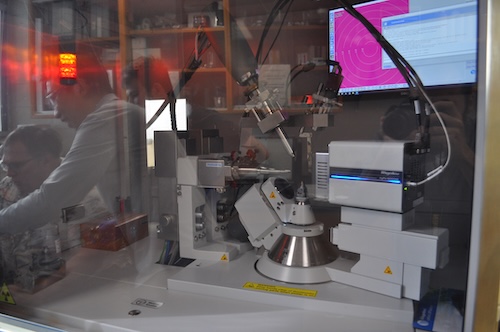
 At Michigan State’s Center for Crystallographic Research, the team will study diffraction patterns produced by iridium oxides under intense pressure and heat, research that will contribute to search for high temperature superconductors. Credit:  Connor Yeck
At Michigan State’s Center for Crystallographic Research, the team will study diffraction patterns produced by iridium oxides under intense pressure and heat, research that will contribute to search for high temperature superconductors Credit: Connor Yeck

Working with iridium oxides, Xie and her team are ultimately on the hunt for critical breakthroughs related to high-temperature superconductivity.

Superconductors are materials that electricity can travel through without losing energy, but typically require extremely low temperatures to function.

“Iridium oxides are similar to compounds known as cuprates, which are currently the highest-temperature superconductors known,” Xie said.

“We’re trying to understand: Why isn’t iridium oxide a superconductor, and can we make it into one?”

The discovery of a true high-temperature superconductor would have monumental implications, from lossless electrical grids to enhanced MRIs and particle accelerators.

“If the current level of superconductors is comparable to our exploration of the solar system, a high-temperature superconductor would take us to the edge of the galaxy,” Xie offered.

As part of these efforts, the team is developing new outreach opportunities to expand and educate those interested in high-pressure chemistry. These will include workshops for graduate students to get hands-on experience with high-pressure experimentation, as well as a visiting scholar series aimed at post-tenure professors.

Xie sees these outreach opportunities as a chance to strengthen the community of high-pressure chemists and provide a glimpse into a unique field of study that might be difficult to enter.

“I’ve learned so much from geologists, engineers and others — people who have a different way of thinking,” Xie said. “Here’s a chance to learn new techniques and exchange our research experiences.”


MEDIA CONTACTS

Emilie Lorditch, Bethany Mauger
Natural SciencesEngineering, Science and TechnologyEngineering, Science and TechnologyEngineering, Science and Technology

MSUToday Weekly Update

The MSUToday Weekly Update email showcases how Spartans are making a difference through academic excellence, research impact and community outreach. Get inspired by these stories of innovation, collaboration and determination. Plus, enjoy photos and videos of campus and more MSU content to help keep you connected to the Spartan community.

Sign UpUpdate My Information

Connect With Us

Visit our Facebook pageVisit our page on XVisit our Instagram pageVisit our LinkedIn pageVisit our YouTube pageVisit our TikTok page

Resources

  • A to Z Index
  • Find People
  • Maps
  • Email
  • Student Information System (SIS)
  • D2L
  • Libraries
  • Tech Support
  • MSU Misconduct Hotline
  • Social Media Directory
  • Events Calendar
  • For Media

Health and Safety

  • MSU Police and Public Safety
  • Olin Health Center
  • Counseling & Psychiatric Services (CAPS)
  • University Health and Wellbeing
  • MSU Health Care
  • Civil Rights and Title IX
  • Our Commitment
  • Center for Survivors
  • Security & Fire Safety Report
  • University Policy on Relationship Violence and Sexual Misconduct
  • Notice of Non-Discrimination, Anti-Harassment and Non-Retaliation
  • Health Care Non-Discrimination Notice

Support Services

  • Disability Resources
  • Supportive Services
  • Learning Resources

Working at MSU

  • Human Resources
  • EBS Login
  • Job Postings
  • Employee Assistance Program

Reports

  • CARES Act Funding
  • Student Achievement and Outcomes

Contact us

517-355-1855

Address

Michigan State University 426 Auditorium Road East Lansing, MI 48824

Follow Us

  • Visit our Facebook page
  • Visit our page on X
  • Visit our Instagram page
  • Visit our TikTok page
  • Visit our LinkedIn page
  • Visit our YouTube page

If you're having accessibility issues, please let us know.

Know More: Campus Safety Information and ResourcesTransparency Reporting: Budget & Salary/Compensation
  • Contact Information|
  • Site Map|
  • Privacy Statement|
  • Site Accessibility|
  • Call MSU: (517) 355-1855|
  • Visit: msu.edu|
  • Notice of Nondiscrimination|

SPARTANS WILL|© Michigan State University|

Latest News