Young, healthy adults who are good at remembering things are good at gluing events together in their memory based on how close they happen in time. When they search their memory, they can efficiently associate memories nearby in their mental timeline to improve their recall. This type of memory, known as episodic memory, is the research focus of Karl Healey, director of the Computational Basis of Cognitive Control, or CBCC, lab in Michigan State University’s Department of Psychology.
“My research focuses on human episodic memory,” explained Healey. “And what that means is we just try to understand how people form memories of the different events or episodes that happen to them — how they form, essentially, a mental timeline of what has happened in their lives.”
Humans have known for thousands of years that memory is based on associations. Temporal proximity, or how close things happen together in time, can create associations even when there is no meaning-based connection. Healey uses the example of going from a serious, boring work meeting to a fun, exciting birthday party after work. The only connection between these events might be temporal proximity, which is enough for the memory system to bind them together.
“We find that that is a really important driver of successful, good memory,” explained Healey. “If you can form those associations and use those associations, you're probably going to have a pretty good memory.”
Experimental Setup and Results

To study episodic memory, the CBCC lab brings research participants into the lab to experience simulated events. The participants are shown a series of images and later asked to recall everything they saw.
While their memory is being tested, the researchers record electrical signals from the surface of the participant’s scalp using an EEG system. These signals show neural patterns when participants remember or forget something. Finally, the researchers use computer models based on mathematical algorithms to understand the neural computations happening in the brain when something is remembered or forgotten.
“It turns out that the memory system really likes to bind together things that happen close together in time, even if they're not related in any other way,” said Healey. “So, if you're recording EEG while people experience different events, the EEG signals of things that are close together in time are more similar than the EEG signals of things that are further apart in time.”
When Episodic Memory Goes Wrong and How to Improve It
As humans age, degraded episodic memory is a significant variable impacting our ability to remember things. In other words, humans get worse at using their mental timeline to guide their memory search. Healey’s work has identified a similar deficit in individuals with ADHD, and he is currently investigating whether this is also true for individuals with autism spectrum traits.
“Going forward, we're really interested in pushing the boundaries of this and, for example, applying it to things like Alzheimer's disease to try to better understand that deep level of neural computational processes,” said Healey. “What exactly is going wrong with the memory system in these conditions that lead to poor memory?”
Healey, along with colleagues and collaborators, identified two key areas where breakdowns can affect episodic memory, which are also the two areas to focus on when working to improve episodic memory.
“The big one is a little boring,” admitted Healey. “It is: pay a lot of attention. The more you're paying attention to something that you're trying to remember, the more distinct that neural pattern of EEG activity is likely to be. And that can help you reinstate it a little bit more clearly. Attention is a major factor. It's hard to remember something if you're not paying close attention in the beginning.”
The second key factor in episodic memory becomes relevant when trying to recall a memory. Vividly reinstating the original experience can recreate the pattern of neural activity that represents the original event. For example, if you are trying to remember a day at the beach, think about the sights, sounds, emotions, temperature, and other factors involved in the original experience because those are represented by neural patterns. Vivid reinstatement can help to improve memory retrieval.
High-Performance Computing in Psychology
While the principles of high-performance computing, or HPC, are integral in some fields of study, it is still relatively unusual to use HPC in the field of psychology. Healey felt pulled in different directions when he chose his field of study in college.
“I was very interested in computers,” said Healey. “I liked to make my own web pages. I ran my own dial-up bulletin board system way back in the day. But I was also really interested in psychiatry, so I was torn between these two areas. I decided to go towards the psychology direction, but I was always still interested in the more computational, mathematical side. I loved my statistics classes. Everybody else hated the statistics classes in grad school.”
After an intensive postdoc in computational neuroscience, Healey knew he found his niche. However, since computer science is not traditionally emphasized in psychology programs, he faced challenges. For one, it could be difficult to communicate his work to colleagues who were unfamiliar with the jargon associated with HPC. In addition, psychology departments were often not set up with resources for HPC research.
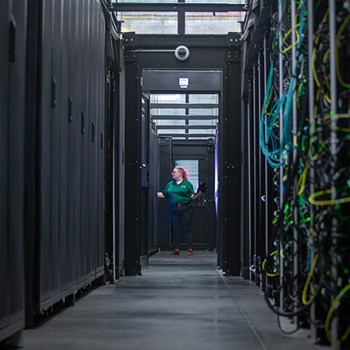
“One of the great things about MSU and the Institute for Cyber-Enabled Research in particular is that it gives HPC access to everybody on campus,” said Healey. “It really reduces the difficulty of getting into this type of research. We rely on ICER for many aspects of this work. The neural signals take up a lot of physical storage space, and the types of mathematical operations we carry out on those signals are complicated. ICER’s resources allow us to do those operations more quickly.
“The really big thing we use ICER for is the computational models. Trying to fit these models to human behavior uses a lot of parameters, which can be thought of as dials. The dials need to be perfectly tuned for each person, and that takes a lot of computational resources. The HPC facilities allow us to do that in a way that takes a day instead of a year.”
This story was originally posted on the Institute for Cyber-Enabled Research website.

