Jump to HeaderJump to Main ContentJump to Footer
Michigan State University
  • Browse Stories By

    Topics

    Explore stories by subject area

    • Arts and Culture
    • Business and Economy
    • Climate and Environment
    • Education and Learning
    • Engineering, Science and Technology
    • Government and Society
    • Health and Medicine
    • Media and Communications
    • MSU Leadership and Impact
    • Sports and Recreation
    • Student and Campus Experience
    View All Stories

    Collections

    Curated story series

    • Turfgrass
    • Ask the Expert
    • Big Ideas
    • Climate solutions
    • Water at MSU
    • Mobility
    • Spartan Perspectives
    • Student views
    • Graduate voices
    • Faculty voices
    View All Collections

    Featured

    Editor's picks

    • The Spartans behind your favorite Michigan golf courses

      July 22, 2026

      The Spartans behind your favorite Michigan golf courses

    • MSU in the 1990s: 10 Spartan milestones

      July 14, 2026

      MSU in the 1990s: 10 Spartan milestones

MSUTODAY
  • Browse Stories By

< Browse Stories By

Topics

Explore stories by subject area

  • Arts and Culture
  • Business and Economy
  • Climate and Environment
  • Education and Learning
  • Engineering, Science and Technology
  • Government and Society
  • Health and Medicine
  • Media and Communications
  • MSU Leadership and Impact
  • Sports and Recreation
  • Student and Campus Experience
  • View All Stories

Collections

Curated story series

  • Turfgrass
  • Ask the Expert
  • Big Ideas
  • Climate solutions
  • Water at MSU
  • Mobility
  • Spartan Perspectives
  • Student views
  • Graduate voices
  • Faculty voices
  • View All Collections

Featured

Editor's picks

  • The Spartans behind your favorite Michigan golf courses

    July 22, 2026

    The Spartans behind your favorite Michigan golf courses

  • MSU in the 1990s: 10 Spartan milestones

    July 14, 2026

    MSU in the 1990s: 10 Spartan milestones

  • For Media
  • Experts
  • Releases and Statements
  • Sign Up
  • Update Information

Resources

  • A to Z Index
  • Find People
  • Maps
  • Email
  • Student Information System (SIS)
  • D2L
  • Libraries
  • Tech Support
  • MSU Misconduct Hotline
  • Social Media Directory
  • Events Calendar
  • For Media
Michigan State University
MSUToday
  • For Media
  • Experts
  • Releases and Statements
  • Sign Up
  • Update Information
MSUTODAY
MSU Economic Impact

Oct. 23, 2024

MSU research: Warming lakes and rivers may spread fish pathogens

Michigan’s rivers and lakes were once cold enough that fish were protected from some infection-causing parasites. As the Great Lakes ecosystem warms, a Michigan State University researcher is investigating new pathogens that may become relevant to the fish that live here.
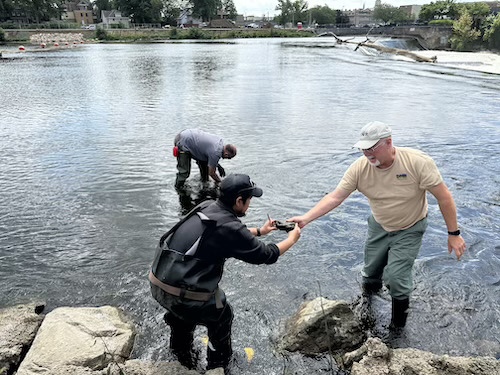
Michigan State University Assistant Professor Bartolomeo Gorgoglione and Cahya Fusianto search for brozoans with Dave Meuninck of the Indiana Department of Natural Resources in the St. Joseph River in Mishawaka, Ind. (Photo provided by Bartolomeo Gorgoglione)

Bartolomeo Gorgoglione, MSU assistant professor leading the Fish Pathobiology and Immunology Laboratory, or FPIL, found new evidence of Tetracapsuloides bryosalmonae occurring in at least three Great Lakes and several rivers throughout the Great Lakes region. This parasite is listed as an “Emergency Pathogen” by the Great Lakes Fish Health Committee and as a reportable pathogen in Michigan and surrounding states. This is because it is known to cause proliferative kidney disease in salmonid fish species. While causing no risk to humans, it has been known to heavily impact farmed and wild fish in Europe and in the western United States. To date, however, no proliferative kidney disease-related fish mortality has ever been documented in the Great Lakes area.

Warming water temperatures due to climate change have created an environment where the parasite is able to reproduce faster, Gorgoglione said. What that means for fish still needs to be studied. It’s possible the infected fish could release infectious malacospores into the water without developing proliferative kidney disease as a tolerant fish host. For now, Gorgoglione is helping the Michigan Department of Natural Resources, or DNR, identify which fish stock is infected and which rivers are free of the parasite, so they can prioritize where their farmed fish may be stocked.

“This is something completely new,” Gorgoglione said. “We don’t precisely know what it may mean for salmonid hosts in the Great Lakes and if they may be able to complete the parasite life cycle naturally and without suffering from disease, or if they will develop the disease and eventually die or become easier prey.”

T. bryosalmonae is a unique fish pathogen because it can’t be spread directly from fish to fish. Instead, it must first infect an aquatic invertebrate called Bryozoa, microscopic aquatic invertebrates that live in colonies and are also known as “moss animals.” Bryozoans then release spores that infect salmonid fish, which may release another type of spore to complete the parasite life cycle. It’s a seasonal parasite that mostly spreads during summer months when water temperatures are warmer.

Gorgoglione previously studied this parasite in Europe, working on trout immune response to proliferative kidney disease in Scotland and discovering its presence in Austria. He also confirmed its presence in Pacific salmon in Alaska. In recent years, the pathogen has caused fish mortality outbreaks in the western United States, including in 2016, when T. bryosalmonae was blamed for a massive fish kill in Montana’s Yellowstone River, leaving thousands of mountain whitefish dead.
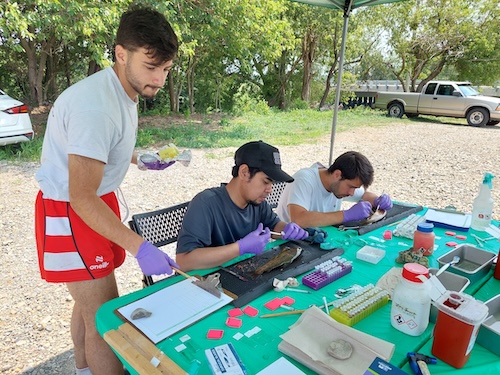
Cahya Fusianto and two visiting veterinary students from Toulouse, France – Baptise Esterez and Axel Valentini – from Michigan State University’s Fish Pathobiology and Immunology Laboratory (FPIL) takes samples from Ohio’s Mad River in partneship with the Ohio Department of Natural Resources. (Photo provided by Bartolomeo Gorgoglione)

This summer, Gorgoglione and his team set out to see if the parasite was infecting wild salmonids in the northern part of Lake Michigan. They boarded the DNR Steelhead research vessels at Charlevoix and sampled lake trout during DNR fish population surveys. They also walked in rivers and lakes around the region, sampling fish and turning over rocks and logs looking for bryozoans.

In some cases, they found bryozoan colonies attached to various material discarded in rivers, such as inside beer bottles. They also found that these invertebrates often share substrates in rivers and lakes with the highly invasive zebra and quagga mussels and have been found growing on top of their shells.

“From a scientific point of view, it’s really exciting,” Gorgoglione said. “There’s no evidence in scientific literature about the involvement of mussels in the T. bryosalmonae life cycle, so it opens up many new questions.”

So far, most of the fish Gorgoglione has tested are asymptomatic and don’t show signs of proliferative kidney disease. He believes it’s possible that fish bred in hatcheries can be essentially immunized against developing proliferative kidney disease from the parasite. Fish in the hatcheries are exposed to T. bryosalmonae when they’re kept in river water, but because the water temperature is low and they are well fed, they don’t develop the disease and they’re able to develop antibodies to fight the parasite.

There’s still more to be studied and more work to be done. Gorgoglione is using the data to warn the DNR of hot spots and areas that may be infected. He also wants to recreate adequate conditions in his lab to study the life cycle of T. bryosalmonae and monitor its effects, which would be a first in the United States. However, the project scope is costly and difficult since it involves adapting his lab conditions and maintenance to accommodate both salmonids and bryozoans. But a study of this magnitude would enable FPIL scientists to provide answers about the tolerance or susceptibility of Great Lakes fish stocks. Gorgoglione says he’s currently seeking grant funding to move forward on this research to help the DNR and to prevent future fish loss caused by warming temperatures.


MSU Economic ImpactMSU Leadership and ImpactAgricultural Sciences and FarmingClimate and EnvironmentClimate and Environment

Collection

more content from this collection

Climate Solutions

Latest News

MSUToday Weekly Update

The MSUToday Weekly Update email showcases how Spartans are making a difference through academic excellence, research impact and community outreach. Get inspired by these stories of innovation, collaboration and determination. Plus, enjoy photos and videos of campus and more MSU content to help keep you connected to the Spartan community.

Sign UpUpdate My Information

Connect With Us

Visit our Facebook pageVisit our page on XVisit our Instagram pageVisit our LinkedIn pageVisit our YouTube pageVisit our TikTok page

Health and Safety

  • MSU Police and Public Safety
  • Olin Health Center
  • Counseling & Psychiatric Services (CAPS)
  • University Health and Wellbeing
  • MSU Health Care
  • Civil Rights and Title IX
  • Our Commitment
  • Center for Survivors
  • Security & Fire Safety Report
  • University Policy on Relationship Violence and Sexual Misconduct
  • Notice of Non-Discrimination, Anti-Harassment and Non-Retaliation
  • Health Care Non-Discrimination Notice

Support Services

  • Disability Resources
  • Supportive Services
  • Learning Resources

Working at MSU

  • Human Resources
  • EBS Login
  • Job Postings
  • Employee Assistance Program

Reports

  • CARES Act Funding
  • Student Achievement and Outcomes

Contact us

517-355-1855

Address

Michigan State University 426 Auditorium Road East Lansing, MI 48824

Follow Us

  • Visit our Facebook page
  • Visit our page on X
  • Visit our Instagram page
  • Visit our TikTok page
  • Visit our LinkedIn page
  • Visit our YouTube page

If you're having accessibility issues, please let us know.

Know More: Campus Safety Information and ResourcesTransparency Reporting: Budget & Salary/Compensation
  • Contact Information|
  • Site Map|
  • Privacy Statement|
  • Site Accessibility|
  • Call MSU: (517) 355-1855|
  • Visit: msu.edu|
  • Notice of Nondiscrimination|

SPARTANS WILL|© Michigan State University|