Jump to HeaderJump to Main ContentJump to Footer
Michigan State University
  • Browse Stories By

    Topics

    Explore stories by subject area

    • Arts and Culture
    • Business and Economy
    • Climate and Environment
    • Education and Learning
    • Engineering, Science and Technology
    • Government and Society
    • Health and Medicine
    • Media and Communications
    • MSU Leadership and Impact
    • Sports and Recreation
    • Student and Campus Experience
    View All Stories

    Collections

    Curated story series

    • Turfgrass
    • Ask the Expert
    • Big Ideas
    • Climate solutions
    • Water at MSU
    • Mobility
    • Spartan Perspectives
    • Student views
    • Graduate voices
    • Faculty voices
    View All Collections

    Featured

    Editor's picks

    • The Spartans behind your favorite Michigan golf courses

      July 22, 2026

      The Spartans behind your favorite Michigan golf courses

    • MSU in the 1990s: 10 Spartan milestones

      July 14, 2026

      MSU in the 1990s: 10 Spartan milestones

MSUTODAY
  • Browse Stories By

< Browse Stories By

Topics

Explore stories by subject area

  • Arts and Culture
  • Business and Economy
  • Climate and Environment
  • Education and Learning
  • Engineering, Science and Technology
  • Government and Society
  • Health and Medicine
  • Media and Communications
  • MSU Leadership and Impact
  • Sports and Recreation
  • Student and Campus Experience
  • View All Stories

Collections

Curated story series

  • Turfgrass
  • Ask the Expert
  • Big Ideas
  • Climate solutions
  • Water at MSU
  • Mobility
  • Spartan Perspectives
  • Student views
  • Graduate voices
  • Faculty voices
  • View All Collections

Featured

Editor's picks

  • The Spartans behind your favorite Michigan golf courses

    July 22, 2026

    The Spartans behind your favorite Michigan golf courses

  • MSU in the 1990s: 10 Spartan milestones

    July 14, 2026

    MSU in the 1990s: 10 Spartan milestones

  • For Media
  • Experts
  • Releases and Statements
  • Sign Up
  • Update Information

Resources

  • A to Z Index
  • Find People
  • Maps
  • Email
  • Student Information System (SIS)
  • D2L
  • Libraries
  • Tech Support
  • MSU Misconduct Hotline
  • Social Media Directory
  • Events Calendar
  • For Media
Michigan State University
MSUToday
  • For Media
  • Experts
  • Releases and Statements
  • Sign Up
  • Update Information
MSUTODAY
Engineering, Science and Technology

Oct. 11, 2024

Ask the expert: Keep an eye out for comet Tsuchinshan-Atlas this weekend

By: Evan Katz

Because of their high visibility and bright, long tails, nothing piques people’s interest in the universe quite like comets. With comet Tsuchinshan-Atlas reaching its peak viewing in the evening on Oct. 13, Shannon Schmoll, director of Abrams Planetarium at Michigan State University, tells us everything we need to know about these icy celestial leftovers. 

Answers are excerpts from an article originally published in The Conversation. 

What is a comet?

Comets are leftover material from the formation of the solar system. When the solar system formed about 4.5 billion years ago,most of the gas, dust, rock and metal ended up in the sun or the planets. 

Everything that was left became comets and asteroids. 

Because comets are clumps made of rock, dust, ice and the frozen forms of various gases and molecules, they are often called “dirty snowballs” or “icy dirtballs” by astronomers.  
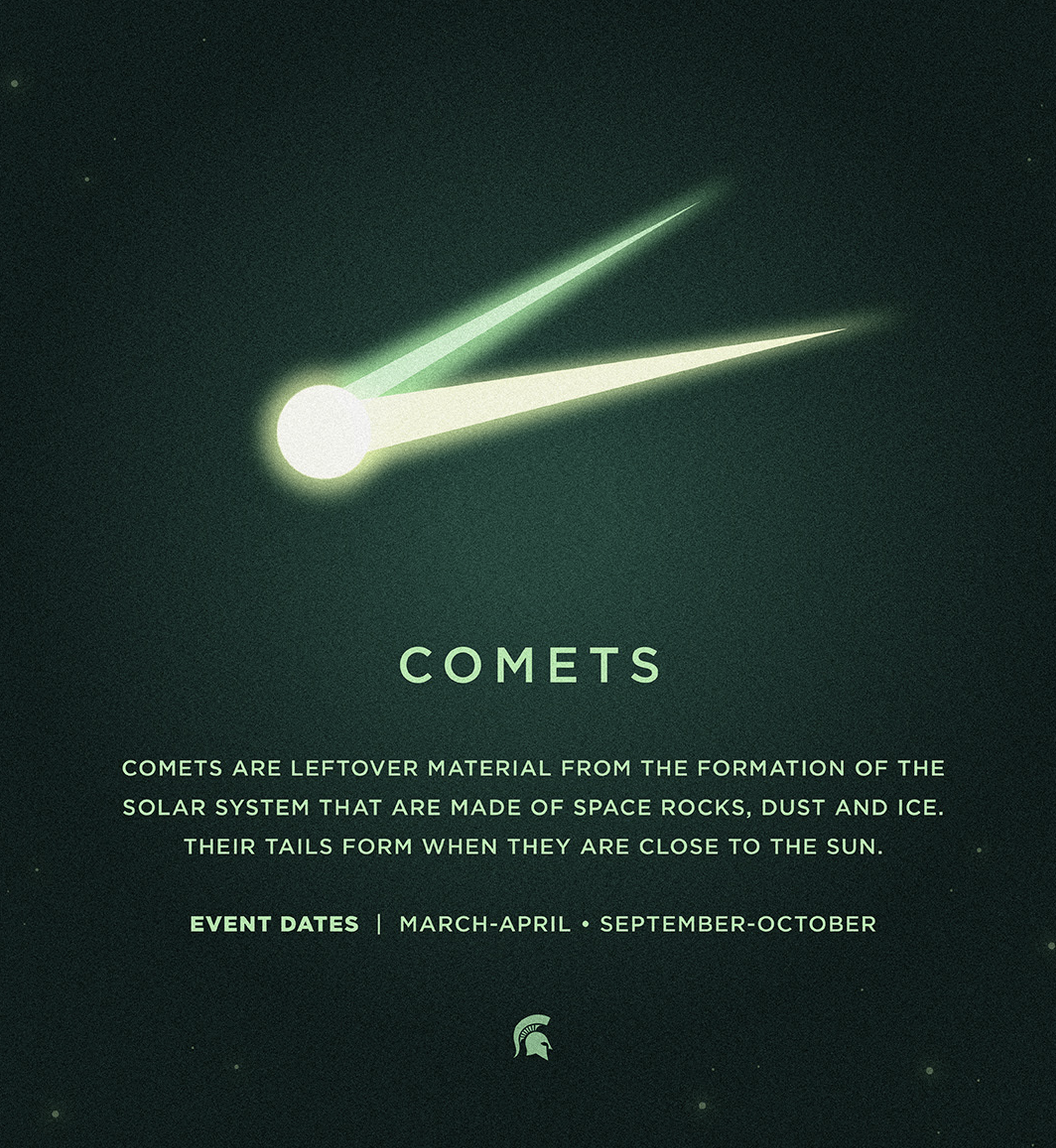
Comet infographic Credit: May Napora
 

Where does a comet’s tail come from?  

As a comet moves close to the sun, it heats up. The various frozen gases and molecules making up the comet change directly from solid ice to gas in a process called sublimation. This sublimation process releases dust particles trapped under the comet’s surface. 

The dust and released gas form a cloud around the comet called a coma. This gas and dust form two different tails.

The first tail, made up of gas, is called the ion tail. The sun’s radiation strips electrons from the gases in the coma, leaving them with a positive charge. These charged gases are called ions. Wind from the sun pushes these charged gas particles directly away from the sun, forming a tail that appears blue in color. The blue color comes from large numbers of carbon monoxide ions in the tail.

The second tail, called the dust tail, forms from the dust particles released during sublimation. This tail is pushed away from the sun by pressure caused by the sun’s light. The tail reflects the sunlight and swoops behind the comet as it moves, giving the comet’s tail a curve.

The closer a comet gets to the sun, the longer and brighter its tail will grow. One comet tail measured   approximately half a million miles long!

How fast do comets move? 

An object will orbit faster the closer it is to the sun, as angular momentum is conserved. Think about how an ice skater spins faster when they bring their arms in closer to their body — similarly, comets speed up when they get close to the sun. Otherwise, comets spend most of their time moving relatively slowly through the outer reaches of the solar system.

A lot of comets likely originate in a far-out region of our solar system called the Oort cloud. 

Comets from the Oort cloud take over 200 years to complete their orbits, a metric called the orbital period. Because of their long periods, they’re called long-period comets. Astronomers often don’t know much about these comets until they get close to the inner solar system. 

Short-period comets, on the other hand, have orbital periods of less than 200 years. Halley’s comet is a famous comet that comes close to the sun every 76 years.

Comets’ time in the inner solar system is relatively short, generally on the order of weeks to months. 

As they approach the sun, their tails grow, and they brighten before fading on their way back to the outer solar system. 

But even the short-period comets don’t come around often, and all of this makes their behavior difficult to predict.


MEDIA CONTACTS

Emilie Lorditch
Engineering, Science and TechnologyEngineering, Science and Technology

Collection

more content from this collection

Ask the Expert

Latest News

MSUToday Weekly Update

The MSUToday Weekly Update email showcases how Spartans are making a difference through academic excellence, research impact and community outreach. Get inspired by these stories of innovation, collaboration and determination. Plus, enjoy photos and videos of campus and more MSU content to help keep you connected to the Spartan community.

Sign UpUpdate My Information

Connect With Us

Visit our Facebook pageVisit our page on XVisit our Instagram pageVisit our LinkedIn pageVisit our YouTube pageVisit our TikTok page

Health and Safety

  • MSU Police and Public Safety
  • Olin Health Center
  • Counseling & Psychiatric Services (CAPS)
  • University Health and Wellbeing
  • MSU Health Care
  • Civil Rights and Title IX
  • Our Commitment
  • Center for Survivors
  • Security & Fire Safety Report
  • University Policy on Relationship Violence and Sexual Misconduct
  • Notice of Non-Discrimination, Anti-Harassment and Non-Retaliation
  • Health Care Non-Discrimination Notice

Support Services

  • Disability Resources
  • Supportive Services
  • Learning Resources

Working at MSU

  • Human Resources
  • EBS Login
  • Job Postings
  • Employee Assistance Program

Reports

  • CARES Act Funding
  • Student Achievement and Outcomes

Contact us

517-355-1855

Address

Michigan State University 426 Auditorium Road East Lansing, MI 48824

Follow Us

  • Visit our Facebook page
  • Visit our page on X
  • Visit our Instagram page
  • Visit our TikTok page
  • Visit our LinkedIn page
  • Visit our YouTube page

If you're having accessibility issues, please let us know.

Know More: Campus Safety Information and ResourcesTransparency Reporting: Budget & Salary/Compensation
  • Contact Information|
  • Site Map|
  • Privacy Statement|
  • Site Accessibility|
  • Call MSU: (517) 355-1855|
  • Visit: msu.edu|
  • Notice of Nondiscrimination|

SPARTANS WILL|© Michigan State University|