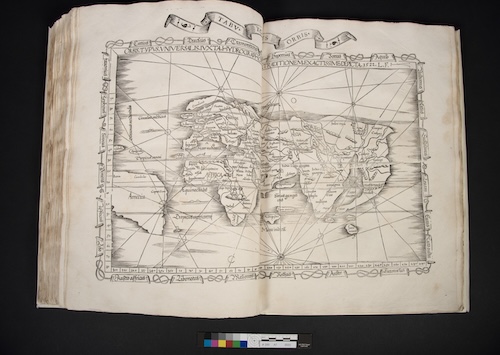
For over 70 years, the Michigan State University Libraries’ 1535 “Ptolemy’s Geographia” was kept under wraps because of its fragile condition. Now, the rare 16th-century cartography text — which contains one of the earliest instances of the term “America” in print — has been restored and made available for use.
Donated to MSU Libraries in 1951 by the E. K. Warren Foundation, “Ptolemy’s Geographia” is one of approximately 60 known copies in existence worldwide. The “Geographia” was previously collected in 1928 by Fred P. Warren of Three Oaks, Michigan, who was the son of E. K. Warren (1847-1919), a wealthy businessman noted for his development of the Warren Featherbone Company. This second edition of the eponymous “Geographia” was translated by German Renaissance lawyer, author and humorist Willibald Pirckheimer (1470-1530), with illustrations by Spanish theologian Michael Villanovanus (1511?-1553), better known as Servetus. The edition contains 228 pages and 49 maps with woodcut borders that some scholars have attributed to renowned Renaissance artists Hans Holbein the Younger and Urs Graf.
Originally written in the second century A.D., this geographical treatise was considered a standard reference until the 16th century and retained influence well into the 18th century, with various scholars and editors offering corrections to inaccuracies in the original. An inscription in the MSU Libraries copy denotes that the volume was once owned and housed by an order of priests known as the Somaschi Fathers at their home church of San Bartolomeo in Somasca, Italy. This inscription, according to Rare Books Curator Tad Boehmer, is likely from the first half of the 16th century.
“This copy of ‘Ptolemy’s Geographia’ — a fascinating text in its own right — tells some remarkable stories, from its printing in Lyon, France, by the Trechsel brothers in 1535 and its early use in Somasca, Italy, to its purchase by Fred Warren at an ‘out of the way bookstore’ in Milan in 1928,” Boehmer said.
In a cinematic description recorded in the Fall 1951 newsletter of the MSU Friends of the Library, due to Benito Mussolini’s declaration that no historical documents could leave the country, Warren enlisted the help of a friendly taxi driver who attached the volume to the undercarriage of his cab, where it eluded the sight of border officials. Though it has had a home at MSU since 1951, it had been underappreciated in recent years until Conservation Librarian Garrett Sumner’s expert work to clean and repair it.
“Nearly half a millennium after its creation, this book now speaks to a new generation of students and scholars who visit the MSU Libraries — and will continue to do so for many more to come,” Boehmer said.
According to Sumner, when he initially received the volume from Boehmer, his first question was “Why isn’t this in quarantine?” Boehmer had retrieved the box containing the “Geographia” from the MSU Libraries vault, which holds the libraries’ most valuable — and delicate — materials in the Stephen O. Murray and Keelung Hong Special Collections. The box, Sumner said, had a note on top warning against opening due to mold, but when he took the text out to examine it, he found that it was a false alarm. What he did find, however, was an immense amount of damage.
“We pulled it out and found there was actually no active mold,” Sumner said. “What I saw was that the binding was completely falling apart — the covers were barely attached, the sewing was frayed throughout, the leather sewing supports used to connect the leaves, sewing and binding together were disintegrating, the paper had numerous water tidelines from suffering multiple flood incidents, and was also heavily embedded with dirt, with tears throughout. In many places, leaves were either loose or detached from the sewing.”
Additional paperwork with the “Geographia” noted that it had been previously sent to two different vendors for conservation treatment. According to Head of Conservation and Preservation Eric Alstrom, the cost to treat the rare text was quoted at over $20,000 in 2013.
Despite the confirmation of an absence of active mold, quarantine still had a role in the historic text’s revival. Sumner, who received the “Geographia” in fall 2019, said he spent the first year under remote work stipulations thinking about how he was going to approach repairing the fragile tome.
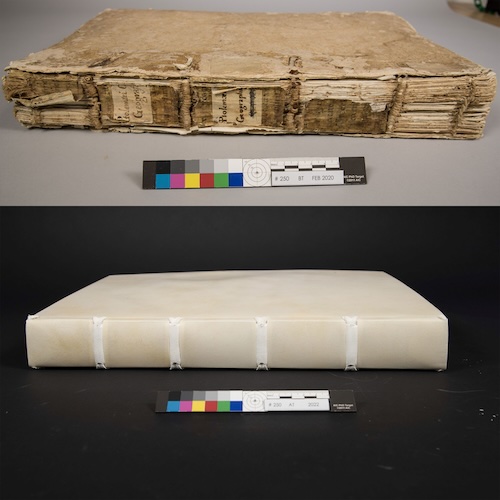
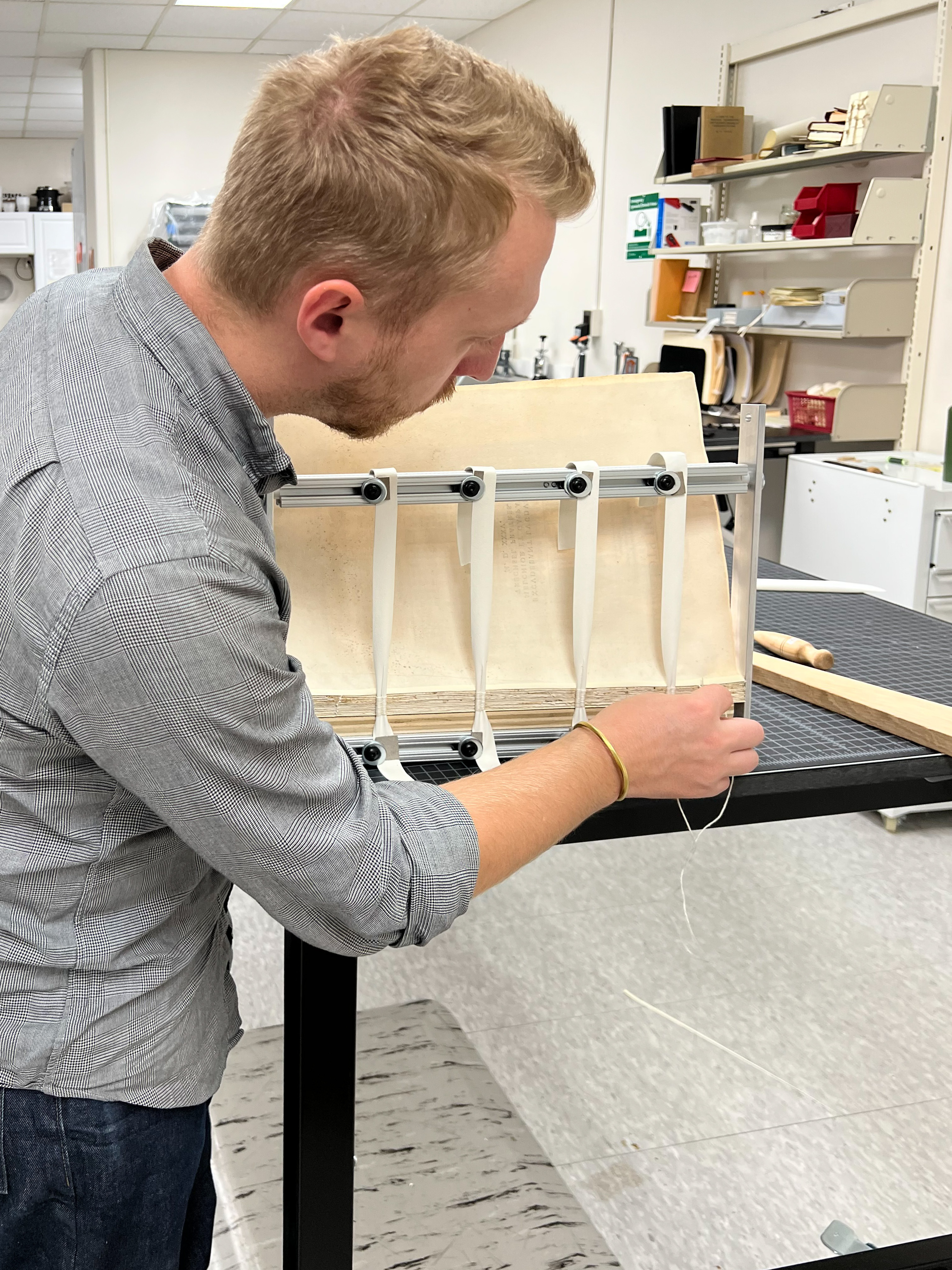
“The very first part of the process was to fully document and photograph the ‘Geographia,’” Sumner explained. “Tad and I then developed a report and treatment plan for the book. In coming up with these plans, we also assess treatment options, one of those being to do absolutely nothing, and what the consequences of that option might be. In this case, the consequence of doing nothing is actually just more and more damage. Doing nothing is always an option because sometimes it’s best, but in this case, we wanted to make sure that the book was usable. The final plan we landed on was basically just the full spa treatment — disbinding, washing all the pages and resizing, mending, sewing, and binding them in a new, conservation-sound binding sympathetic to the original, and finally housing the book and its original remnants in a custom enclosure.”
Sumner made his first cut into the sewing of the “Geographia” in January 2022, completing the text conservation treatment just 10 months later. The volume was used on the first day it became available for a topics of art history course taught by Silvia Tita, Carol Ann Bennett-Vallès Endowed Professor of art history and visual culture, in the MSU College of Arts and Letters.
“Over the centuries, ‘Ptolemy’s Geographia’ has fascinated and informed curious minds in search of practical, abstract and encyclopedic knowledge related to humans’ experience of inhabiting and understanding the earth,” Tita said. “Preserved in various manuscripts, the ‘Geographia’ was published for the first time in the last quarter of the 15th century, soon after the advent of printing in Europe. The printed editions of the early modern period were equipped with maps and updated knowledge about the world. Such subsequent versions are extremely important as they attest not only to the absorption of ancient theories but more significantly to the changing of ideas and perceptions about the world. At the same time, they alert us nowadays to the duty of preserving them. The MSU Special Collections holds such a copy. Recently restored, it is a splendid teaching tool — as noticed firsthand during classes — for both its content and its capability of illuminating on the early stages of printing.”
While access to the “Geographia” and other Special Collections materials normally requires making an appointment with the MSU Special Collections staff, select services have been put on hold as the MSU Libraries Special Collections begins the process of relocating to the third floor of the Main Library’s East Wing this August. For current updates on the relocation and related services, please visit the Special Collections webpage.

