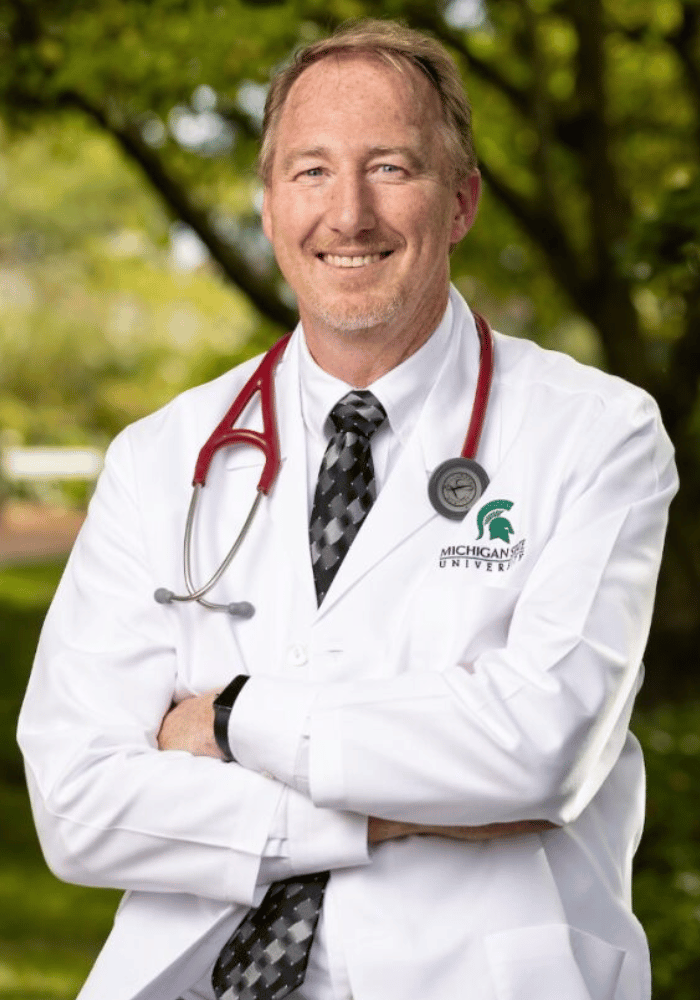
Most people don’t imagine medical school happening in the woods. But it’s one way future physicians can learn to have a bigger impact in their communities, said David Klee, MD.
“If you’re out seeing [patients] in the woods and you realize it’s 84 degrees out today and there’s no water source, how do you deal with that?” Klee said. “It helps [students] understand true problems that they might not think about if they’re seeing patients in the clinic.”
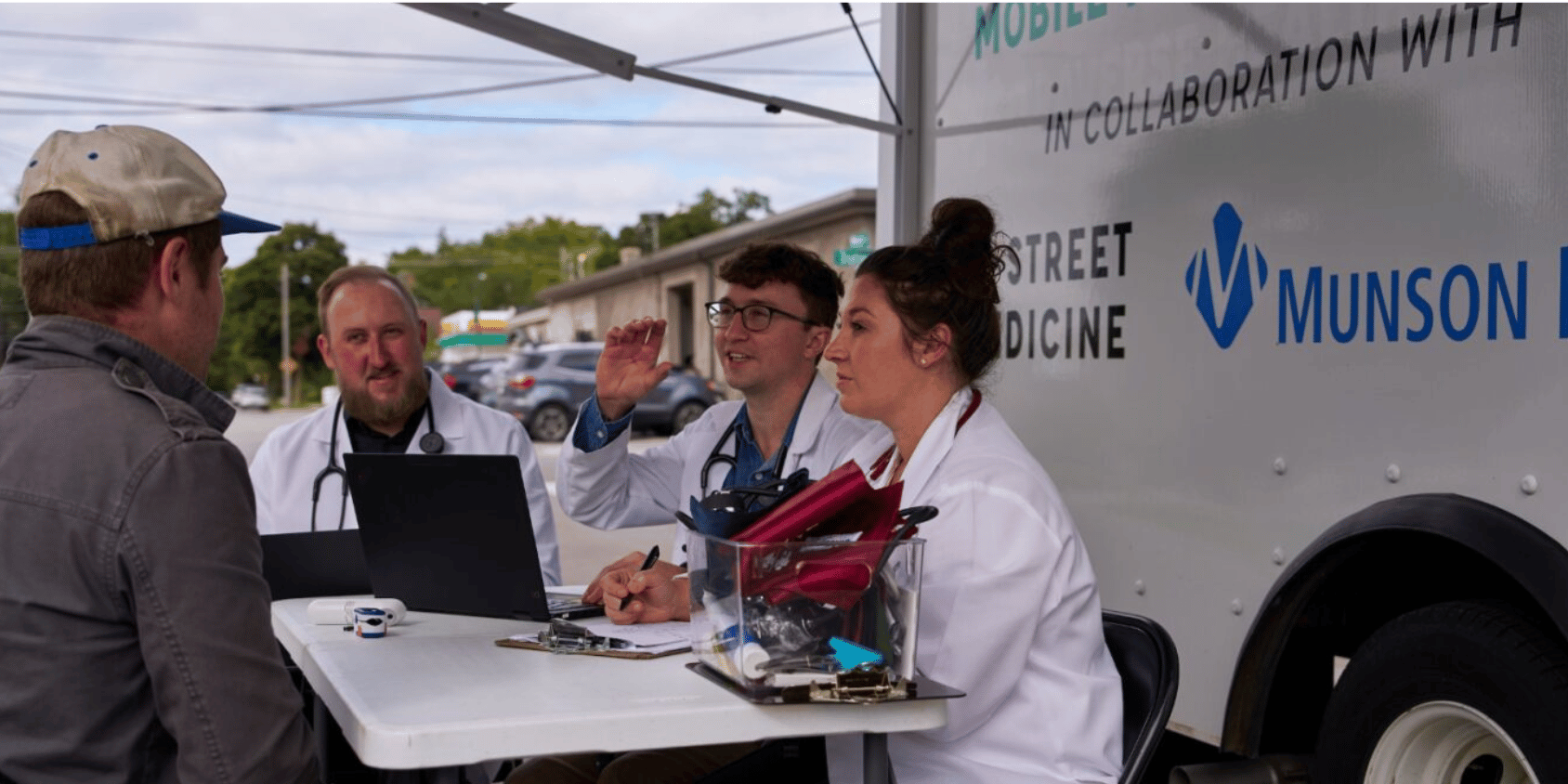
Klee works with medical residents and third- and fourth-year College of Human Medicine students who choose to participate in Traverse City Street Medicine—a unique program that meets unhoused patients where they are, from encampments to the woods.
“I think a big thing it changes is [students] see not just people with barriers, but they see people,” said Klee. “And that’s a big difference, because you can talk about somebody not having access to water, but when you’re able to put a name and a face together and you start to build a relationship with somebody, now it becomes more personal.”
Klee is the community associate dean of the MSU College of Human Medicine Traverse City Campus and associate program director for the MSU-affiliated Munson Family Residency Program, where the Traverse City Street Medicine program is based.
Street Medicine is a real-time solution to a very real problem in rural Northern Michigan, where there’s a higher than average number of people experiencing homelessness compared to the rest of the state. The idea sprang from a 2016 program launched by the Traverse Health Clinic, which brought in partnerships with Munson Healthcare, Goodwill Northern Michigan, and MSU during the height of the pandemic.
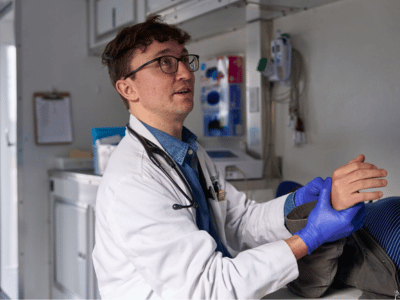
“There was an element of our community that didn’t have access to care at all,” Klee said. “It was a perfect time for us to be able to become involved. By building it into our curriculum, it became part of our residents’ education for them to go out into the community—and part of our job as residency faculty to supervise them. We graduate a group then we bring in a new group, so we have an ongoing supply of residents…we’re able to maintain a sustainable program that way.”
In addition to creating sustainability, Klee said the constant rotation of students and residents bring something extra special to Street Medicine: energy.
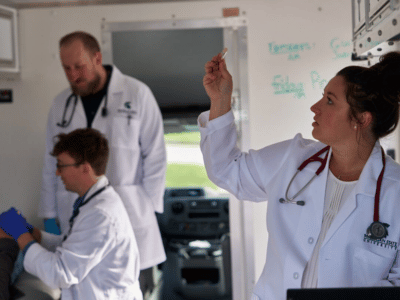
“They’re new to the field and they’re excited. They want to be there. They don’t have the baggage that other people may have developed over time,” he said.
That’s especially helpful when physicians are building trust with patients whose experiences with the medical community have not always been positive.
“The patients are developing relationships with our team. That’s been a big barrier for many of the unhoused—they’ve often had bad experiences with traditional medical care, so they have a lack of trust and rightfully so,” Klee said. “A lot of them have had lives of a lot of empty promises.”
He added that physicians are often used to health care being the main issue they think about when seeing patients.
“Some days, their highest need is not medical,” he said. “It may be they need to talk about their housing application or they don’t have a state ID. That’s where we’re able to step aside and go, okay, well, you don’t really need to talk to me. You need to talk to one of my partners here, so let me connect you with them.”
Whether it’s Traverse Health Clinic, Goodwill, or the psychiatry and pharmacy residents who also rotate through Street Medicine every week, the patients get connected to the people who can best help them in that moment. According to Aron Sousa, MD, dean of the College of Human Medicine, that kind of collaboration is part of a unique experience for MSU’s emerging physicians and the community they serve.
“Many, many schools have some version of Street Medicine, but the Traverse City experience is particularly well done and impactful,” he said. “Traverse City is a relatively small city with a homeless population that persists through an intense winter. In large cities there are many groups available to help."
"In Traverse City, the Street Medicine program can truly be the difference between living and dying for these members of the community.”
Such comprehensive services are about to get even more accessible.
Munson Healthcare recently donated $300,000 to support the expansion of Street Medicine services, and part of that money is being spent on a dedicated coordinator position.
“When our unhoused patients come to the emergency department or to the hospital, they’ll be connected back to our outpatient Street Medicine team,” Klee said. “And so again, we continue that ongoing trust circle.”
The coordinator will also be the bridge between the care team and other resources throughout the community.
“We’re really excited about that, and thankful to Munson for their donation,” Klee said. “We’ve been talking about it for a while, but we needed those monetary resources to be able to make it happen.”
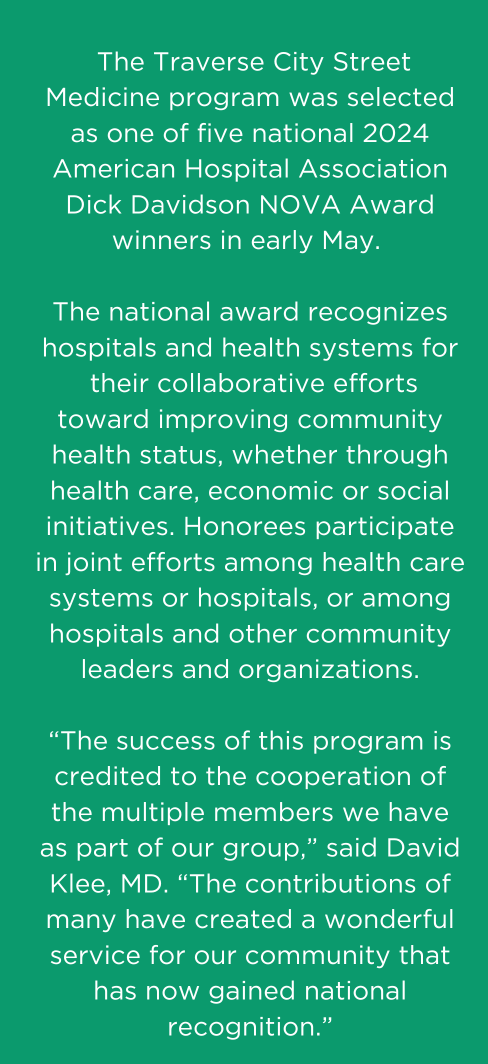
These kinds of partnerships are what make the Street Medicine program so successful at creating real-time solutions—so much so that the American Hospital Association recently named it as one of five winners of their 2024 Dick Davidson Nova Award for Improving Community Health.
What’s more, Klee said the program has had a measurable impact on the Traverse City community over the past four years.
“We are getting more of our unhoused housed,” he said, “and we know that really is the end goal to be able to achieve better health. Just being unhoused decreases your life expectancy by 30 years, so if we can get people housed with minimal barriers, their health improves.”
He said there’s been a noticeable shift in the last year alone.
“We’ve had less of our patients getting a majority of their medical care through the emergency department, which helps some of the overcrowding there as well.”
As he looks to the future of the Street Medicine program, Klee said there are two projects he’s especially excited about—particularly because they’re ideas that sprang from student interactions.
“One of the things they brought up was advocacy,” he said. “Being that they’re new to medicine and coming in without big connections to the establishment, they thought they may be a voice that the community would listen to.”
He’s referring to the wider community of Northern Michigan, where there’s been both support for the Street Medicine program and some opposition.
“I can see them talking to some of the community groups here in town, talking to our city council and our community governance so they understand…from a younger generation, the importance of this, and maybe build some bridges that otherwise would be more difficult to build.”
The other project is an educational group for students from the Colleges of Human Medicine and Osteopathic Medicine, who will participate in a class taught by someone from the unhoused community.
“It’s based off of a program done at the University of Southern California…a few of the unhoused will be the instructors working with a small group of students through a curriculum on what it’s like to be unhoused,” Klee said. “What are the struggles that you’re working through, how do you work through those on a safety standpoint, on a basic needs standpoint—how does that affect your mental health? It’s a great way to turn the tables and be instructed in a different manner.”
Sousa echoed Klee’s regard for the kinds of unconventional learning opportunities being developed through Street Medicine.
“There are so many ways to be useful as a physician and a medical student, and perhaps the most impactful do not require an operating room or the traditional technologies of medicine,” Sousa said. “Our work can empower communities to make a larger difference for more people than any of us could ever do on our own.”
This story originally ran on the College of Human Medicine website.

