Jump to HeaderJump to Main ContentJump to Footer
Michigan State University
MSUTODAY
  • Browse Stories By

    Topics

    Explore stories by subject area

    • Arts and Culture
    • Business and Economy
    • Climate and Environment
    • Education and Learning
    • Engineering, Science and Technology
    • Government and Society
    • Health and Medicine
    • Media and Communications
    • MSU Leadership and Impact
    • Sports and Recreation
    • Student and Campus Experience
    View All Stories

    Collections

    Curated story series

    • Alumni stories
    • Turfgrass
    • Ask the Expert
    • Big Ideas
    • Climate solutions
    • Water at MSU
    • Mobility
    • Spartan Perspectives
    • Student views
    • Graduate voices
    • Faculty voices
    View All Collections

    Featured

    Editor's picks

    • 9 reasons to love being a Spartan

      Aug. 28, 2026

      9 reasons to love being a Spartan

    • NIH awards multi-university team over $4M to improve women’s health

      Sept. 15, 2026

      NIH awards multi-university team over $4M to improve women’s health

MSUTODAY
  • Browse Stories By

< Browse Stories By

Topics

Explore stories by subject area

  • Arts and Culture
  • Business and Economy
  • Climate and Environment
  • Education and Learning
  • Engineering, Science and Technology
  • Government and Society
  • Health and Medicine
  • Media and Communications
  • MSU Leadership and Impact
  • Sports and Recreation
  • Student and Campus Experience
  • View All Stories

Collections

Curated story series

  • Alumni stories
  • Turfgrass
  • Ask the Expert
  • Big Ideas
  • Climate solutions
  • Water at MSU
  • Mobility
  • Spartan Perspectives
  • Student views
  • Graduate voices
  • Faculty voices
  • View All Collections

Featured

Editor's picks

  • 9 reasons to love being a Spartan

    Aug. 28, 2026

    9 reasons to love being a Spartan

  • NIH awards multi-university team over $4M to improve women’s health

    Sept. 15, 2026

    NIH awards multi-university team over $4M to improve women’s health

  • For Media
  • Experts
  • Releases and Statements
  • Sign Up
  • Update Information

Resources

  • A to Z Index
  • Find People
  • Maps
  • Email
  • Student Information System (SIS)
  • D2L
  • Libraries
  • Tech Support
  • MSU Misconduct Hotline
  • Social Media Directory
  • Events Calendar
  • For Media
Michigan State University
MSUToday
  • For Media
  • Experts
  • Releases and Statements
  • Sign Up
  • Update Information
Diseases, Conditions and Treatments

May 24, 2024

New grant supports fight against gut pain

By: Samantha Brichta

Michigan State University researcher Brian Gulbransen has been awarded a nearly $1.8 million grant from the National Institutes of Health to tackle chronic gut pain. Visceral pain significantly impacts quality of life for millions of people and is the most common symptom of gastrointestinal, or GI, problems.

This four-year grant will fuel Gulbransen's team's exploration of how sex, stress and past experiences with inflammation influence a person's vulnerability to visceral pain. Their research holds promise for the development of novel therapeutic approaches to alleviate chronic gut pain.

Currently, there's a lack of effective treatments for chronic gut pain, Gulbransen said, because the complexities of gut-brain communication pose a challenge for therapeutic development.

Getting to the source of visceral gut pain

Nearly 40% of all humans are affected by a group of disorders involving gut-brain interaction, which includes afflictions like irritable bowel syndrome, reflux hypersensitivity and functional dyspepsia. 

Brian Gulbransen

“It’s a big problem,” said Gulbransen, an MSU Research Foundation Professor in the Department of Physiology. “Receiving this grant from NIH opens up opportunities to understand what might be causing all this pain and ultimately changing the process to eliminate or alleviate it.” 

Gulbransen's lab isn't new to investigating gut pain and why certain people are more susceptible to it than others. 

They’ve been delving into inflammation, and how previous experience with inflammation conditions make individuals more prone to future gut pain. 

Now, Gulbransen and his team are broadening their scope to encompass the cellular basis of why and how factors like sex and stress levels play such a crucial role in visceral gut pain. Specifically, they’re focusing on nervous system cells known as glia. 

Although glia don't send pain signals, they sensitize the neurons that do, making the neurons more likely to fire off. 

"We're ideally looking to figure out the key differences between glia and how they exert control over neurons differently,” Gulbransen said. “We think they could be the key to understanding the root cause of pain felt from GI disorders.” 

The research is unpacking pain at a fundamental biological level, looking at how cells interact with one another in the gut. To investigate these interactions, the team will make use of mouse models that serve as proxies for a number of variables in human gut health, including sex differences, early-life stress and previous inflammation of the gut.
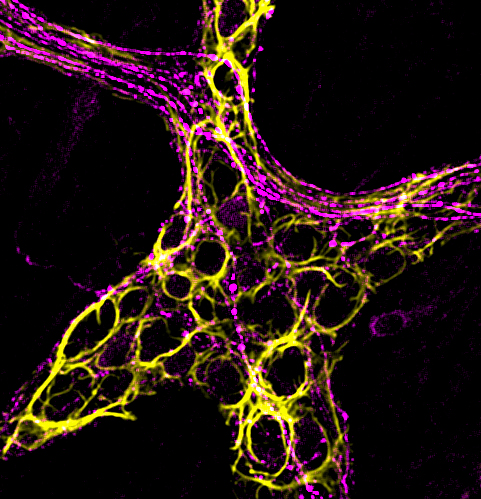
Glial cells

“Other researchers are looking into the nervous system specifically and how pain is being perceived throughout the body. We’re focusing on the fundamental mechanisms underlying gut pain sensitization, specifically the glia in the gut,” Gulbransen said.

Collaboration and advanced techniques 

A faculty member at MSU for the past 12 years, Gulbransen has found immense value in the gut, or enteric, neuroscience research community at MSU. 

“It’s one of the only enteric focused neuroscience groups in the world,” Gulbransen said. “And having that unique community with colleagues like Geoffroy Laumet, a pain mechanisms expert within the department, is a huge advantage for us to do research no one else is doing.” 

Access to a new confocal microscope has also given the researchers a surge. 

"The support we've received from the College of Natural Science has been instrumental," Gulbransen said. "Their recent contribution of the confocal microscope will significantly enhance our ability to image the tiny nerve fibers in the gut, allowing for faster and more precise data collection."

Gulbransen's long-standing interest in the enteric nervous system and past experience studying pain mechanisms makes him uniquely positioned to address this problem of visceral gut pain. 

"This national funding of our work opens doors to new avenues for understanding why people develop chronic pain and lead to development of targeted therapies that could impact millions.” 

This story originally appeared on the College of Natural Science website. 

MEDIA CONTACTS

Matt Davenport
Diseases, Conditions and TreatmentsHealth and MedicineNatural SciencesEngineering, Science and TechnologyMSU ResearchMSU Leadership and Impact

Latest News

MSUToday Weekly Update

The MSUToday Weekly Update email showcases how Spartans are making a difference through academic excellence, research impact and community outreach. Get inspired by these stories of innovation, collaboration and determination. Plus, enjoy photos and videos of campus and more MSU content to help keep you connected to the Spartan community.

Sign UpUpdate My Information

Connect With Us

Visit our Facebook pageVisit our page on XVisit our Instagram pageVisit our LinkedIn pageVisit our YouTube pageVisit our TikTok page

Health and Safety

  • MSU Police and Public Safety
  • Olin Health Center
  • Counseling & Psychiatric Services (CAPS)
  • University Health and Wellbeing
  • MSU Health Care
  • Civil Rights and Title IX
  • Our Commitment
  • Center for Survivors
  • Security & Fire Safety Report
  • University Policy on Relationship Violence and Sexual Misconduct
  • Notice of Non-Discrimination, Anti-Harassment and Non-Retaliation
  • Health Care Non-Discrimination Notice

Support Services

  • Disability Resources
  • Supportive Services
  • Learning Resources

Working at MSU

  • Human Resources
  • EBS Login
  • Job Postings
  • Employee Assistance Program

Reports

  • CARES Act Funding
  • Student Achievement and Outcomes

Contact us

517-355-1855

Address

Michigan State University 426 Auditorium Road East Lansing, MI 48824

Follow Us

  • Visit our Facebook page
  • Visit our page on X
  • Visit our Instagram page
  • Visit our TikTok page
  • Visit our LinkedIn page
  • Visit our YouTube page

If you're having accessibility issues, please let us know.

Know More: Campus Safety Information and ResourcesTransparency Reporting: Budget & Salary/Compensation
  • Contact Information|
  • Site Map|
  • Privacy Statement|
  • Site Accessibility|
  • Call MSU: (517) 355-1855|
  • Visit: msu.edu|
  • Notice of Nondiscrimination|

SPARTANS WILL|© Michigan State University|
