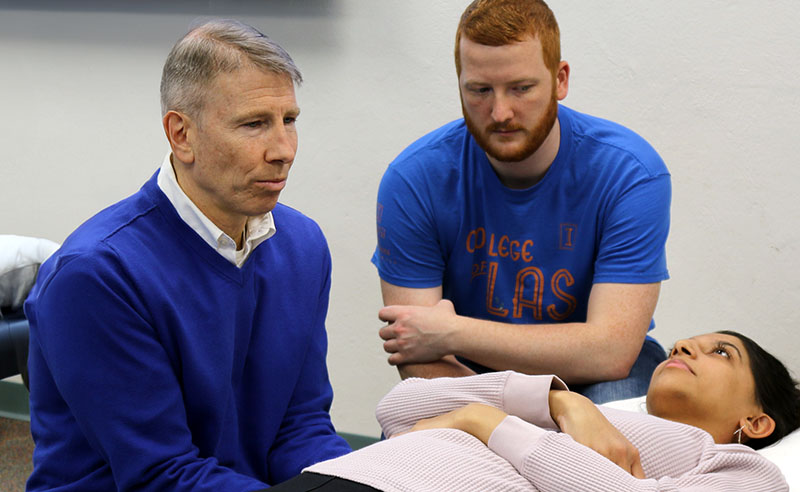
Jake Rowan is an associate professor at the MSU College of Osteopathic Medicine in the Department of Osteopathic Manipulative Medicine. He serves patients at the MSU Healthcare Osteopathic Manipulative Medicine clinic, where he focuses on outpatient neuromusculoskeletal rehabilitation. Rowan explains what makes osteopathic medicine unique and what it’s like to work with an osteopathic physician.
Who practices osteopathic medicine, and who practices allopathic medicine?
Physicians with D.O. degrees practice osteopathic medicine, while allopathic medicine is practiced by physicians with M.D. degrees. D.O.s and M.D.s are fully licensed physicians who practice in all areas of medicine.
What makes osteopathic medicine distinctive?
Osteopathic medicine is a distinct philosophy of medical care based on four principles:
1. The body is a unit, and the person is a unit of the body, mind and spirit.
2. The body is capable of self-regulation, self-healing and health maintenance.
3. Structure and function are reciprocally interrelated. This means there’s a musculoskeletal component to disease, and osteopathic manipulative treatment can help to restore the body’s function, enhance wellness and assist in recovery from disease and injury.
4. Rational treatment should be based on the understanding of these principles.
Why are these principles important?
I think that’s the beauty of osteopathic medicine — we have these principles on which our education and practice are founded.
What might a patient who has never seen a D.O. before notice in their first appointment?
With my own patients, the fact that I can evaluate their musculoskeletal system through inspection, palpation and motions testing and treat them with my hands is something that is very unique to osteopathic medicine.
Because we believe the body is a unit and the person is a unit of body, mind and spirit, we look at them not just as a disease process, but as a person who may be single or married, who may have children, who may work in the home or at a job — we’re trying to look comprehensively at that person. We might take into account their religious preferences, their living situation and myriad other factors.
And because we know the body is capable of self-regulation and self-healing and health maintenance, and our role as physicians is to help those along, D.O.s would, hopefully, try to use the least invasive approach possible.That might include, for example, using exercise or nutrition, not necessarily rushing to prescription medication or surgery or those types of more invasive interventions.
In addition to our philosophy, all our osteopathic medical students are trained to do an osteopathic structural exam and trained in osteopathic manipulative treatment.
What is osteopathic manipulative treatment?
Osteopathic manipulative treatment is a set of hands-on techniques. It’s not one specific thing. For example, there’s high-velocity, low-amplitude thrust, which is when you might hear a pop or a crack. There’s strain-counter strain technique, where we position the body in a point of ease and let the body relax. There’s muscle energy treatment, where we position the body and have the patient pull or push in a certain direction to get the body to move in a certain way.
The goal is to improve the mobility of the tissues, whether that’s the bone or a joint, muscle, ligament, fascia or fluid, and to restore the normal physiologic motion, if possible. I want to get those tissues to move and to restore that normal motion of the musculoskeletal system so patients can have normal self-healing capacity and for health maintenance to take effect.
How might an osteopathic physician approach some common ailments?
Headache is a good example. Most doctors can’t say with a lot of certainty what’s causing a headache. An osteopathic physician would take a good history and evaluate pertinent body systems including the musculoskeletal system, looking at the cervical spine and the muscles. We would also take into consideration other factors like the patient’s job — if they’re looking at a computer all day, maybe they have eye strain causing the headache. Or maybe the patient is eating, or not eating, certain foods and there’s a nutritional issue.
What is a musculoskeletal examination? Is it intimidating?
I think most patients want their physician to do a really good history and physical exam to come up with an accurate diagnosis. I think our osteopathic structural exam is part of that, and our patients look forward to it because they don’t want their physician to miss something.
Our structural examination involves three things:
1. Inspection of the area
2. Palpation of the area
3. Motion testing of the area
When D.O.s do this examination, we’re looking for three things:
1. Asymmetry
2. Range of motion restrictions
3. Tissue texture abnormalities or changes
How often, and when, do patients need musculoskeletal exams?
It depends. I think for almost any problem that a patient has, there can be a musculoskeletal component, whether it’s asthma, a headache, constipation or foot pain — it wouldn’t be uncommon for an osteopathic physician to do a structural exam on that patient.
Now, there are certain situations — time, acuity or setting — where you may not be able to do that exam immediately. For example, a patient on an athletic field with an acute injury or a patient coming into the hospital emergency department with chest pain, the structural exam may not occur right away but hopefully it would be done at the appropriate time.
This story was originally featured on the College of Osteopathic Medicine website.

