Jump to HeaderJump to Main ContentJump to Footer
Michigan State University
  • Browse Stories By

    Topics

    Explore stories by subject area

    • Arts and Culture
    • Business and Economy
    • Climate and Environment
    • Education and Learning
    • Engineering, Science and Technology
    • Government and Society
    • Health and Medicine
    • Media and Communications
    • MSU Leadership and Impact
    • Sports and Recreation
    • Student and Campus Experience
    View All Stories

    Collections

    Curated story series

    • Turfgrass
    • Ask the Expert
    • Big Ideas
    • Climate solutions
    • Water at MSU
    • Mobility
    • Spartan Perspectives
    • Student views
    • Graduate voices
    • Faculty voices
    View All Collections

    Featured

    Editor's picks

    • The Spartans behind your favorite Michigan golf courses

      July 22, 2026

      The Spartans behind your favorite Michigan golf courses

    • MSU in the 1990s: 10 Spartan milestones

      July 14, 2026

      MSU in the 1990s: 10 Spartan milestones

MSUTODAY
  • Browse Stories By

< Browse Stories By

Topics

Explore stories by subject area

  • Arts and Culture
  • Business and Economy
  • Climate and Environment
  • Education and Learning
  • Engineering, Science and Technology
  • Government and Society
  • Health and Medicine
  • Media and Communications
  • MSU Leadership and Impact
  • Sports and Recreation
  • Student and Campus Experience
  • View All Stories

Collections

Curated story series

  • Turfgrass
  • Ask the Expert
  • Big Ideas
  • Climate solutions
  • Water at MSU
  • Mobility
  • Spartan Perspectives
  • Student views
  • Graduate voices
  • Faculty voices
  • View All Collections

Featured

Editor's picks

  • The Spartans behind your favorite Michigan golf courses

    July 22, 2026

    The Spartans behind your favorite Michigan golf courses

  • MSU in the 1990s: 10 Spartan milestones

    July 14, 2026

    MSU in the 1990s: 10 Spartan milestones

  • For Media
  • Experts
  • Releases and Statements
  • Sign Up
  • Update Information

Resources

  • A to Z Index
  • Find People
  • Maps
  • Email
  • Student Information System (SIS)
  • D2L
  • Libraries
  • Tech Support
  • MSU Misconduct Hotline
  • Social Media Directory
  • Events Calendar
  • For Media
Michigan State University
MSUToday
  • For Media
  • Experts
  • Releases and Statements
  • Sign Up
  • Update Information
MSUTODAY
Student Life

April 19, 2024

New exhibit at MSU Libraries explores rare almanacs and calendars

A new exhibit exploring the almanacs and calendars of Michigan State University Libraries’ Special Collections is now on display at the MSU Libraries Main Gallery through the end of April.
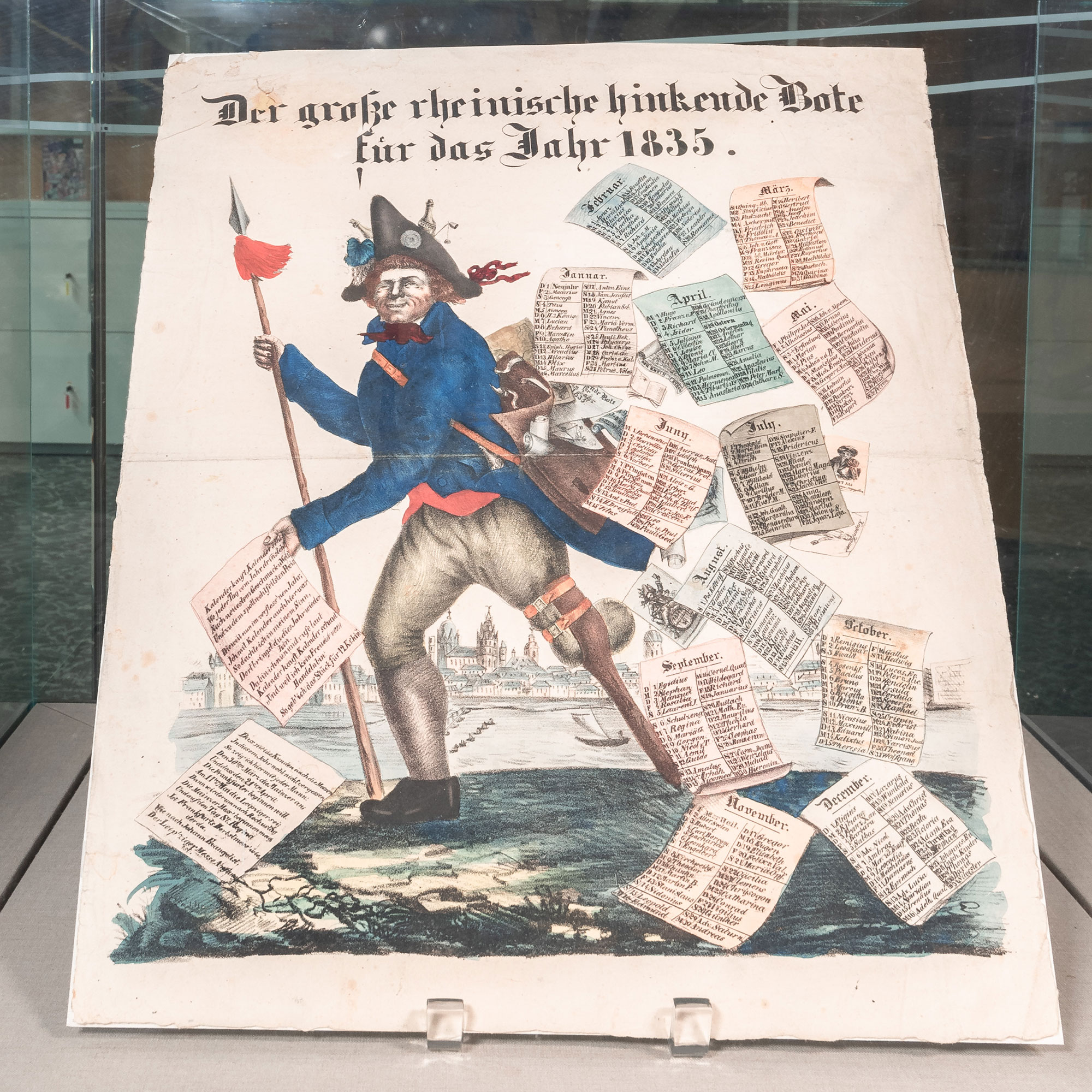
A drawing of a pirate surrounded by a bunch of papers blowing in the wind. The text at the top of the drawing reads “Grosse rheinische hinkende Bote,” which translates to “Great Rhenish Limping Messenger.”
Close up of the broadside advertisement “Grosse rheinische hinkende Bote (Great Rhenish Limping Messenger),” 1835.

“Marking Time: Almanacs and Calendars from the Stephen O. Murray and Keelung Hong Special Collections” features more than 65 historical and rare publications ranging from the 15th to the 20th century. Items on display include:

  • A fragment of the earliest known almanac printed in Latin, one of two surviving copies, most likely printed in 1480. It was printed in Passau, Germany, by Benediktus Mayr and covers the year 1481.
  • A broadside advertisement for the 1835 issue of the “Grosse rheinische hinkende Bote,” or “Great Rhenish Limping Messenger,” featuring its title character as he travels from town to town selling his almanac.
  • Several editions of “Poor Richard’s Almanack,” which was written, printed and published pseudonymously by Benjamin Franklin from 1732 to 1758, along with several editions of the more fact-oriented annual “The Old Farmer’s Almanac,” founded by Robert Bailey Thomas in 1792.
  • International almanacs from Turkey, Russia, Indonesia, Spain, Italy, the Netherlands and Portugal that show how information contained in almanacs could differ according to communal need.
  • Miniature or pocket almanacs, which began appearing in the 18th century and usually included the standard calendar, as well as lists of monarchs and government officials, currency conversion tables and other valuable information.

Almanacs are considered by some scholars to have their beginnings rooted over 3,000 years ago in the Near East and are some of the most universal types of chronological text. The word “almanac” (also spelled “almanack” or “almanach”) first appeared in English in the late 14th century, referring to a collection of permanent tables of astronomical data, though the term appeared in Anglo-Latin usage during the previous century.

A person posing next to a sign that reads: “Marking Time: Almanacs and Calendars.” Books are displayed in glass cases behind him.
Tad Boehmer, curator of rare books and special collections cataloger at MSU Libraries, put on the “Marking Time” exhibit.

In addition to the calendar for the year, almanacs include current information like weather forecasts, astronomical predictions, tide tables and information regarding religious festivals. For centuries, almanacs were the second most popular genre of text in Europe and North America after religious works like the Bible and prayer books.

“Almanacs are tremendously important sources for historical research, not only for the information they contain but also for what they can tell us about their owners and readers,” said Tad Boehmer, curator of rare books and special collections cataloger at MSU Libraries. “We have almanacs in the collection containing marginal notes documenting their owners’ travels and finances, along with major life events (the births, marriages and deaths of family members) and references to the weather. In effect, the almanacs act as snapshots of daily life in an age-long past.”
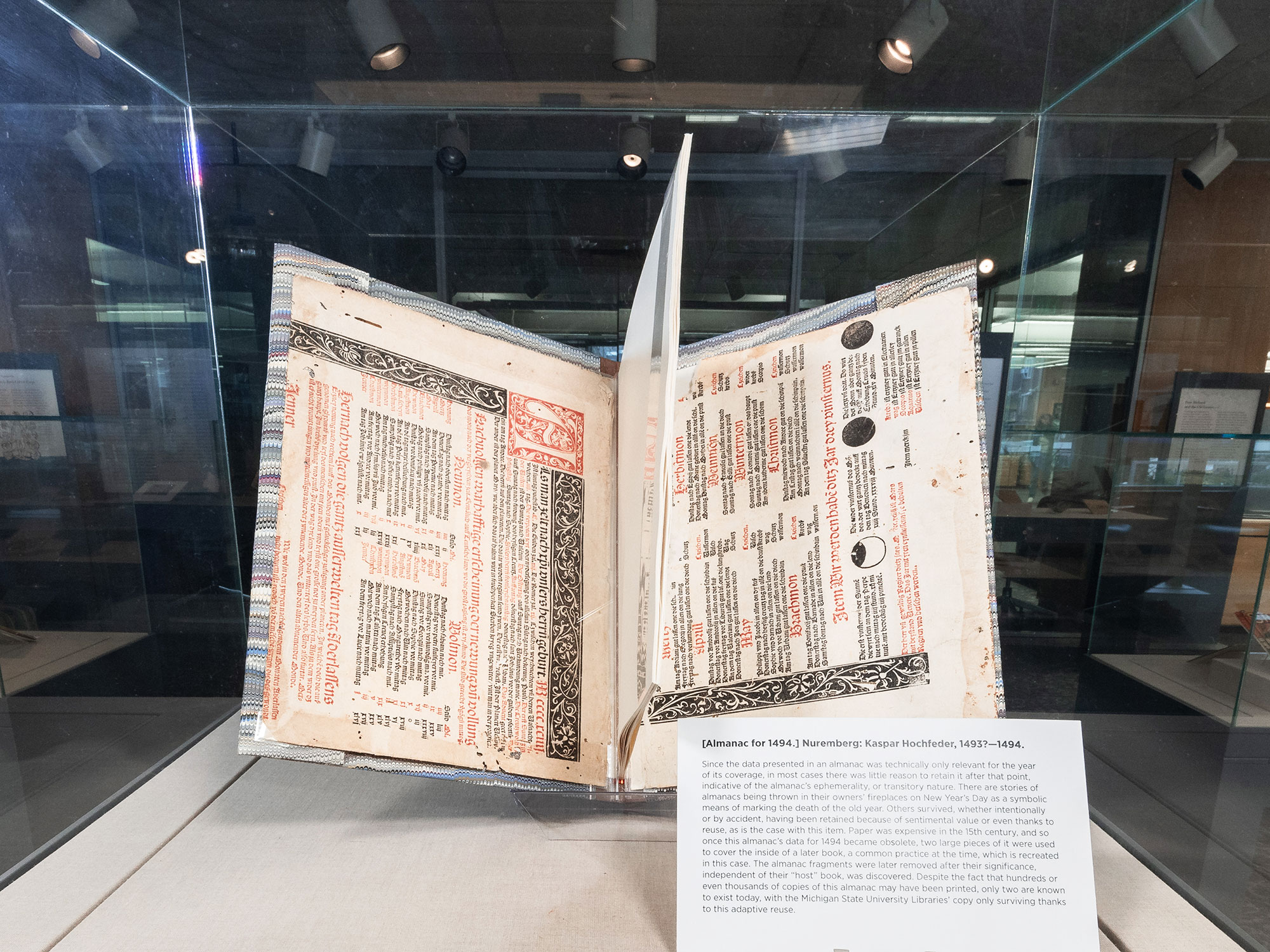
 Book pages in a plastic protector. The pages are bound together and housed in a glass case.
A fragment of the earliest known almanac printed in Latin for year 1494 being used to cover the inside of a book published at a later date.

According to Boehmer, the seed of the Murray and Hong’s almanac collection began with the development of the library’s popular culture collection in the late 1960s, which was guided by pop culture studies pioneer Professor Russel Nye during his tenure at MSU. Another significant leap forward came in 2016 with the acquisition of the William D. “Bill” and Helen M. Chase Collection. Bill Chase was renowned for “Chase’s Calendar of Events,” which he began publishing in 1957 with his brother, Harrison Chase, out of a basement under the Chases’ Apple Tree Press imprint. Now owned by Rowman and Littlefield, the calendar has been issued every year since and includes holidays, special events, and notable birthdays and anniversaries, as well as unusual traditions like National Nothing Day, which “provide[s] Americans with one National Day when they can just sit without celebrating, observing or honoring anything.”

Catherine Ryan, daughter of Bill and Helen Chase, said that her father would be “most pleased” to have his calendars on display and that the MSU Libraries is “keeping his collection alive.”


MEDIA CONTACTS

Alex Tekip, Elise Jajuga
Student LifeStudent and Campus ExperienceSocial SciencesGovernment and SocietySocial Sciences

Latest News

MSUToday Weekly Update

The MSUToday Weekly Update email showcases how Spartans are making a difference through academic excellence, research impact and community outreach. Get inspired by these stories of innovation, collaboration and determination. Plus, enjoy photos and videos of campus and more MSU content to help keep you connected to the Spartan community.

Sign UpUpdate My Information

Connect With Us

Visit our Facebook pageVisit our page on XVisit our Instagram pageVisit our LinkedIn pageVisit our YouTube pageVisit our TikTok page

Health and Safety

  • MSU Police and Public Safety
  • Olin Health Center
  • Counseling & Psychiatric Services (CAPS)
  • University Health and Wellbeing
  • MSU Health Care
  • Civil Rights and Title IX
  • Our Commitment
  • Center for Survivors
  • Security & Fire Safety Report
  • University Policy on Relationship Violence and Sexual Misconduct
  • Notice of Non-Discrimination, Anti-Harassment and Non-Retaliation
  • Health Care Non-Discrimination Notice

Support Services

  • Disability Resources
  • Supportive Services
  • Learning Resources

Working at MSU

  • Human Resources
  • EBS Login
  • Job Postings
  • Employee Assistance Program

Reports

  • CARES Act Funding
  • Student Achievement and Outcomes

Contact us

517-355-1855

Address

Michigan State University 426 Auditorium Road East Lansing, MI 48824

Follow Us

  • Visit our Facebook page
  • Visit our page on X
  • Visit our Instagram page
  • Visit our TikTok page
  • Visit our LinkedIn page
  • Visit our YouTube page

If you're having accessibility issues, please let us know.

Know More: Campus Safety Information and ResourcesTransparency Reporting: Budget & Salary/Compensation
  • Contact Information|
  • Site Map|
  • Privacy Statement|
  • Site Accessibility|
  • Call MSU: (517) 355-1855|
  • Visit: msu.edu|
  • Notice of Nondiscrimination|

SPARTANS WILL|© Michigan State University|