Jump to HeaderJump to Main ContentJump to Footer
Michigan State University
  • Browse Stories By

    Topics

    Explore stories by subject area

    • Arts and Culture
    • Business and Economy
    • Climate and Environment
    • Education and Learning
    • Engineering, Science and Technology
    • Government and Society
    • Health and Medicine
    • Media and Communications
    • MSU Leadership and Impact
    • Sports and Recreation
    • Student and Campus Experience
    View All Stories

    Collections

    Curated story series

    • Turfgrass
    • Ask the Expert
    • Big Ideas
    • Climate solutions
    • Water at MSU
    • Mobility
    • Spartan Perspectives
    • Student views
    • Graduate voices
    • Faculty voices
    View All Collections

    Featured

    Editor's picks

    • The Spartans behind your favorite Michigan golf courses

      July 22, 2026

      The Spartans behind your favorite Michigan golf courses

    • MSU in the 1990s: 10 Spartan milestones

      July 14, 2026

      MSU in the 1990s: 10 Spartan milestones

MSUTODAY
  • Browse Stories By

< Browse Stories By

Topics

Explore stories by subject area

  • Arts and Culture
  • Business and Economy
  • Climate and Environment
  • Education and Learning
  • Engineering, Science and Technology
  • Government and Society
  • Health and Medicine
  • Media and Communications
  • MSU Leadership and Impact
  • Sports and Recreation
  • Student and Campus Experience
  • View All Stories

Collections

Curated story series

  • Turfgrass
  • Ask the Expert
  • Big Ideas
  • Climate solutions
  • Water at MSU
  • Mobility
  • Spartan Perspectives
  • Student views
  • Graduate voices
  • Faculty voices
  • View All Collections

Featured

Editor's picks

  • The Spartans behind your favorite Michigan golf courses

    July 22, 2026

    The Spartans behind your favorite Michigan golf courses

  • MSU in the 1990s: 10 Spartan milestones

    July 14, 2026

    MSU in the 1990s: 10 Spartan milestones

  • For Media
  • Experts
  • Releases and Statements
  • Sign Up
  • Update Information

Resources

  • A to Z Index
  • Find People
  • Maps
  • Email
  • Student Information System (SIS)
  • D2L
  • Libraries
  • Tech Support
  • MSU Misconduct Hotline
  • Social Media Directory
  • Events Calendar
  • For Media
Michigan State University
MSUToday
  • For Media
  • Experts
  • Releases and Statements
  • Sign Up
  • Update Information
MSUTODAY
Climate and Environment

April 17, 2024

MSU’s 700 acres of natural areas bring the classroom outdoors

By: Liam Boylan-Pett, Kelsie Lane, Garret Morgan

In 2021, Alan Prather and his team at the Michigan State University Herbarium published a paper about declining native species in natural areas. Conducting research at MSU’s Baker Woodlot and Rajendra Neotropical Migrant Bird Sanctuary, they visited several times each week to inventory and observe plant species in the 78-acre area in the southeast of MSU’s main campus. “It was only possible,” Prather says, “because we could walk from the herbarium to the natural area in seven minutes.”

It was also possible, Prather says, because similar research had been conducted 40 years earlier at the same site. Prather, now the interim director of the Beal Botanical Garden, and his team compared their findings to an inventory from decades ago, allowing them to see what had changed. The paper found that MSU was doing a good job at preservation but was still slowly losing native species.

MSU researchers and faculty have been utilizing their proximity to natural areas across campus for a long time. The research may not go as far back as the Beal Seed Experiment, but there are reports and publications dating back to at least the 1930s. Plus, researchers have more spaces than the Baker Woodlot, which is just one of MSU’s many campus natural areas. There are more than 700 acres in 25 distinct sites across campus, providing important examples of MSU’s rich natural heritage and offering significant resources for teaching, research, demonstration and nature appreciation.

Thanks to these spaces, research and teaching at MSU extend beyond the classroom.

David Rothstein wears an orange vest and speaks to a group in a forestDavid Rothstein, a professor in the Department of Forestry, has conducted research and taught classes at MSU since 2000. Photo by Department of Forestry, Michigan State University

Going outside for hands-on learning

To take an exam or quiz in David Rothstein’s forest vegetation course, students trek to the Baker Woodlot or other natural areas on campus. With pen and paper in hand, they follow a predetermined route examining trees, shrubs and plants, writing down the common name, scientific name and what family each one belongs to.

“That kind of hands-on learning is very unique,” Rothstein says. “The natural areas on campus provide that opportunity — you’re not getting that at a lot of universities.”

Rothstein is a professor in the Department of Forestry and has conducted research and taught classes at MSU since 2000. The forest vegetation course was the first one he taught, and he has always used the campus natural areas, which, he says are “as important for a forestry education as any sort of brick-and-mortar classroom.” The fact that they are a five-minute walk from his office in the Natural Resources Building and accessible for students makes a big difference for his classes.

It makes a difference for students, too.

Matthew Peña is a senior majoring in forestry. Along with studying and collecting data in natural areas on campus, he has worked as a Beal Scholar to create reports with data on the spaces.

A selfie of Matthew Peña wearing a bucket hat in front of a lake
Matthew Peña. Courtesy photo

“I have learned a ton from these forests,” Peña says, “and I continue to keep learning every time I go back to them. These natural areas have been my best resource during my education, and I would not be nearly as proficient in forest and ecological skills and knowledge if these natural areas didn't exist. I've seen all the work that's been put into improving these spaces and have been very fortunate to be able to participate in much of that improvement. I can't wait to see how they keep improving in the coming years."

Paige Payter, a graduate student in the Department of Entomology, uses the natural spaces on campus as part of a vast research project. Payter studies native communities of longhorned beetles and the factors that influence their abundance and diversity within Michigan. To do so, she is part of a statewide trapping program to monitor for insects at 45 sites in the state as far south as Warren Dunes State Park on Michigan’s west coast and as far north as Tahquamenon Falls in the Upper Peninsula. One of those sites is the Minnis Woodland near the MSU Pavilion in south campus.

“From the outside, it’s just a woodlot,” Payter says, “but then you dig a little deeper and you see the diversity of plants and species of beetles — there’s beetles, metallic wood borers and horntails that are all within that specific area.”

It is important that Payter monitor these woodlands because many of the native insects break down dead and decaying trees that are present. Seeing that this nutrient recycling is occurring is helpful for protecting and potentially regenerating natural areas.

The fact that it’s all happening right here on campus, says Payter, is a bonus.

Stewarding sustainability and research opportunities

The 25 sites that make up MSU’s natural areas span the Sanford Natural Area that hugs the Red Cedar River from Bogue Street to Hagadorn Road at the northeast corner of campus to the Lott Woodland a few miles south on the MSU research farms. As Prather says, “The natural areas permeate campus.” MSU is a steward of these spaces, protecting native biodiversity, sustainable management of resources within the natural areas and balancing activities proposed for specific natural areas with conservation objectives.
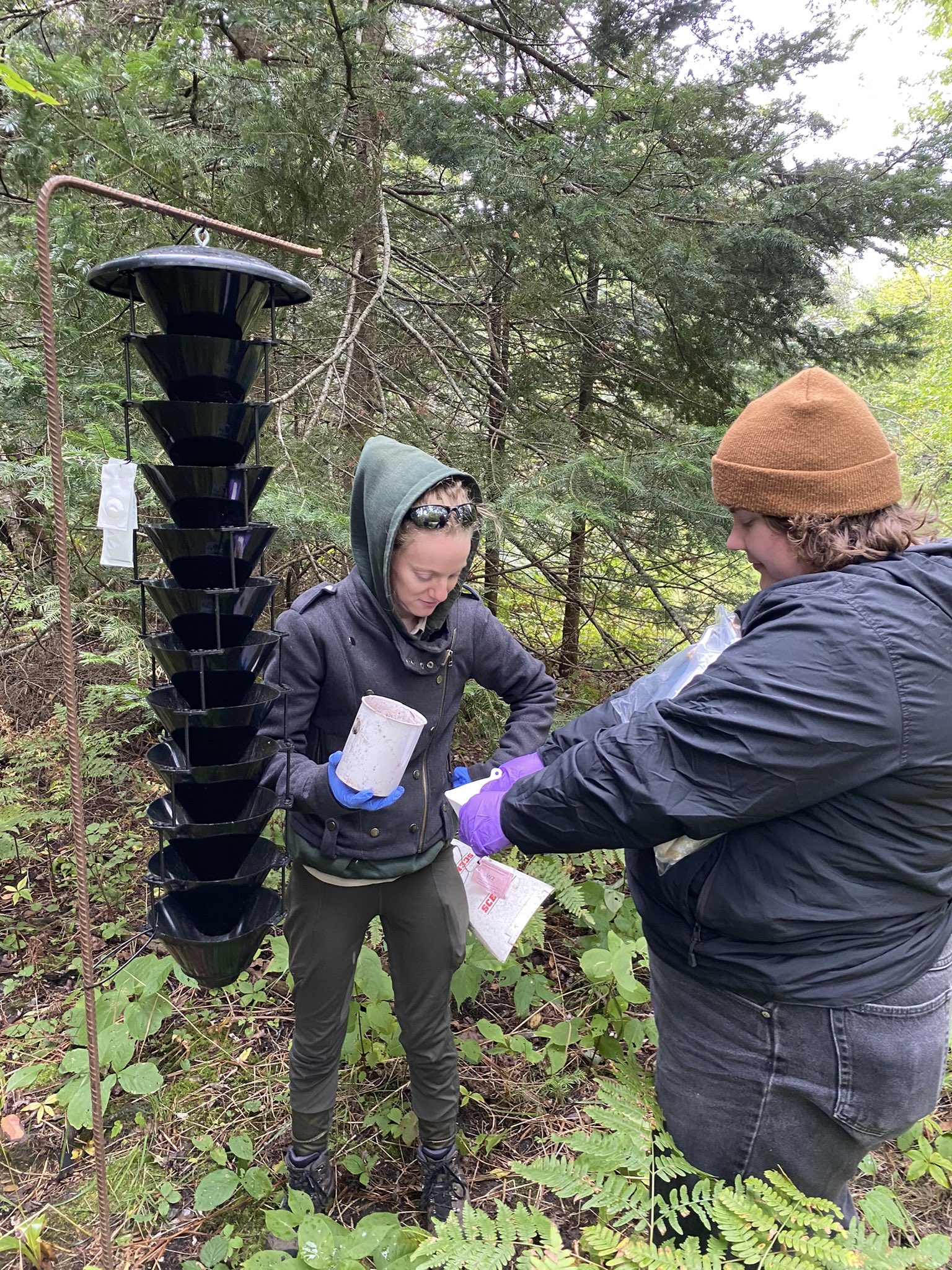
Paige Payter and Ren McIntyre checking a beetle funnel trap, which looks like a very large screw almost as tall as a person, in a forest.
Paige Payter (left) and Ren McIntyre checking a funnel trap for beetles. Courtesy photo

As part of the MSU 2030 Strategic Plan, the university is taking steps toward climate neutrality by 2050, doing its part to address global climate challenges through its work on campus and beyond. According to the latest Times Higher Education Impact Rankings, MSU is No. 2 in the U.S. and No. 26 globally for sustainability. The university also earned a gold rating for sustainability achievements through the Association for the Advancement of Sustainability in Higher Education.

Maintaining these natural areas is a vital part of that sustainability commitment. MSU’s campus is home to more than 20,000 trees, many of which can be found in places like the Baker Woodlot, which is part of the national Old Growth Forest Network. The Toumey Woodlot is on the National Park Service Register of Natural Landmarks. And the Baker Woodlot and Sanford, Hudson and Red Cedar natural areas all have state-listed rare plants.

Stewarding these areas is important not only for sustainability but also for the enjoyment and benefits they provide to the entire Spartan community.

Protecting and expanding MSU’s natural footprint

Rothstein, Prather and Payter are not the only faculty and graduate students utilizing campus natural areas. Research is encouraged by many and so is use by the public for activities like walking, hiking, bird-watching, nature photography and field trips. The Department of Forestry hosts Spartan Nature Walks at the Baker Woodlot each year — including during the summer — led by faculty members like Rothstein.

Alan Prather poses in front of a tree wearing a half-zip Spartan shirt
Alan Prather. Courtesy photo

The spaces are managed by the Campus Natural Areas Classroom, Curriculum and Conservation Committee, or CNA3C, a group of faculty and staff who represent an array of disciplines and expertise in natural science and resource management. The CNA3C is responsible for optimizing instruction and research value while also preserving the areas for future generations — which currently means removing invasive species that have made their way into some spaces on campus.

And soon the CNA3C will have more space to steward. As part of the new Integrated Facilities and Land Use Plan, the MSU Board of Trustees approved a new to-be-named natural area adjacent to the Baker Woodlot.

This means MSU’s outdoor classrooms are expanding, too. “Just like our more traditional classrooms and technology-aided learning spaces,” Rothstein says, “our natural areas are very much a critical infrastructure for education.”
Celebrate Earth Day - Support MSU's sustainable initiatives - Give now
Climate and EnvironmentNatural Resources and ConservationNatural Resources and Conservation

Latest News

MSUToday Weekly Update

The MSUToday Weekly Update email showcases how Spartans are making a difference through academic excellence, research impact and community outreach. Get inspired by these stories of innovation, collaboration and determination. Plus, enjoy photos and videos of campus and more MSU content to help keep you connected to the Spartan community.

Sign UpUpdate My Information

Connect With Us

Visit our Facebook pageVisit our page on XVisit our Instagram pageVisit our LinkedIn pageVisit our YouTube pageVisit our TikTok page

Health and Safety

  • MSU Police and Public Safety
  • Olin Health Center
  • Counseling & Psychiatric Services (CAPS)
  • University Health and Wellbeing
  • MSU Health Care
  • Civil Rights and Title IX
  • Our Commitment
  • Center for Survivors
  • Security & Fire Safety Report
  • University Policy on Relationship Violence and Sexual Misconduct
  • Notice of Non-Discrimination, Anti-Harassment and Non-Retaliation
  • Health Care Non-Discrimination Notice

Support Services

  • Disability Resources
  • Supportive Services
  • Learning Resources

Working at MSU

  • Human Resources
  • EBS Login
  • Job Postings
  • Employee Assistance Program

Reports

  • CARES Act Funding
  • Student Achievement and Outcomes

Contact us

517-355-1855

Address

Michigan State University 426 Auditorium Road East Lansing, MI 48824

Follow Us

  • Visit our Facebook page
  • Visit our page on X
  • Visit our Instagram page
  • Visit our TikTok page
  • Visit our LinkedIn page
  • Visit our YouTube page

If you're having accessibility issues, please let us know.

Know More: Campus Safety Information and ResourcesTransparency Reporting: Budget & Salary/Compensation
  • Contact Information|
  • Site Map|
  • Privacy Statement|
  • Site Accessibility|
  • Call MSU: (517) 355-1855|
  • Visit: msu.edu|
  • Notice of Nondiscrimination|

SPARTANS WILL|© Michigan State University|

