When Project GREEEN began 25 years ago with a mission of advancing the Michigan plant agriculture economy, an opportunity arose to create a game-changing tool for growers.
Together with plant commodity organizations and the Michigan Department of Agriculture and Rural Development, leaders and researchers at Michigan State University identified the need for real-time weather information to help make farming decisions — dealing with pests, plant development and natural resources management.
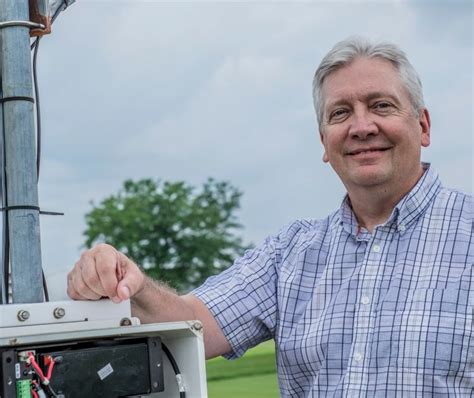
Jeff Andresen, a professor in the MSU Department of Geography, Environment and Spatial Sciences, was tapped to direct the initiative, now known as Enviroweather. Andresen, who also serves as the state climatologist for Michigan, visited new operations in Nebraska and Washington to learn how to effectively launch a sustainable weather monitoring program.
“The big takeaway was to find recurring funding support,” Andresen said. “That was the main barrier to success because in most places, there aren’t many options for recurring funding. We’ve been extremely fortunate to have that through Project GREEEN. It was amazing foresight and vision from Project GREEEN leaders to support the program at that time.”
The Michigan Automated Weather Network, as it was formerly known, was born — a partnership among MSU AgBioResearch, MSU Extension and Project GREEEN — and included six stations.
Today, the Enviroweather system has 93 sites across Michigan, each consisting of a solar-powered tower that collects information on temperature, rainfall, relative humidity, dew point, soil temperature, wind direction and more. Information is uploaded to the Enviroweather website, where data can be viewed at 5-minute, hourly or daily resolution.
Enviroweather partners with the National Weather Service to provide basic weather information, but Andresen said the site-specific, detailed measurements collected by the towers are particularly valuable to growers.
The program used to support more than 100 stations when factoring in partner sites in Wisconsin, but those are now managed solely through a new Enviroweather-type program at the University of Wisconsin-Madison.

Alongside Andresen, Keith Mason helps lead Enviroweather as the program coordinator. He said the ability to access the wealth of information in one place is the program’s best selling point.
“Farmers are very busy people, and time-saving tools are needed to help make their jobs manageable and keep their businesses competitive in today’s markets,” Mason said. “Enviroweather is helping with that by providing growers with real-time, weather-based information to help support decision making on the farm. This includes current local weather observations, forecasts from the National Weather Service, as well as models that track crop development and predict the timing of key insect pests and diseases.”
More than 60 models, applications and informational products have been developed that are aimed at specific challenges such as spotted wing drosophila, or SWD, a devastating invasive pest of soft-fleshed fruits such as cherries and berries. The SWD model was developed in partnership with MSU entomologists and pinpoints weather conditions likely to foster increased pest populations and activity.
“The fruit industries have consistently been one of the main users of our system,” Andresen said. “Tree fruit management, in particular, requires a lot of attention to pesticide and fungicide timing. It’s one of the reasons we have so many stations across the fruit belt of West Michigan.”
For Ben Smith, a grower of juice and wine grapes in southwest Michigan, Enviroweather is a critical management tool. He said the system’s tracking of growing degree days — which are used to track crop development — and the ability to time nutrient, pest and disease applications is invaluable.
“Using this information, we can better predict disease or insect lifecycles, for example, and that lets us know when to spray,” said Smith, who is also the executive secretary of the Michigan State Horticultural Society. “I really can’t overstate how important Enviroweather is to making good crop management decisions. Michigan is a very diverse state with respect to weather, so having Enviroweather stations close to us is very helpful. We rely on this information every growing season.”
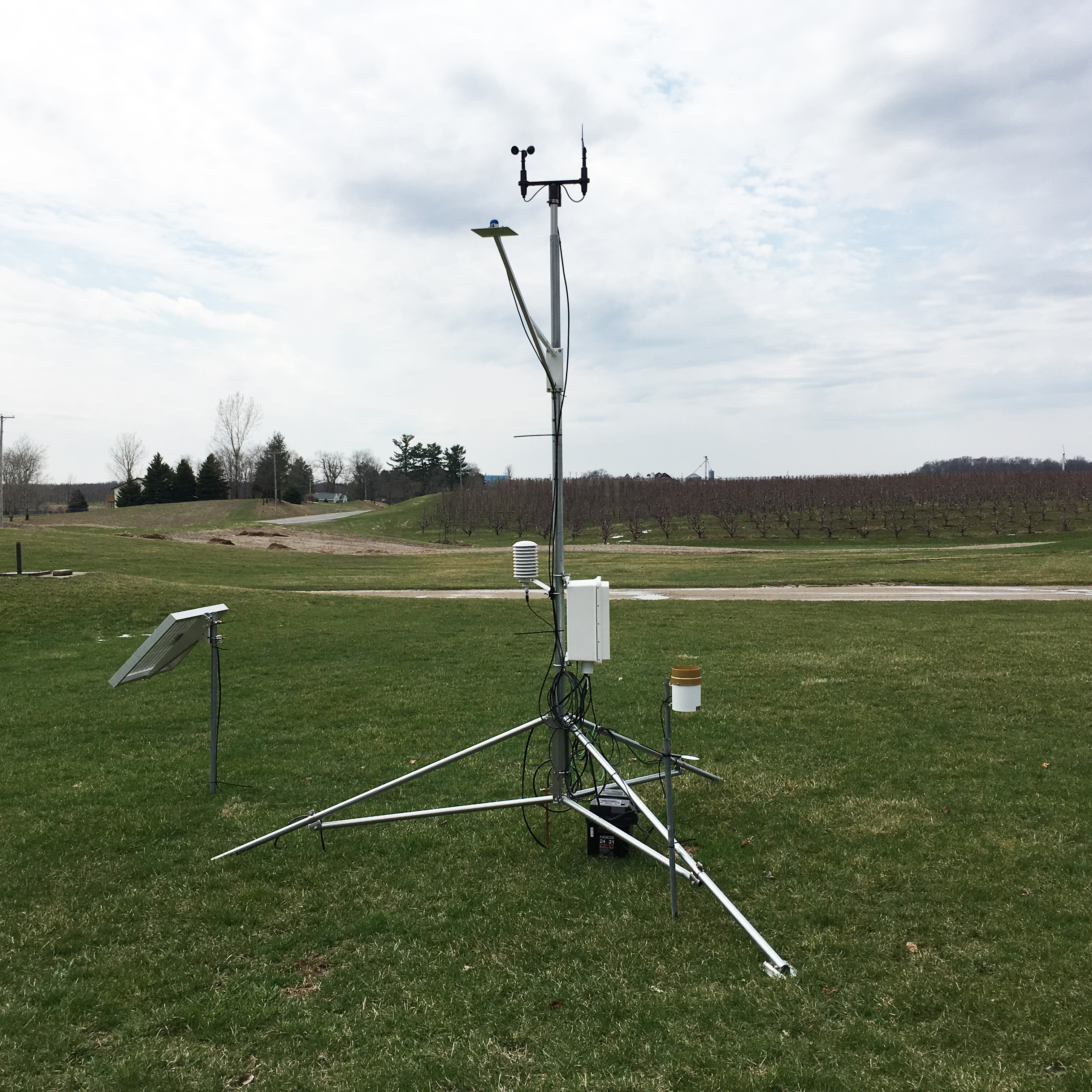
As advanced as Enviroweather has become, one of the primary obstacles is hosting enough sites to adequately cover the state’s growing regions. Andresen said that adding more stations will always be the goal, but there are financial and practical limitations.
The original idea was to organize the stations in a grid pattern, but given the high quality of the equipment, the cost of installation is prohibitive.
“It’s roughly $10,000 to $12,000 to install a new station,” Andresen said. “We know that growers could benefit from more stations, and we’re trying to install as many as we can in strategic growing regions. Obviously the closer a grower is to a station, the more relevant the measurements will be. But there are financial constraints, so we make those decisions accordingly.”
Using a Project GREEEN grant, researchers are currently exploring ways to supplement the information gathered by MSU-supported stations by testing the feasibility of letting growers with their own equipment tap into the Enviroweather network. This work is in its infancy, and there are some drawbacks, but Andresen said this could help those who don’t have access to Enviroweather stations nearby.
“We use high-end equipment for our stations because when it comes to weather monitoring, you get what you pay for,” Andresen said. “If you buy a small unit for $100 to collect some basic information, for example, you may not get really accurate, usable data on a dependable basis. But for those willing to invest, we’re happy to share our system and find ways to make it beneficial to them. We think that is really the next frontier for our system, making it more accessible to as many growers as possible.”
In addition, Mason noted that users have inquired about mobile-friendly system upgrades such as a phone application. Growers have provided feedback that the current website can be difficult to navigate on a phone, and the Enviroweather team is working to address those concerns.
“Enviroweather must continue to grow, both in the number of stations and in the number and types of weather-based tools that we develop and host on our website,” Mason said. “Whenever I talk with growers at MSU Extension meetings or commodity group events, I always hear that they start their day by checking conditions on Enviroweather, and I can see how they rely on and appreciate what we do. It’s incumbent on us to continue to improve the system and explore ways to better meet grower needs.”
For more information on Enviroweather, visit enviroweather.msu.edu.
This story originally appeared on the College of Agriculture and Natural Resources website.

