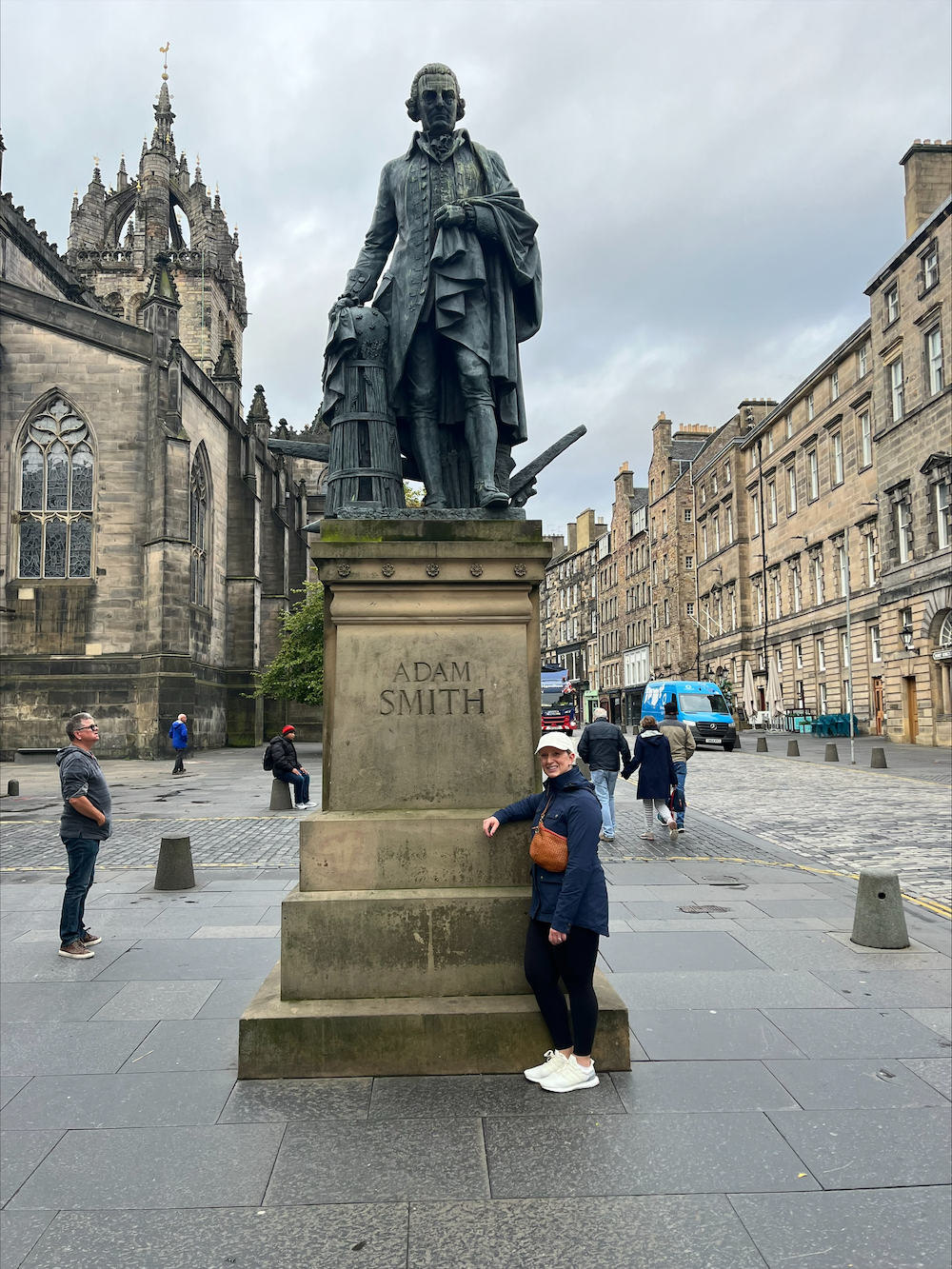
Philosophers and economists from centuries ago offered theories and insight that have shaped our economy today, including Adam Smith, an 18th century philosopher who many credit as the father of modern economics. Despite living several centuries ago, examining Smith’s theories offers value today as the economy remains a top concern for many Americans. Although a Gallup poll found Americans are saying the economy has started to improve, 45% still rated the economy as in poor condition, at the start of 2024.
Brianne Wolf, an assistant professor of political theory and constitutional democracy at Michigan State University’s James Madison College, specializes in the history of political thought and the interaction of economics and politics. She answers questions about what insight we can learn from Adam Smith – including taking her to the archives in Scotland.
What should we know about Smith and your research?
Adam Smith’s ideas were much more complicated than we often claim, and so too, economic issues in our day cannot be reduced to political slogans or doctrines. While Smith certainly cared about advancing economic prosperity, he was also committed to improving the lives of less advantaged people. My research shows that Smith was committed to many liberal values such as equality, freedom, dignity, and moral connections in civil society and not just the supremacy of the market. In Smith’s time, moral, political, and economic concerns were not considered separate disciplines in the way that they are studied today in the academy. We’re seeing a resurgence of this interdisciplinary approach today as many colleges and universities are offering philosophy, politics and economics or political economy degrees. James Madison College has offered a political economy major, minor, or concentration since 1988 and I get to advance my research program by teaching in this minor.
How does studying Smith help us better understand capitalism and our economy today?
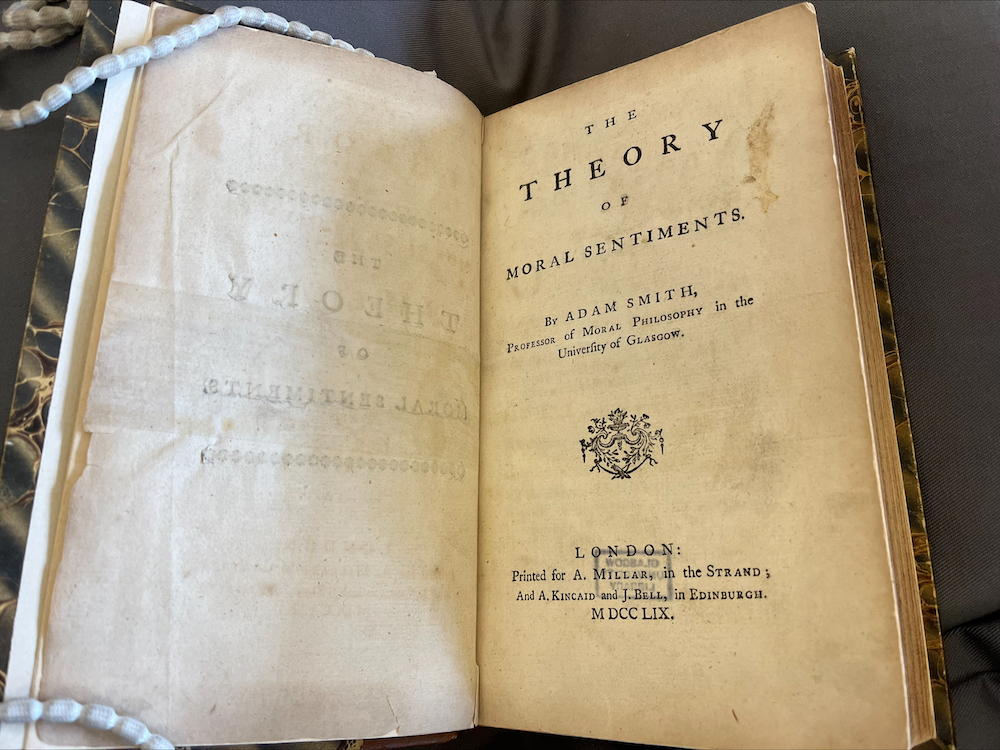
Sp Coll Mu40-d.10, With permission of University ofGlasgowArchives& Special Collections.
Reading about Smith’s can give us an outsider’s lens through which to view our own practices. One of Smith’s primary purposes in writing Wealth of Nations was to argue against mercantilism, or the state offering special privileges to specific individuals in domestic industry.
For example, he argued in particular against the state encouraging specific domestic industries through bounties and tariffs at the expense of free trade. We can examine trade debates today through the way that Smith describes them which allows us to be more objective and thoughtful about the claims we make today about whether we should engage in international trade or whether trade necessarily leads to the exploitation of workers. He also allows us to see the way that history repeats itself in the controversies that continue to plague us at the intersection of markets and politics. He also allows us to appreciate the advances in the economy and overall prosperity of society that we take for granted now.
My students are always horrified when we reach a section in Wealth of Nations where Smith explains why poor families need to have many children to ensure they have enough labor to survive because “poverty…is extremely unfavorable to the rearing of children” and “great mortality…will everywhere be found chiefly among the children of the common people, who cannot afford to send them with the same care as those of better station.”
Smith is describing an unfortunate economic reality of the eighteenth century where it was common for not all children to live to adulthood. So, if a family was poor, they needed to ensure that they had enough children because children worked to support the family from a young age. These descriptions help us see our economic advances, but also question and morally consider the development of labor in the eighteenth century.
One of Smith’s primary purposes in writing Wealth of Nations was to argue against mercantilism, or the state offering special privileges to specific individuals in domestic industry. For example, he argued in particular against the state encouraging specific domestic industries through bounties and tariffs at the expense of free trade.
How did your trip to Scotland support your research?
In the Smith archives, I was able to see the first editions of his work, unpublished notes, and in Edinburgh specifically, review some of the books he held in his personal library and examine them for notes he took in the margins. In Glasgow, I was able to see the student notes from his courses on jurisprudence which are the only record we have of what would have been a third work from Smith but was never completed. I further analyzed his various early fragments on the division of labor that eventually appear as the first chapters of Wealth of Nations—some of these are published. All of this research and more helped advance my understanding of Smith’s perspective on political economy and the interaction of morality, politics, and economics.
What would Smith think about our economy today?
First, I would think Smith would be amazed and excited by the amount of prosperity that has been achieved through the division of labor and through trade. Second, he would not be as worried about economic inequality as we all are today, as he accepted a degree of inequality as a natural part of any society.
That said, he would not be in favor of the high degree of cronyism that operates alongside capitalism and liberal democracy today. For example, in 2022, the United States government passed the CHIPS Act to prevent those who receive government funding from purchasing semiconductor chips from countries that pose a national security threat to the United States. This intervention in the market — a protectionist policy — potentially benefits domestic chip producers if they can hire enough workers to keep up with the demand but hurts the overall market for innovation and raises costs because of many new rules and regulations.
He would also be concerned about limiting the potential for individuals to connect with distant others and sympathize or put themselves in one another’s shoes through economic exchange. He would be disappointed at the ways in which we allow the rich in both politics and the private sphere to use the tools of government to insulate themselves from checks on their power and the tools of the market to limit competition and to choose winners and losers in the economic game, especially based on political connections, trading favors to further enrich leaders in politics and business, or funding political candidates to remain in office.

