Jump to HeaderJump to Main ContentJump to Footer
Michigan State University
MSUTODAY
  • Browse Stories By

    Topics

    Explore stories by subject area

    • Arts and Culture
    • Business and Economy
    • Climate and Environment
    • Education and Learning
    • Engineering, Science and Technology
    • Government and Society
    • Health and Medicine
    • Media and Communications
    • MSU Leadership and Impact
    • Sports and Recreation
    • Student and Campus Experience
    View All Stories

    Collections

    Curated story series

    • Alumni stories
    • Turfgrass
    • Ask the Expert
    • Big Ideas
    • Climate solutions
    • Water at MSU
    • Mobility
    • Spartan Perspectives
    • Student views
    • Graduate voices
    • Faculty voices
    View All Collections

    Featured

    Editor's picks

    • 9 reasons to love being a Spartan

      Aug. 28, 2026

      9 reasons to love being a Spartan

    • NIH awards multi-university team over $4M to improve women’s health

      Sept. 15, 2026

      NIH awards multi-university team over $4M to improve women’s health

MSUTODAY
  • Browse Stories By

< Browse Stories By

Topics

Explore stories by subject area

  • Arts and Culture
  • Business and Economy
  • Climate and Environment
  • Education and Learning
  • Engineering, Science and Technology
  • Government and Society
  • Health and Medicine
  • Media and Communications
  • MSU Leadership and Impact
  • Sports and Recreation
  • Student and Campus Experience
  • View All Stories

Collections

Curated story series

  • Alumni stories
  • Turfgrass
  • Ask the Expert
  • Big Ideas
  • Climate solutions
  • Water at MSU
  • Mobility
  • Spartan Perspectives
  • Student views
  • Graduate voices
  • Faculty voices
  • View All Collections

Featured

Editor's picks

  • 9 reasons to love being a Spartan

    Aug. 28, 2026

    9 reasons to love being a Spartan

  • NIH awards multi-university team over $4M to improve women’s health

    Sept. 15, 2026

    NIH awards multi-university team over $4M to improve women’s health

  • For Media
  • Experts
  • Releases and Statements
  • Sign Up
  • Update Information

Resources

  • A to Z Index
  • Find People
  • Maps
  • Email
  • Student Information System (SIS)
  • D2L
  • Libraries
  • Tech Support
  • MSU Misconduct Hotline
  • Social Media Directory
  • Events Calendar
  • For Media
Michigan State University
MSUToday
  • For Media
  • Experts
  • Releases and Statements
  • Sign Up
  • Update Information
Natural Sciences

Feb. 18, 2024

Illuminating the source-sink balancing act of photosynthetic ‘tiny green bacteria’

By: Kara Headley

Cyanobacteria are little green microorganisms that photosynthesize, like plants and algae do, but with stark differences in how they function. 

“I prefer to say that they are tiny green bacteria that are able to perform photosynthesis as plants but within a really tiny compartment,” María Santos-Merino, a postdoctoral researcher in the Ducat lab at the Michigan State University-Department of Energy Plant Research Laboratory, or PRL. 
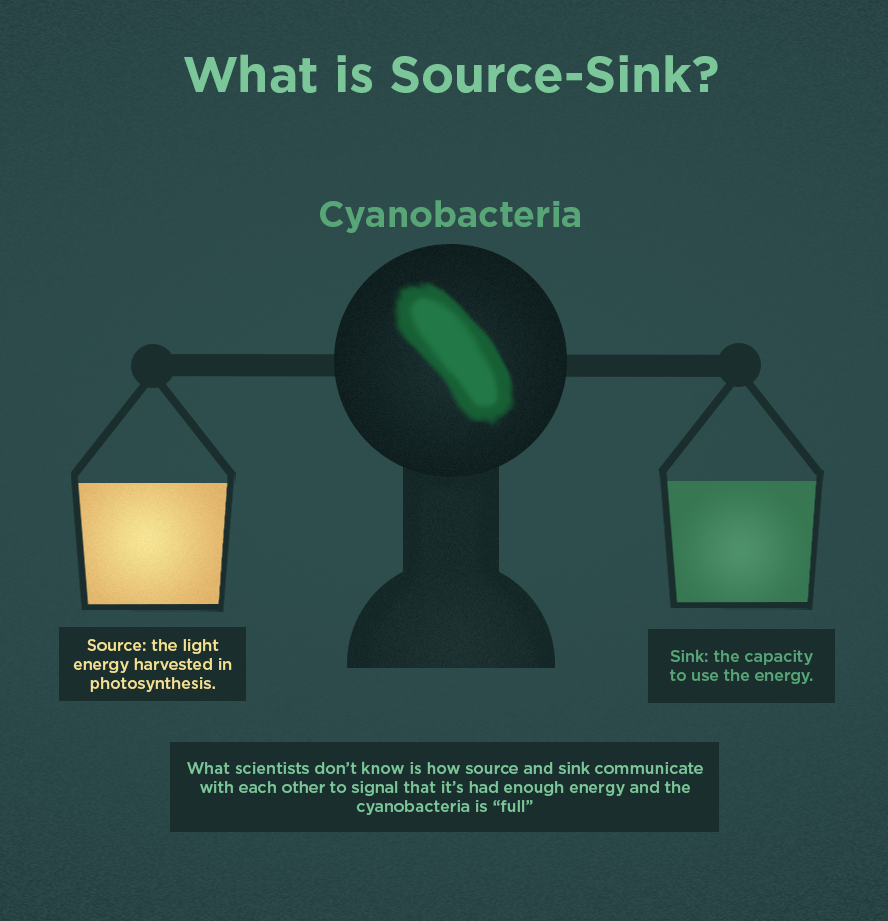
Source-sink is the name given to a regulatory mechanism that balances the light energy harvested in photosynthesis — source — with the capacity to use said light energy — sink.

Santos-Merino was the first author of a recent publication in "Metabolic Engineering" that looks at how cyanobacteria balance cellular energy between “source and sink,” which may have downstream applications in bioproduction. 

During photosynthesis, an organism performs many steps when taking light energy and converting it to the fuel it needs to grow and survive. At the same time, the organism does not want to work to harvest more energy than it needs. So it needs to be able to signal itself from within to indicate that it has harvested enough energy. 

Source-sink is the name given to a regulatory mechanism that balances the light energy harvested in photosynthesis — source — with the capacity to use said light energy — sink.  

“We are trying to identify the communication between source and sink activities,” said Santos-Merino. “In other words, we are trying to identify how cyanobacteria are able to balance the activity of the source with its capacity to use this energy in the different sinks. We know that this process happens, but we did not know how it was regulated.” 

The researchers started with a library of 44 two-component protein systems. Two component systems work like text messages. One component sends a message and the other receives and responds. This is how cyanobacteria normally communicate and respond to environmental and internal cues. 

Taking the 44 two-component systems, the researchers created mutant cyanobacteria lacking one of each of these components. They then observed whether the communication between source and sink was disturbed, allowing them to determine which, if any, of these 44 two-component systems were involved in this signaling pathway. 
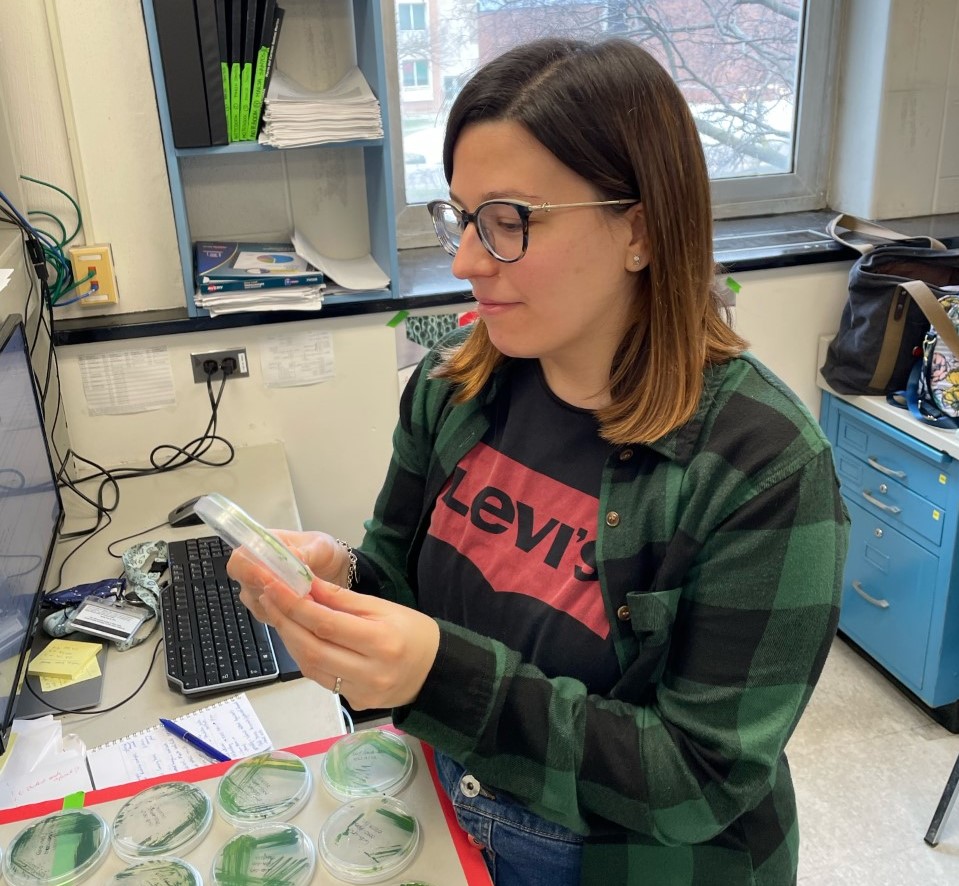
María Santos Merino checking her collection of mutant cyanobacteria.

The study identified four candidates of the 44 thought to be involved. Next steps for the lab include further characterizing what these individual candidates do at the molecular and metabolic level. 

“The most interesting takeaway of this research was that it implies that the central network regulating energy balance in cyanobacteria may rest on a relatively few regulatory proteins,” said Daniel Ducat, associate professor at the PRL and in the Department of Biochemistry and Molecular Biology. He was the principal investigator on this study. “These proteins have largely not been implicated in energy balancing roles in the prior literature. In the long term, the practical application of this research is that if we learn how to dial in the metabolic balance of cyanobacteria, it could enable us to poise them for higher photosynthetic activity and efficiency.” 

Santos-Merino has been working with cyanobacteria since she started her doctoral studies in 2012. 

“I think that they are fascinating, underappreciated microorganisms that had very important ecological roles,” she said. “Every time that I discover something that is unknown, my curiosity increases, [motivating me] to get deeper in the significance of this finding. There are still a lot of unanswered questions on how certain metabolic processes take place in cyanobacteria and how they are regulated. Answering some of them — or at least trying to answer them — is what makes me want to continue working with these organisms.” 

This work was primarily supported by the Department of Energy and Basic Energy Sciences Division. Additional support was provided from the National Science Foundation, Molecular and Cellular Bioscience Division.

This story originally appeared on the College of Natural Science website. 

Natural SciencesEngineering, Science and TechnologyMSU ResearchMSU Leadership and ImpactMSU Research

Latest News

MSUToday Weekly Update

The MSUToday Weekly Update email showcases how Spartans are making a difference through academic excellence, research impact and community outreach. Get inspired by these stories of innovation, collaboration and determination. Plus, enjoy photos and videos of campus and more MSU content to help keep you connected to the Spartan community.

Sign UpUpdate My Information

Connect With Us

Visit our Facebook pageVisit our page on XVisit our Instagram pageVisit our LinkedIn pageVisit our YouTube pageVisit our TikTok page

Health and Safety

  • MSU Police and Public Safety
  • Olin Health Center
  • Counseling & Psychiatric Services (CAPS)
  • University Health and Wellbeing
  • MSU Health Care
  • Civil Rights and Title IX
  • Our Commitment
  • Center for Survivors
  • Security & Fire Safety Report
  • University Policy on Relationship Violence and Sexual Misconduct
  • Notice of Non-Discrimination, Anti-Harassment and Non-Retaliation
  • Health Care Non-Discrimination Notice

Support Services

  • Disability Resources
  • Supportive Services
  • Learning Resources

Working at MSU

  • Human Resources
  • EBS Login
  • Job Postings
  • Employee Assistance Program

Reports

  • CARES Act Funding
  • Student Achievement and Outcomes

Contact us

517-355-1855

Address

Michigan State University 426 Auditorium Road East Lansing, MI 48824

Follow Us

  • Visit our Facebook page
  • Visit our page on X
  • Visit our Instagram page
  • Visit our TikTok page
  • Visit our LinkedIn page
  • Visit our YouTube page

If you're having accessibility issues, please let us know.

Know More: Campus Safety Information and ResourcesTransparency Reporting: Budget & Salary/Compensation
  • Contact Information|
  • Site Map|
  • Privacy Statement|
  • Site Accessibility|
  • Call MSU: (517) 355-1855|
  • Visit: msu.edu|
  • Notice of Nondiscrimination|

SPARTANS WILL|© Michigan State University|
