Jump to HeaderJump to Main ContentJump to Footer
Michigan State University
  • Browse Stories By

    Topics

    Explore stories by subject area

    • Arts and Culture
    • Business and Economy
    • Climate and Environment
    • Education and Learning
    • Engineering, Science and Technology
    • Government and Society
    • Health and Medicine
    • Media and Communications
    • MSU Leadership and Impact
    • Sports and Recreation
    • Student and Campus Experience
    View All Stories

    Collections

    Curated story series

    • Turfgrass
    • Ask the Expert
    • Big Ideas
    • Climate solutions
    • Water at MSU
    • Mobility
    • Spartan Perspectives
    • Student views
    • Graduate voices
    • Faculty voices
    View All Collections

    Featured

    Editor's picks

    • The Spartans behind your favorite Michigan golf courses

      July 22, 2026

      The Spartans behind your favorite Michigan golf courses

    • MSU in the 1990s: 10 Spartan milestones

      July 14, 2026

      MSU in the 1990s: 10 Spartan milestones

MSUTODAY
  • Browse Stories By

< Browse Stories By

Topics

Explore stories by subject area

  • Arts and Culture
  • Business and Economy
  • Climate and Environment
  • Education and Learning
  • Engineering, Science and Technology
  • Government and Society
  • Health and Medicine
  • Media and Communications
  • MSU Leadership and Impact
  • Sports and Recreation
  • Student and Campus Experience
  • View All Stories

Collections

Curated story series

  • Turfgrass
  • Ask the Expert
  • Big Ideas
  • Climate solutions
  • Water at MSU
  • Mobility
  • Spartan Perspectives
  • Student views
  • Graduate voices
  • Faculty voices
  • View All Collections

Featured

Editor's picks

  • The Spartans behind your favorite Michigan golf courses

    July 22, 2026

    The Spartans behind your favorite Michigan golf courses

  • MSU in the 1990s: 10 Spartan milestones

    July 14, 2026

    MSU in the 1990s: 10 Spartan milestones

  • For Media
  • Experts
  • Releases and Statements
  • Sign Up
  • Update Information

Resources

  • A to Z Index
  • Find People
  • Maps
  • Email
  • Student Information System (SIS)
  • D2L
  • Libraries
  • Tech Support
  • MSU Misconduct Hotline
  • Social Media Directory
  • Events Calendar
  • For Media
Michigan State University
MSUToday
  • For Media
  • Experts
  • Releases and Statements
  • Sign Up
  • Update Information
MSUTODAY
Social Sciences

Aug. 2, 2023

MSU unearths observatory foundation more than a century old

Discovery gives insight into campus history, provides educational opportunities


In summer of 2023, workers from Michigan State University Infrastructure Planning and Facilities, or IPF, were installing hammock posts close to student residence halls near West Circle Drive when they encountered a hard, impenetrable surface under the ground. 

Believing it to be either a large rock or building foundation, IPF called MSU’s Campus Archaeology Program, or CAP. After cross-checking old maps, campus archaeologists determined that it was the foundation of the first observatory on MSU’s campus, constructed in 1881. 

“The campus archaeology program is designed to protect and mitigate our below ground heritage here at MSU,” said Stacey Camp, director of CAP and associate professor of anthropology at MSU, “We collaborate with IPF on construction projects and we are involved in preplanning stages to ensure that if they potentially hit an archaeological site, we can protect it in some manner.”

The observatory discovery gives insight into how scientific observation, as well as life on campus, has changed over the last 140-plus years.

“It gives us a sense of what early campus looked like in the late 19th century,” said Ben Akey, MSU campus archaeologist and anthropology doctoral student. “The original campus observatory was built and used at a time when Michigan Agricultural College — what would become MSU — was a radically different institution with only a handful of professors and a relatively small student body.”

Akey’s role entails collaborating with IPF to keep up with campus construction projects, researching any discoveries and supervising crews of students participating in on-campus archaeological dig sites. Working closely with MSU Archives, Akey conducted most of the research to confirm that IPF’s discovery was indeed the foundation of the first campus observatory. They also drew on the book “Stars Over the Red Cedar” by Horace A. Smith, professor emeritus in the MSU Department of Physics and Astronomy for additional information.

“I did a lot of reading to learn more about the first observatory: its history, how it was used and what the building itself might have looked like,” Akey said.

Astronomical observation at MSU: Then and now

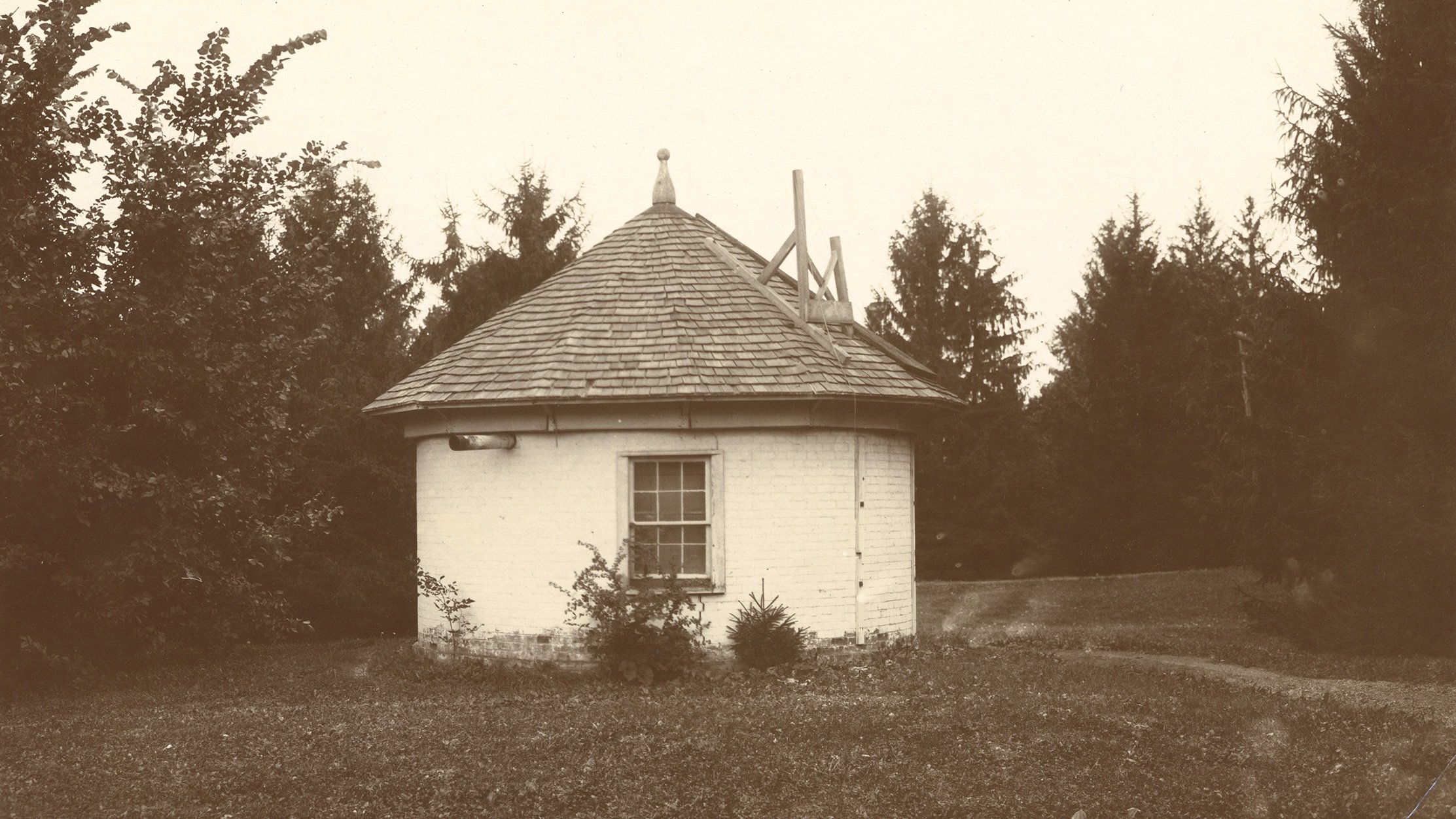
Located just behind what is now Wills House, the first observatory on MSU’s campus was built by Professor Rolla Carpenter. An 1873 graduate of Michigan State Agricultural College, Carpenter returned as a professor and taught a wide variety of courses, including mathematics, astronomy, French and civil engineering. 
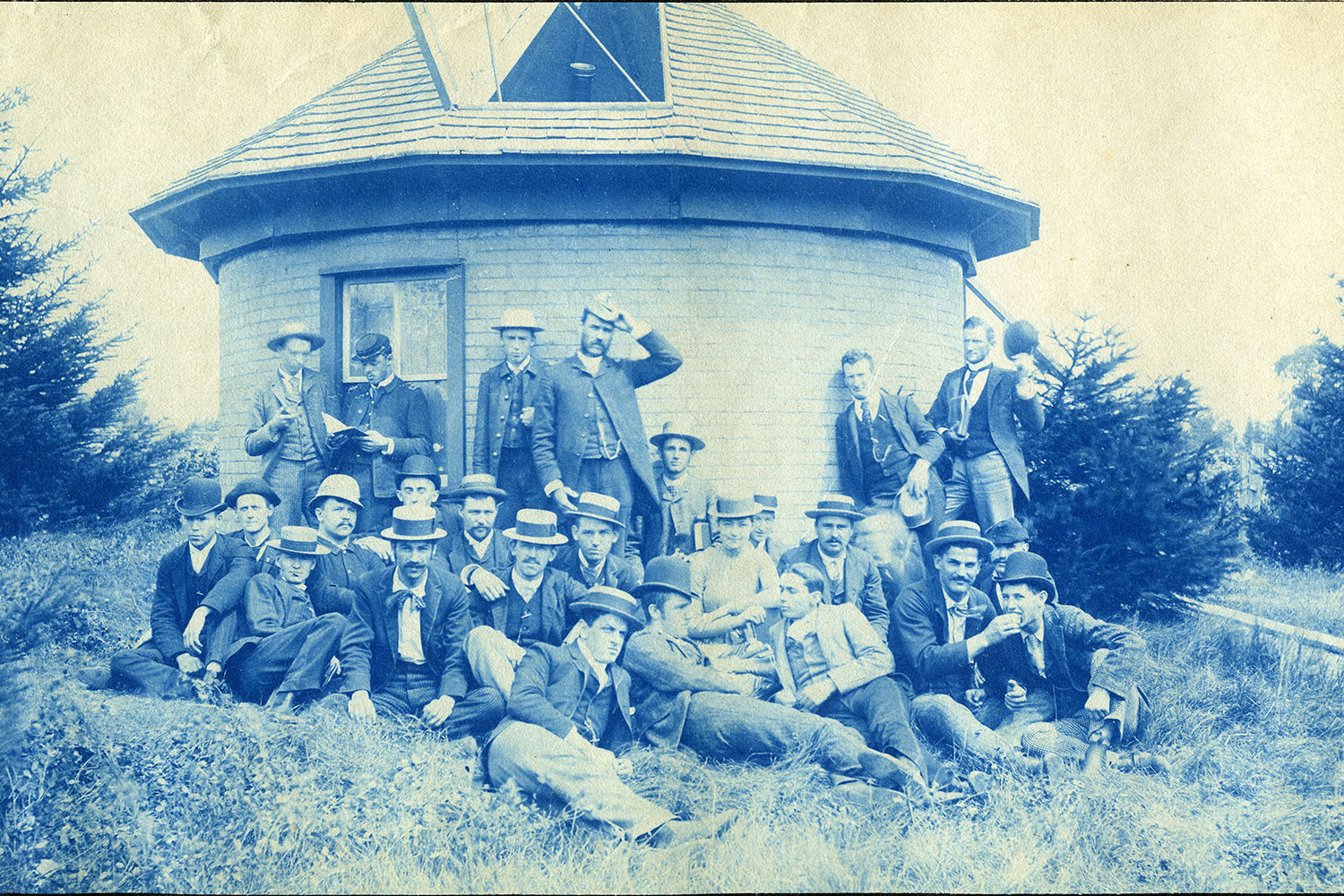
A black and white historical photo of men posing outside of MSU’s first observatory.
Individuals pose outside of MSU’s first observatory, circa 1888. The observatory is located behind where Willis House now stands on MSU’s campus, just south of Grand River in North Neighborhood. Photo courtesy of Michigan State University Archives and Historical Collections.

“In the early days of MSU’s astronomy program, Carpenter would take students to the roof of College Hall and have them observe from there, but he didn’t find it a sufficient solution for getting students experience in astronomical observation,” Akey said. “When MSU acquired a telescope, Carpenter successfully argued for funding for a place to mount it: the first campus observatory.”

Today, the MSU observatory is located just south of campus at the intersection of Forest and College roads. It boasts a 24-inch telescope and is used for undergraduate and graduate education and research, as well as faculty research. It also hosts free public observation nights.

Levi Webb is a fourth-year astrophysics and anthropology major who works at MSU’s current campus observatory and participated in the archaeological dig of the first on-campus observatory. 

“It’s amazing to see how far we’ve come from a little 16-foot circular building to a large building with a high-quality telescope and an electric dome,” Webb said. “Seeing the difference between how observing used to be versus how it is now is very interesting to me and makes me appreciative of the observatory we have now.”

Real-world experience: Field school and summer digs

While most students who work with campus archaeology are anthropology majors, some — like Webb — have backgrounds in other areas of study. In addition to Webb, the observatory dig crew included students majoring in classical and romance studies and forensics. 

“Having students from majors outside anthropology gives us a different perspective on what we’re finding in the ground,” said Camp. “We feel really lucky to have a wide variety of knowledge on our dig sites.” 

Akey said working on a dig site, such as the first campus observatory, helps prepare students for careers in archaeology. 

“CAP provides an essential venue of professional training for both graduate students and undergraduates in archaeological fieldwork in analysis,” Akey said.

One training opportunity is an undergraduate field school led by CAP. Most archaeology and anthropology programs require fieldwork, which is often done overseas and can often be costly. Every other summer, MSU hosts a field school that gives Michigan students who are interested in archaeology, but may not have the financial resources to travel abroad, an opportunity to do hands-on work on an actual site. 

For the upcoming field school in 2024, CAP is planning to focus on the first observatory site.
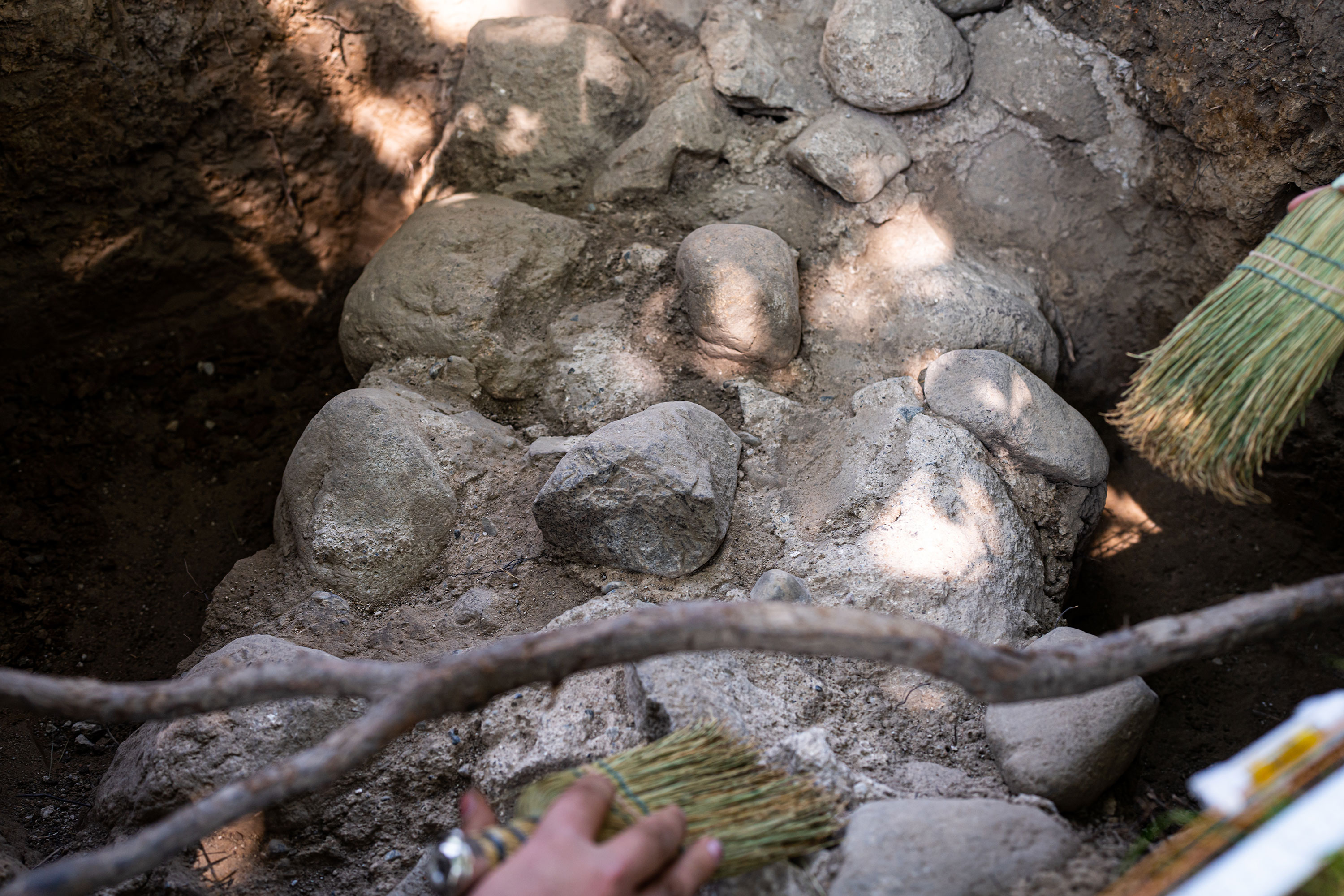
Stones and cement surrounded by dirt. They are being brushed off with brooms.
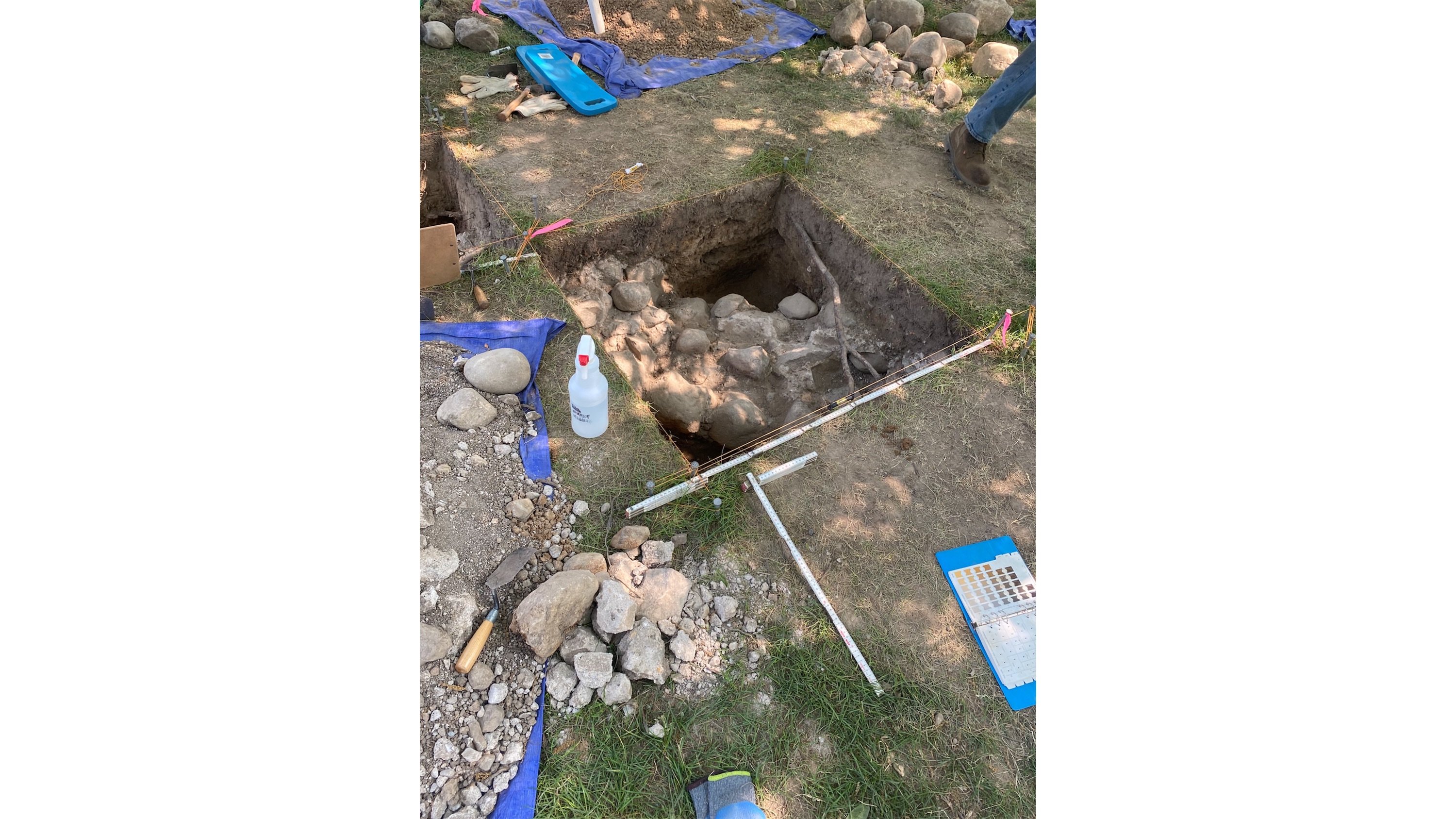
The foundation of MSU’s first observatory. The discovery gives insight into how scientific observation, as well as life on campus, has changed since the original observatory was built in 1881. Photo credit: Nick Schrader, MSU University Communications.

“Next summer, we’re planning to run an undergraduate archaeological field school where students can enroll for credit and get experience excavating the foundation of the first observatory on campus,” Camp said. “We anticipate having 18 to 20 students work on the project and get great experience doing archaeology.”

Camp said seeing students develop an interest in connecting the past with the present energizes her.

“I love watching students connect with artifacts and try to tell a bigger story about humankind with those objects,” she said. 

Connecting past and present

Akey said they appreciate the unique opportunity to learn more about MSU’s campus history while developing skills that will serve them beyond the completion of their Ph.D.

“One of the things I value most about archaeological work is kind of building a sense of connection to landscapes and people,” they said. “With a campus this old, there’s a lot of historic materials, archaeological materials that would be disturbed by all the ongoing construction on campus. Because of our partnership with IPF, those objects are not disturbed, and we get a chance to document and analyze some of them. It’s a pretty cool job.”

Camp was initially drawn to archaeology as a tactile way to interact with history and gain new perspectives.

“Archaeology gives us a bit more knowledge about how people lived in the past, how they did things differently and how maybe we could do things differently in the contemporary world as well,” she said. 

Webb sees this firsthand through his work at the observatory and on archaeological dig sites. 

“In my job working outreach at the observatory, I meet people who graduated from MSU many, many years ago who come and see the work that we’re doing, and they’re very proud to see how campus has grown,” he said. “I have even more insight into the campus’ evolution after learning about the first observatory and the history of scientific observation on campus.”

Camp said she feels honored to connect MSU’s past to its present through her work with CAP.

“MSU is a passionate and dedicated community,” she said. “Spartans are very invested in this campus and its history, and being able to share a little bit of my knowledge with people is very rewarding.”
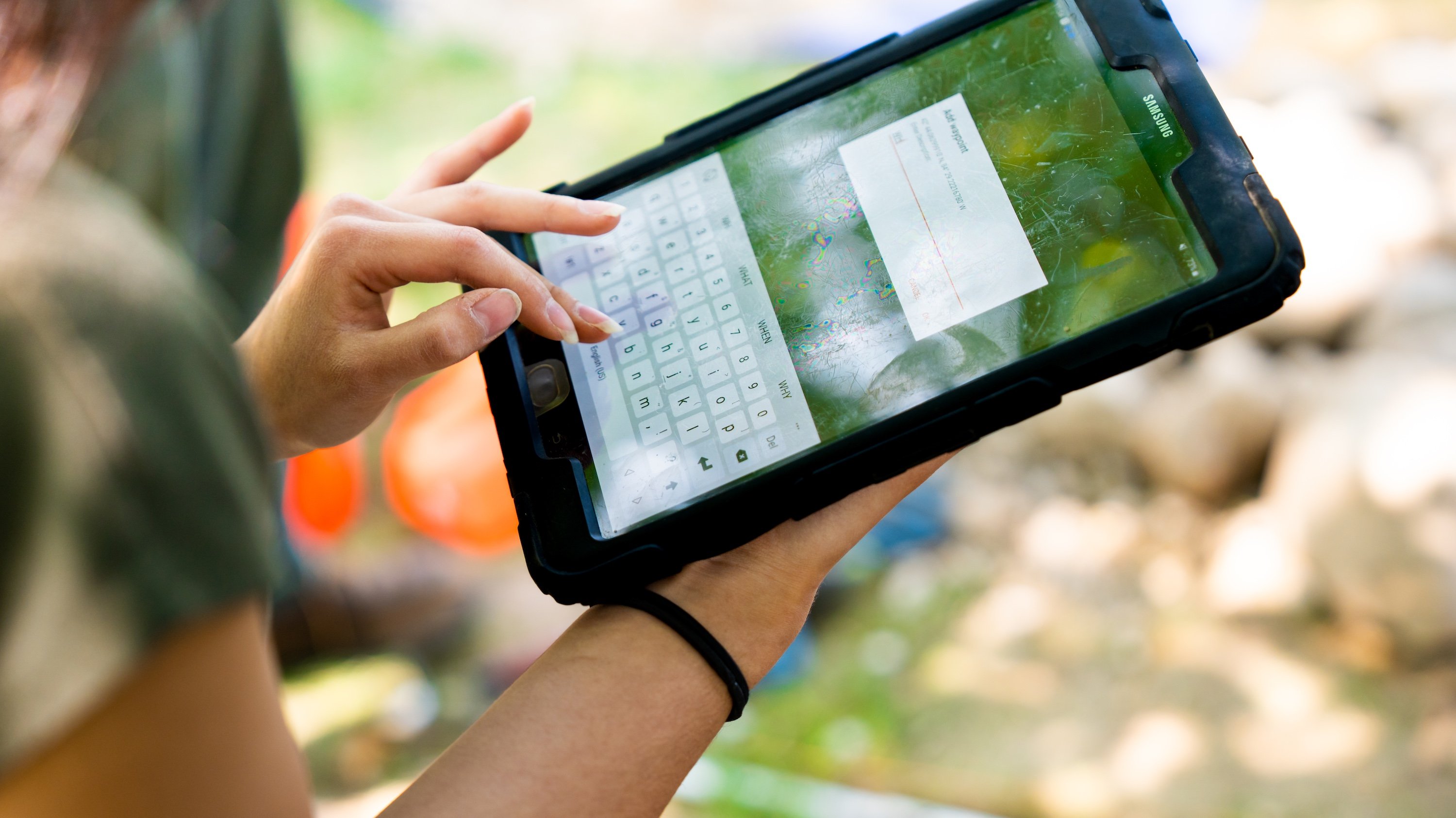
A person types on an iPad.
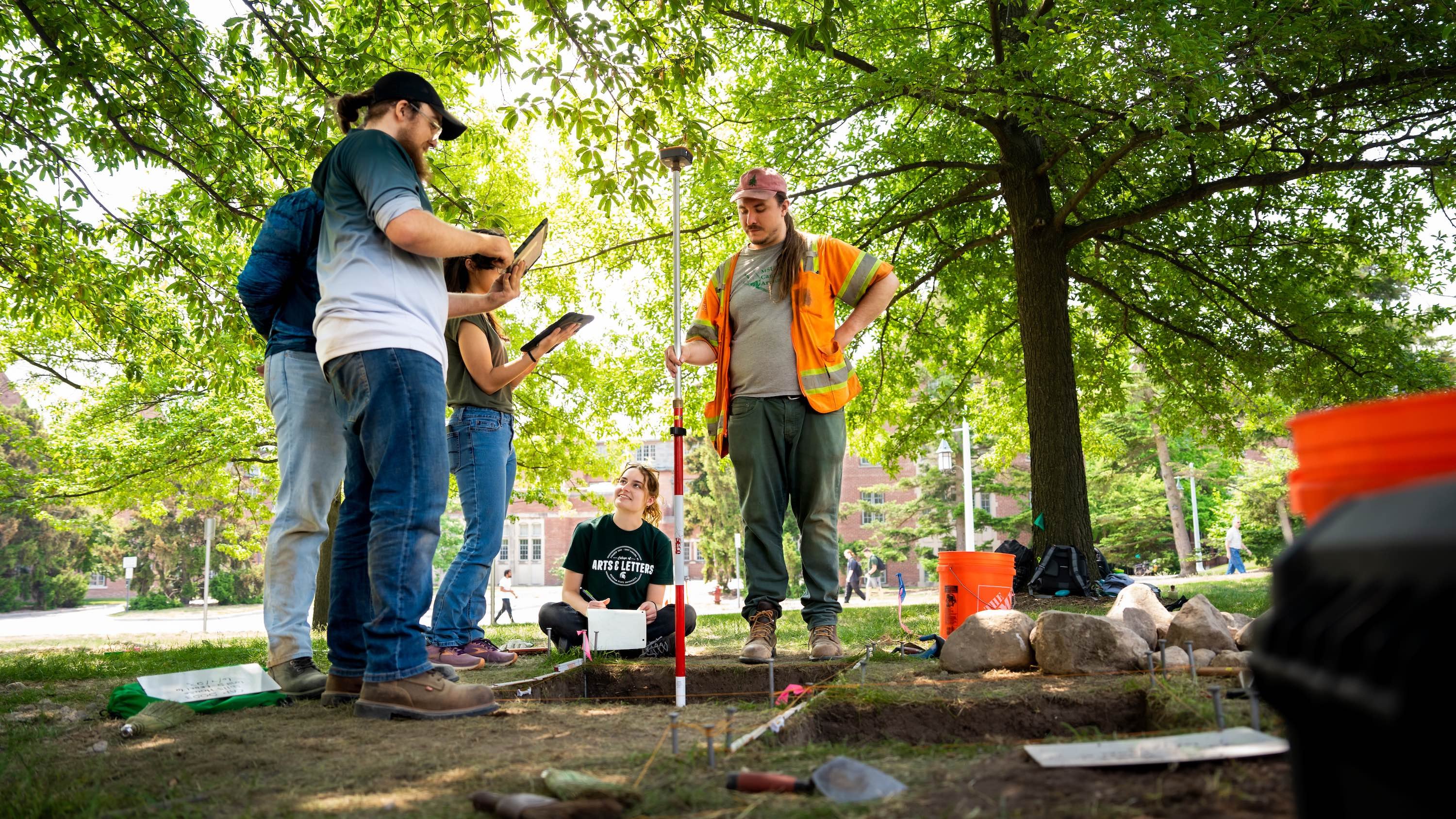
A person holds a long rod in one of two square holes dug into the grass. Three others take notes on paper or iPads.
A sepia-toned historical photo of a small hut in a grass field surrounded by pine trees.
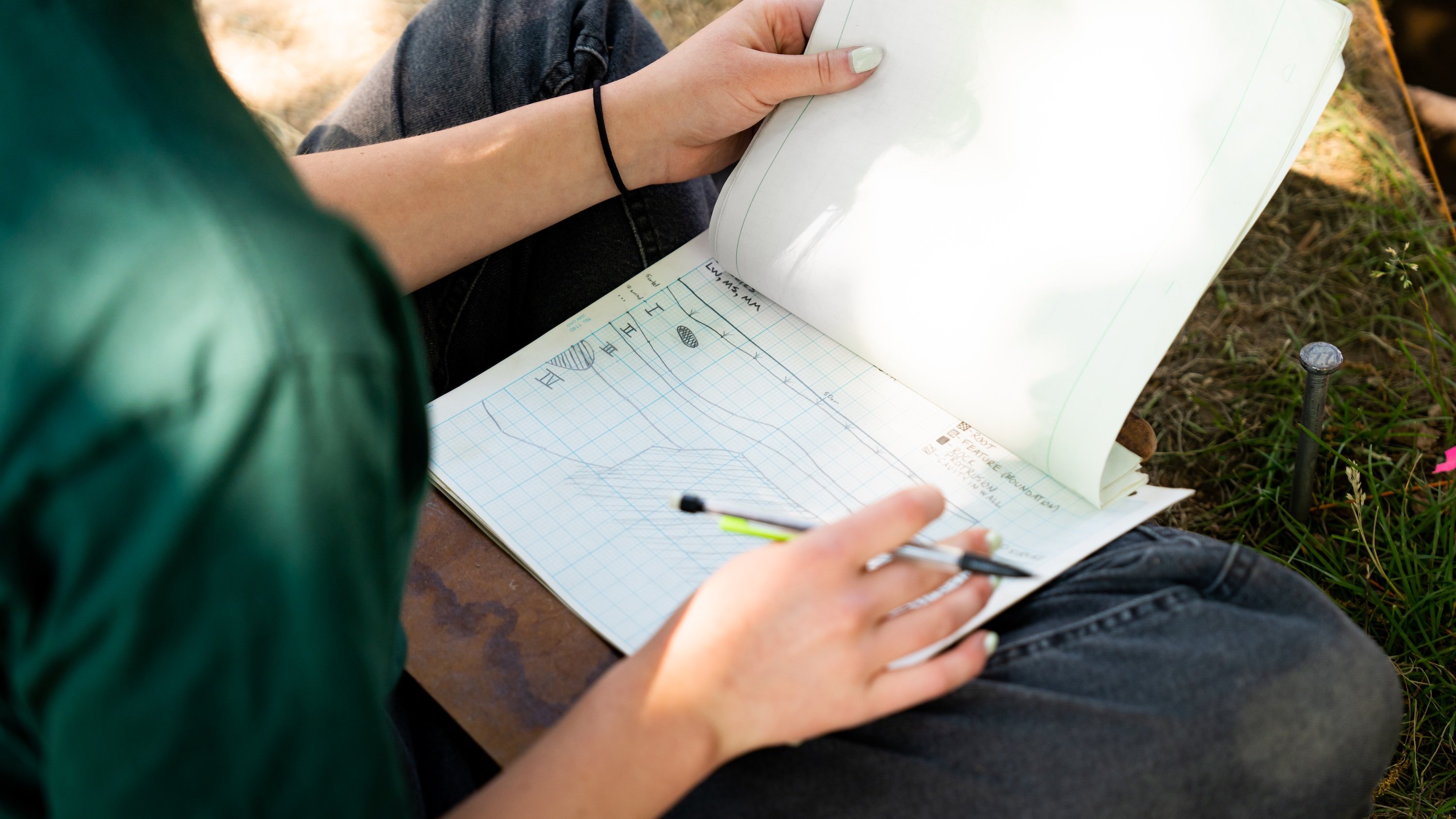
A person draws horizontal lines on grid paper.
A rock and cement foundation in square hole dug in the ground
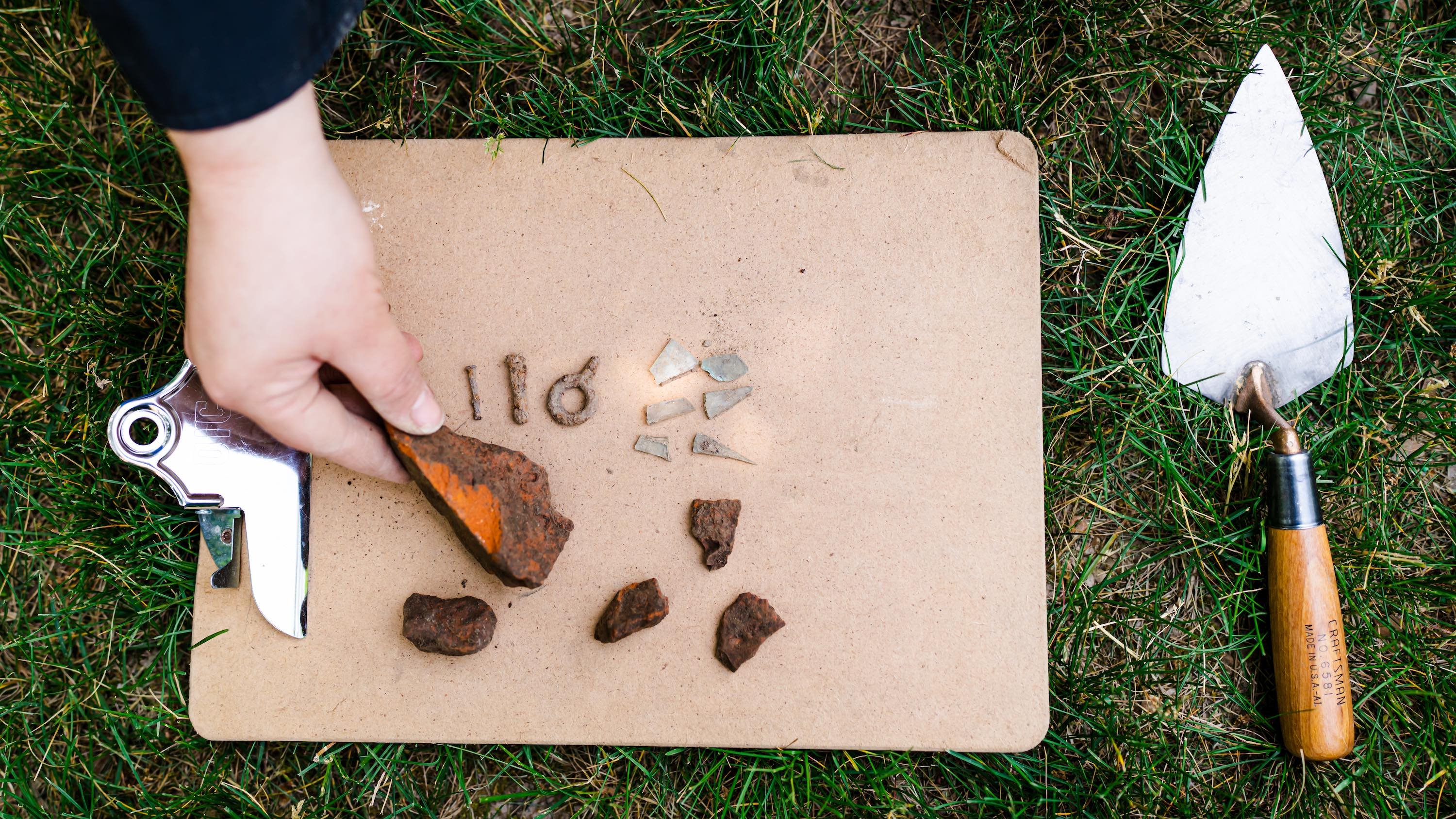
Three iron screws, six flat glass shards and five red brick fragments on brown clipboard. A hand is holding the largest brick fragment. The clipboard lays on grass and a trowel is laying on the on the right side of the clipboard.
A sepia-toned photo of a telescope
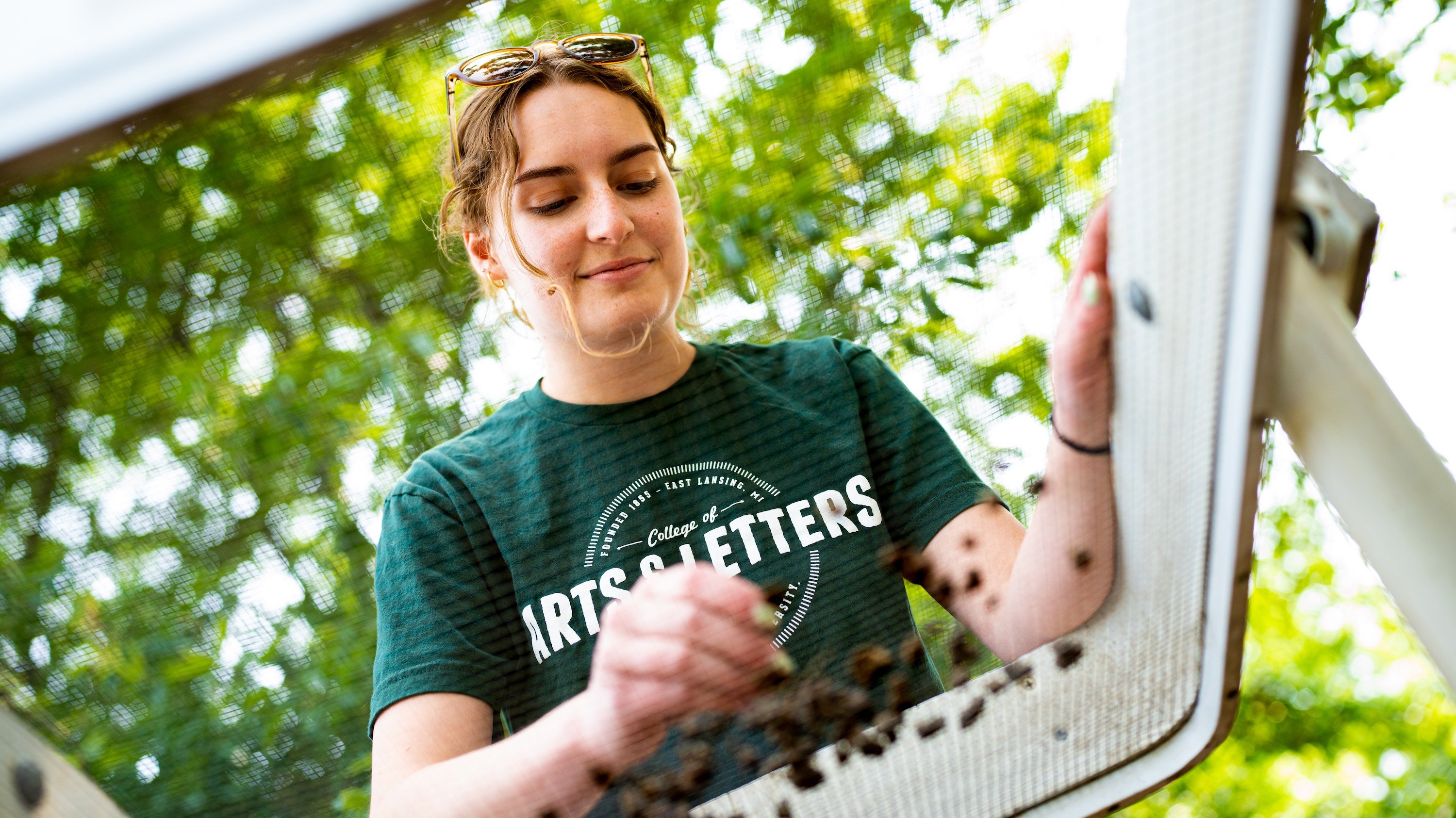
A young woman uses a large mechanism to sift through soil. The image is taken from underneath the large sifter.
A person types on an iPad.
A person holds a long rod in one of two square holes dug into the grass. Three others take notes on paper or iPads.
MSU Campus Archeology Program crew member Kelly Sullivan records geospatial data on a tablet connected to a GPS receiver. Photo by Nick Schrader, MSU University Communications.
The campus archaeology team at the observatory foundation dig site. Left to right: Mac Stevens, Kelly Sullivan, Morgan Manuszak, Campus Archeologist Benjamin Akey. Photo by Nick Schrader, MSU University Communications.
The exterior of MSU’s first campus observatory, circa 1900. Photo courtesy Michigan State University Archives and Historical Collections.
MSU Campus Archaeology Program crewmember Morgan Manuszak, Arts and Humanities senior, works on drawing a soil profile, a process archaeologists use to record changes in soil composition, texture, color, etc. of the excavation unit. Photo by Nick Schrader, MSU University Communications.
The MSU observatory foundation excavation site. Photo by Alex Tekip, MSU University Communications.
Some of the artifacts recovered in proximity to the observatory foundation. Top row (left to right): two partial iron square-cut nails, an iron eye bolt screw, and six shards of flat glass, which are likely from window pane. Bottom row: Several red brick fragments, which likely represent the remains of the observatory’s brick walls. Photo by Nick Schrader, MSU University Communications.
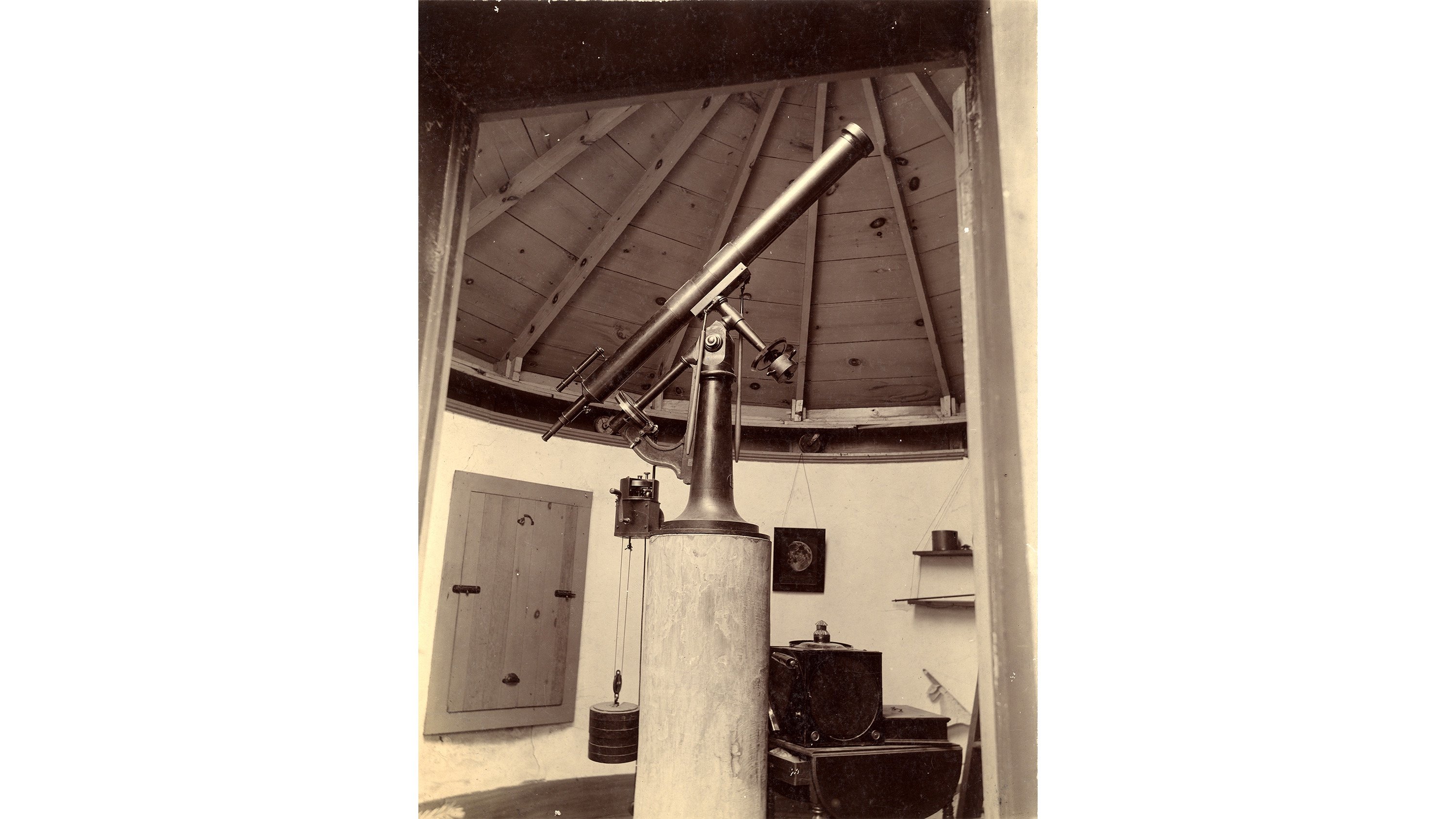
The telescope inside of MSU’s first observatory in 1909. Photo courtesy of Michigan State University Archives and Historical Collections.
Campus archaeology crew member Morgan Manuszak, Arts and Humanities senior, uses a screen to sift through materials found in soil at the dig site. Photo by Nick Schrader, MSU University Communications.
MSU Campus Archeology Program crew member Kelly Sullivan records geospatial data on a tablet connected to a GPS receiver. Photo by Nick Schrader, MSU University Communications.
The campus archaeology team at the observatory foundation dig site. Left to right: Mac Stevens, Kelly Sullivan, Morgan Manuszak, Campus Archeologist Benjamin Akey. Photo by Nick Schrader, MSU University Communications.

01 / 08

MEDIA CONTACTS

Alex Tekip
Social SciencesGovernment and SocietySocial SciencesNuclear ScienceEngineering, Science and Technology

Latest News

MSUToday Weekly Update

The MSUToday Weekly Update email showcases how Spartans are making a difference through academic excellence, research impact and community outreach. Get inspired by these stories of innovation, collaboration and determination. Plus, enjoy photos and videos of campus and more MSU content to help keep you connected to the Spartan community.

Sign UpUpdate My Information

Connect With Us

Visit our Facebook pageVisit our page on XVisit our Instagram pageVisit our LinkedIn pageVisit our YouTube pageVisit our TikTok page

Health and Safety

  • MSU Police and Public Safety
  • Olin Health Center
  • Counseling & Psychiatric Services (CAPS)
  • University Health and Wellbeing
  • MSU Health Care
  • Civil Rights and Title IX
  • Our Commitment
  • Center for Survivors
  • Security & Fire Safety Report
  • University Policy on Relationship Violence and Sexual Misconduct
  • Notice of Non-Discrimination, Anti-Harassment and Non-Retaliation
  • Health Care Non-Discrimination Notice

Support Services

  • Disability Resources
  • Supportive Services
  • Learning Resources

Working at MSU

  • Human Resources
  • EBS Login
  • Job Postings
  • Employee Assistance Program

Reports

  • CARES Act Funding
  • Student Achievement and Outcomes

Contact us

517-355-1855

Address

Michigan State University 426 Auditorium Road East Lansing, MI 48824

Follow Us

  • Visit our Facebook page
  • Visit our page on X
  • Visit our Instagram page
  • Visit our TikTok page
  • Visit our LinkedIn page
  • Visit our YouTube page

If you're having accessibility issues, please let us know.

Know More: Campus Safety Information and ResourcesTransparency Reporting: Budget & Salary/Compensation
  • Contact Information|
  • Site Map|
  • Privacy Statement|
  • Site Accessibility|
  • Call MSU: (517) 355-1855|
  • Visit: msu.edu|
  • Notice of Nondiscrimination|

SPARTANS WILL|© Michigan State University|