Jump to HeaderJump to Main ContentJump to Footer
Michigan State University
MSUTODAY
  • Browse Stories By

    Topics

    Explore stories by subject area

    • Arts and Culture
    • Business and Economy
    • Climate and Environment
    • Education and Learning
    • Engineering, Science and Technology
    • Government and Society
    • Health and Medicine
    • Media and Communications
    • MSU Leadership and Impact
    • Sports and Recreation
    • Student and Campus Experience
    View All Stories

    Collections

    Curated story series

    • Turfgrass
    • Ask the Expert
    • Big Ideas
    • Climate solutions
    • Water at MSU
    • Mobility
    • Spartan Perspectives
    • Student views
    • Graduate voices
    • Faculty voices
    View All Collections

    Featured

    Editor's picks

    • 9 reasons to love being a Spartan

      Aug. 28, 2026

      9 reasons to love being a Spartan

    • NIH awards multi-university team over $4M to improve women’s health

      Sept. 15, 2026

      NIH awards multi-university team over $4M to improve women’s health

MSUTODAY
  • Browse Stories By

< Browse Stories By

Topics

Explore stories by subject area

  • Arts and Culture
  • Business and Economy
  • Climate and Environment
  • Education and Learning
  • Engineering, Science and Technology
  • Government and Society
  • Health and Medicine
  • Media and Communications
  • MSU Leadership and Impact
  • Sports and Recreation
  • Student and Campus Experience
  • View All Stories

Collections

Curated story series

  • Turfgrass
  • Ask the Expert
  • Big Ideas
  • Climate solutions
  • Water at MSU
  • Mobility
  • Spartan Perspectives
  • Student views
  • Graduate voices
  • Faculty voices
  • View All Collections

Featured

Editor's picks

  • 9 reasons to love being a Spartan

    Aug. 28, 2026

    9 reasons to love being a Spartan

  • NIH awards multi-university team over $4M to improve women’s health

    Sept. 15, 2026

    NIH awards multi-university team over $4M to improve women’s health

  • For Media
  • Experts
  • Releases and Statements
  • Sign Up
  • Update Information

Resources

  • A to Z Index
  • Find People
  • Maps
  • Email
  • Student Information System (SIS)
  • D2L
  • Libraries
  • Tech Support
  • MSU Misconduct Hotline
  • Social Media Directory
  • Events Calendar
  • For Media
Michigan State University
MSUToday
  • For Media
  • Experts
  • Releases and Statements
  • Sign Up
  • Update Information
MSU Research

Oct. 27, 2023

Wired in: Simulating how electrons move through nanowires

The movement of electrons across wires is what allows us to use electricity every day. Biological nanowires, microscopic wires made of proteins, have caught researchers’ attention for their ability to carry electrons over long distances.
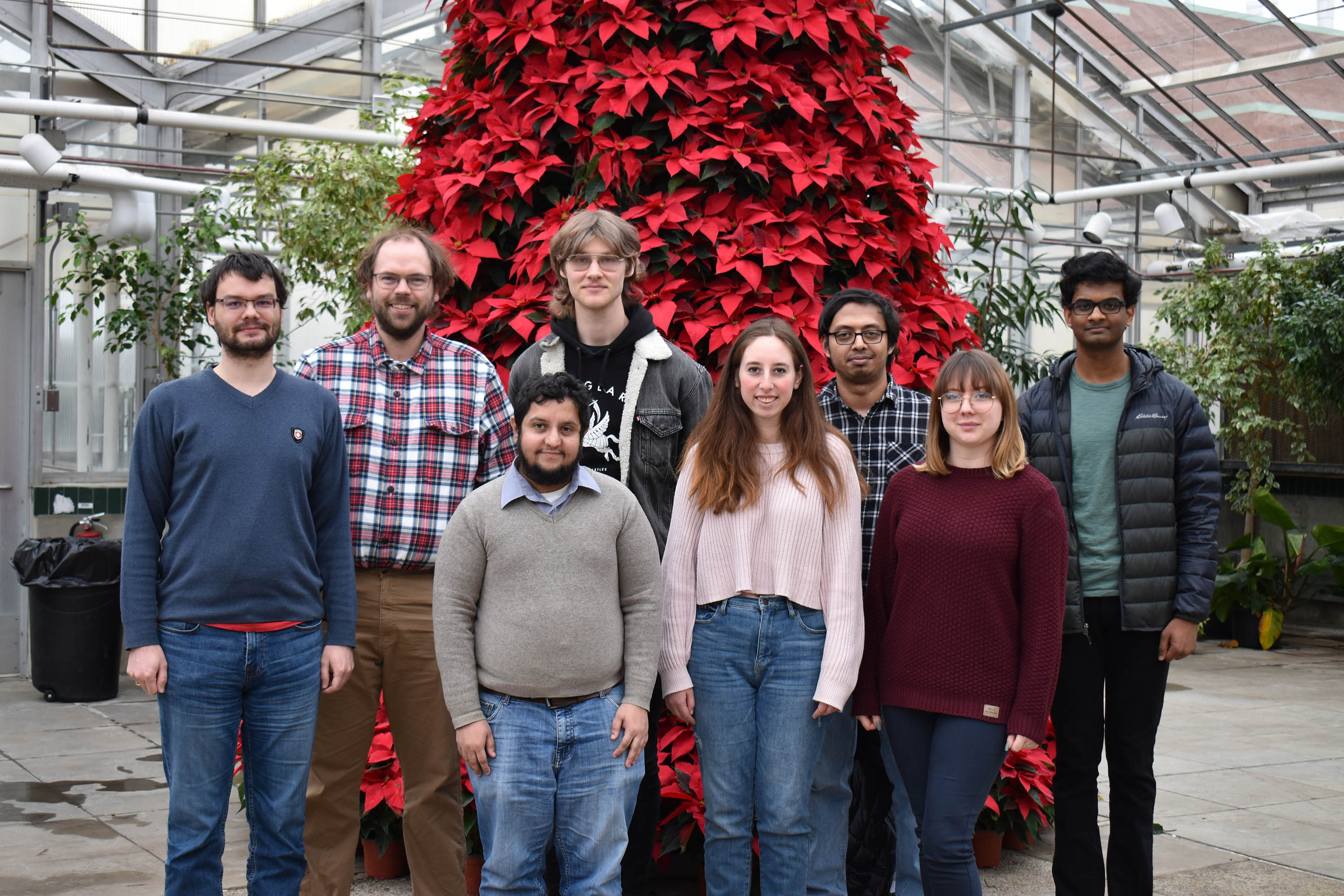
Group photo of members of Vermaas lab
Martin Kulke (far left) and Josh Vermaas (second from left) with other members of the Vermaas lab. Photo by Kara Headley, PRL 2022.

In a recent study published in Small by the Vermaas lab at the MSU-DOE Plant Research Laboratory, researchers expand our understanding of biological nanowires through the use of computer simulations.

Martin Kulke, first author of the study, accompanied by the Vermaas lab team, created simulations of crystals using data from the real-life experiments in the PRL Kramer lab, where they pointed a light source at a nanocrystal made up of proteins and calculated how fast excited electrons traveled through it. The real question was why electron transfer was getting slower with increasing temperature, which usually accelerates processes at the nanoscale.

One potential idea was that the distances electrons would need to jump within the nanocrystal might increase with temperature, slowing down how fast they could move through the protein.
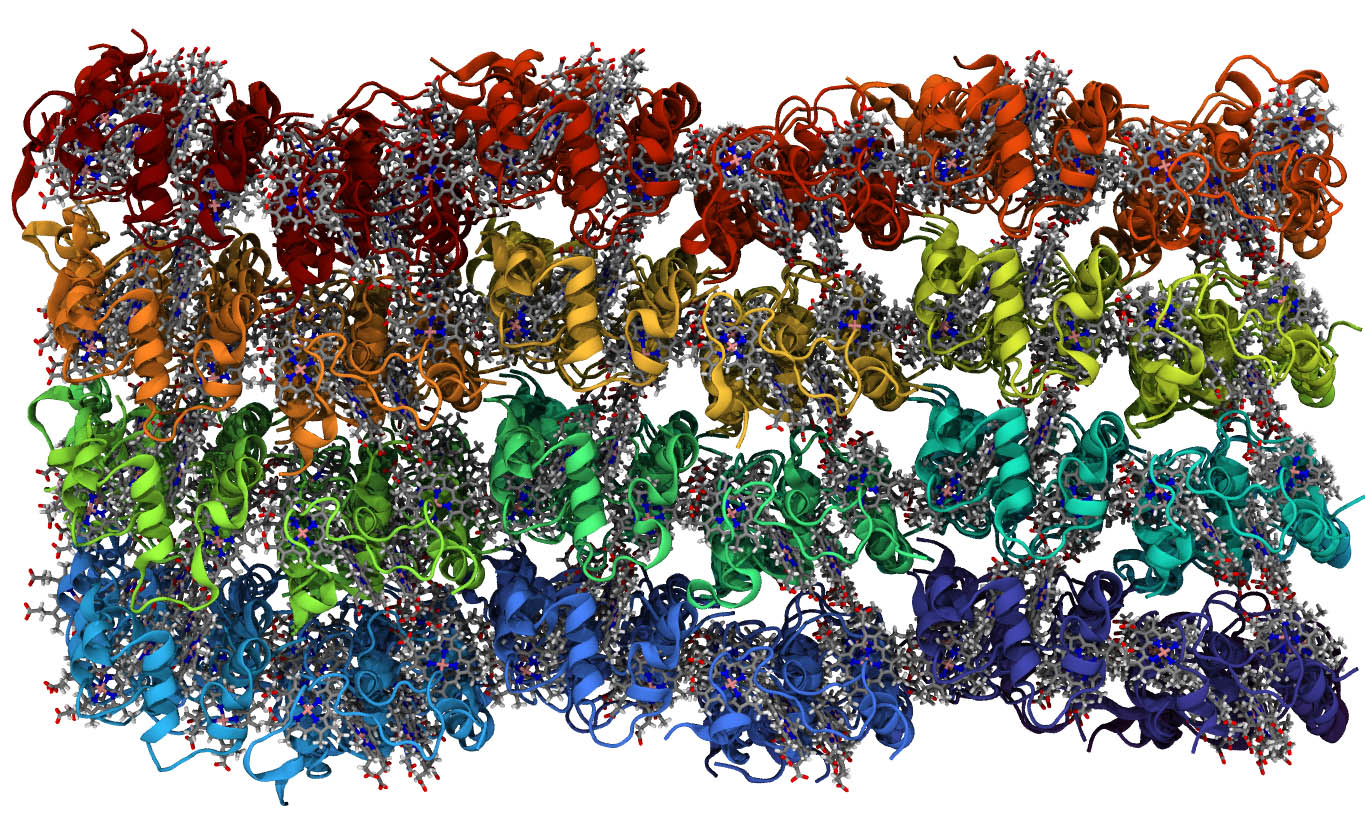
Scientific rendering of nanocrystals, each in a different color
In this representation, each of the 96 proteins in the nanocrystal are a different color. The electrons travel from heme group to heme group inside the protein. The hemes are shown in a stick representation, with gray for the carbons, blue for the nitrogens and a pink iron atom. Image crourtesy of the Vermaas lab.

“We simulated these protein nanocrystals at different temperatures to test this idea,” said Josh Vermaas, primary investigator for this study and assistant professor in the Department of Biochemistry and Molecular Biology and at the PRL. “What we found is that the distance changes across different temperatures are not so dramatic on their own.”

When variables other than temperature were manipulated, the researchers started to see some interesting action from the electrons’ hops within the nanowire. The nanowire protein network was made longer, shorter, thicker and thinner to identify bottlenecks to the electron flow within the nanocrystal.

“We found that in biological nanowires, the electron transport is based on the motion of the proteins in the wire,” Kulke said. “What that means is in the end, the longer you make those nanowires, the less electron transport you get through them and the thicker you make them, the more electron transport you get through them.”

The use of biological nanowires is speculative at the moment, but understanding how they can be constructed to allow for more electron flow is crucial to future endeavors using them to connect biological processes to conventional electronics.

Banner image: A rendering of a protein nanowire (yellow) cutting through a protein blob (gray) with electron carriers (orange) traveling along it. Photo by Martin Kulke.

This article was originally featured on the College of Natural Science website.

MEDIA CONTACTS

Kara Headley
MSU ResearchMSU Leadership and ImpactEngineering, Science and TechnologyEngineering

Latest News

MSUToday Weekly Update

The MSUToday Weekly Update email showcases how Spartans are making a difference through academic excellence, research impact and community outreach. Get inspired by these stories of innovation, collaboration and determination. Plus, enjoy photos and videos of campus and more MSU content to help keep you connected to the Spartan community.

Sign UpUpdate My Information

Connect With Us

Visit our Facebook pageVisit our page on XVisit our Instagram pageVisit our LinkedIn pageVisit our YouTube pageVisit our TikTok page

Health and Safety

  • MSU Police and Public Safety
  • Olin Health Center
  • Counseling & Psychiatric Services (CAPS)
  • University Health and Wellbeing
  • MSU Health Care
  • Civil Rights and Title IX
  • Our Commitment
  • Center for Survivors
  • Security & Fire Safety Report
  • University Policy on Relationship Violence and Sexual Misconduct
  • Notice of Non-Discrimination, Anti-Harassment and Non-Retaliation
  • Health Care Non-Discrimination Notice

Support Services

  • Disability Resources
  • Supportive Services
  • Learning Resources

Working at MSU

  • Human Resources
  • EBS Login
  • Job Postings
  • Employee Assistance Program

Reports

  • CARES Act Funding
  • Student Achievement and Outcomes

Contact us

517-355-1855

Address

Michigan State University 426 Auditorium Road East Lansing, MI 48824

Follow Us

  • Visit our Facebook page
  • Visit our page on X
  • Visit our Instagram page
  • Visit our TikTok page
  • Visit our LinkedIn page
  • Visit our YouTube page

If you're having accessibility issues, please let us know.

Know More: Campus Safety Information and ResourcesTransparency Reporting: Budget & Salary/Compensation
  • Contact Information|
  • Site Map|
  • Privacy Statement|
  • Site Accessibility|
  • Call MSU: (517) 355-1855|
  • Visit: msu.edu|
  • Notice of Nondiscrimination|

SPARTANS WILL|© Michigan State University|
