Jump to HeaderJump to Main ContentJump to Footer
Michigan State University
  • Browse Stories By

    Topics

    Explore stories by subject area

    • Arts and Culture
    • Business and Economy
    • Climate and Environment
    • Education and Learning
    • Engineering, Science and Technology
    • Government and Society
    • Health and Medicine
    • Media and Communications
    • MSU Leadership and Impact
    • Sports and Recreation
    • Student and Campus Experience
    View All Stories

    Collections

    Curated story series

    • Turfgrass
    • Ask the Expert
    • Big Ideas
    • Climate solutions
    • Water at MSU
    • Mobility
    • Spartan Perspectives
    • Student views
    • Graduate voices
    • Faculty voices
    View All Collections

    Featured

    Editor's picks

    • The Spartans behind your favorite Michigan golf courses

      July 22, 2026

      The Spartans behind your favorite Michigan golf courses

    • MSU in the 1990s: 10 Spartan milestones

      July 14, 2026

      MSU in the 1990s: 10 Spartan milestones

MSUTODAY
  • Browse Stories By

< Browse Stories By

Topics

Explore stories by subject area

  • Arts and Culture
  • Business and Economy
  • Climate and Environment
  • Education and Learning
  • Engineering, Science and Technology
  • Government and Society
  • Health and Medicine
  • Media and Communications
  • MSU Leadership and Impact
  • Sports and Recreation
  • Student and Campus Experience
  • View All Stories

Collections

Curated story series

  • Turfgrass
  • Ask the Expert
  • Big Ideas
  • Climate solutions
  • Water at MSU
  • Mobility
  • Spartan Perspectives
  • Student views
  • Graduate voices
  • Faculty voices
  • View All Collections

Featured

Editor's picks

  • The Spartans behind your favorite Michigan golf courses

    July 22, 2026

    The Spartans behind your favorite Michigan golf courses

  • MSU in the 1990s: 10 Spartan milestones

    July 14, 2026

    MSU in the 1990s: 10 Spartan milestones

  • For Media
  • Experts
  • Releases and Statements
  • Sign Up
  • Update Information

Resources

  • A to Z Index
  • Find People
  • Maps
  • Email
  • Student Information System (SIS)
  • D2L
  • Libraries
  • Tech Support
  • MSU Misconduct Hotline
  • Social Media Directory
  • Events Calendar
  • For Media
Michigan State University
MSUToday
  • For Media
  • Experts
  • Releases and Statements
  • Sign Up
  • Update Information
MSUTODAY
Social Sciences

Aug. 28, 2023

New images use AI to provide more detail on Maui fires

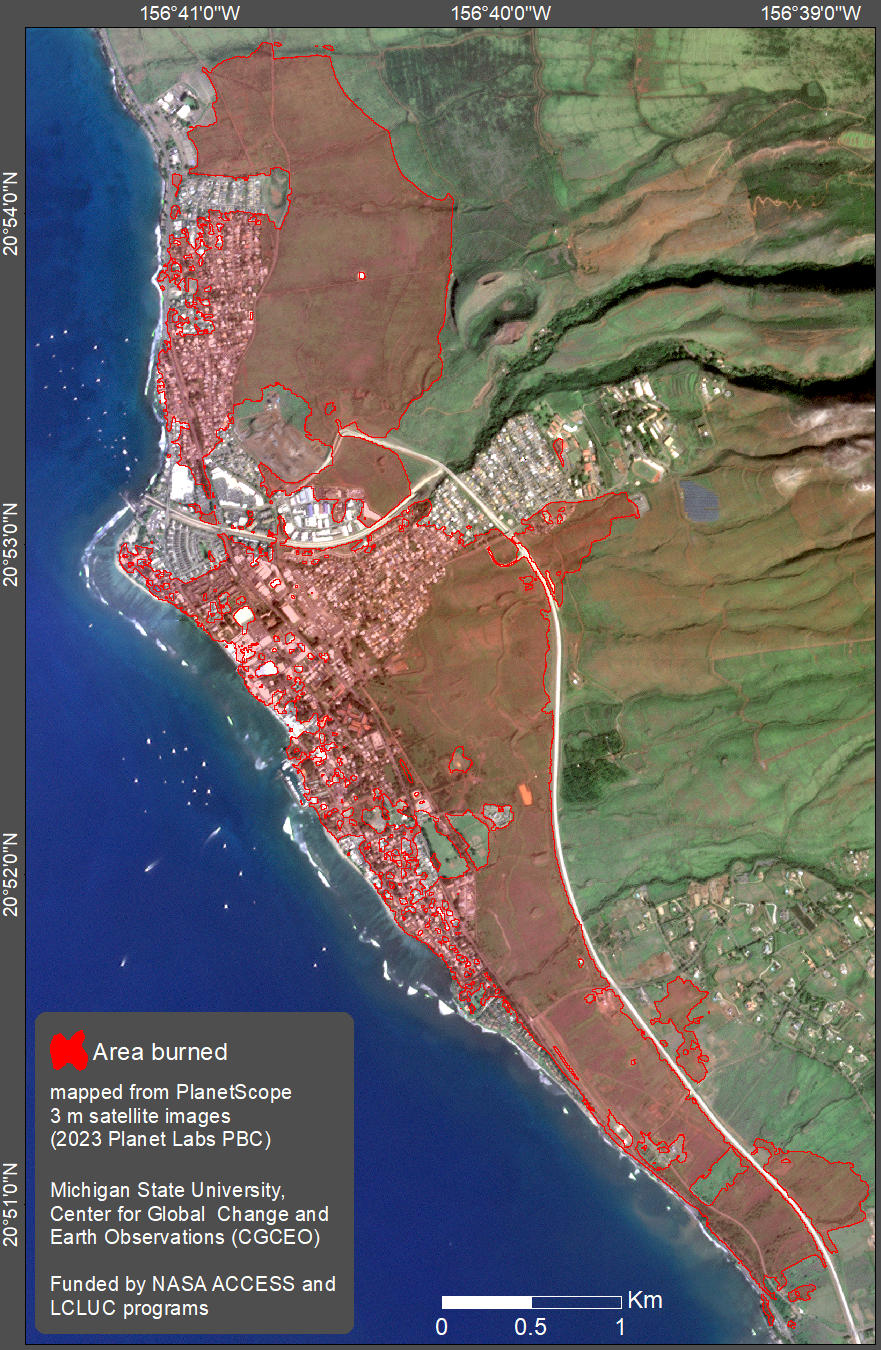
Map of Maui fire path.
Lahaina detail. Courtesy photo.

Michigan State University researchers have produced new detailed maps of the devastating fires in Maui, which can be used to help work out where and when the fires occurred to guide where postfire remediation activities should be prioritized and to assess future fire risk.

The researchers created the maps using high-resolution commercial satellite images from Planet Labs PBC, an American public Earth imaging company based in San Francisco, California.

A sequence of images acquired from Aug. 3 to 13 was used to map the area burned at 3-by-3-meter resolution. According to David Roy, director of MSU’s Center for Global Change and Earth Observations, the images offer a breakthrough for fire mapping from space.

“By using the Planet Labs images and a new artificial intelligence algorithm, we can map the area burned in much greater detail than before,” Roy said. “The only global coverage burned area products processed on a systematic basis are generated by NASA, and map burned areas at 500 by 500 meters, which is a much coarser level of detail.” 

Roy is a member of the NASA science team that developed and maintains the global burned area product that has been used for the last 20 years to map fires from space at 500-by-500-meter resolution. Along with MSU colleagues Haiyan Huang, assistant professor, and Hugo De Lemos, postdoctoral research associate, Roy is developing new mapping algorithms funded by NASA.
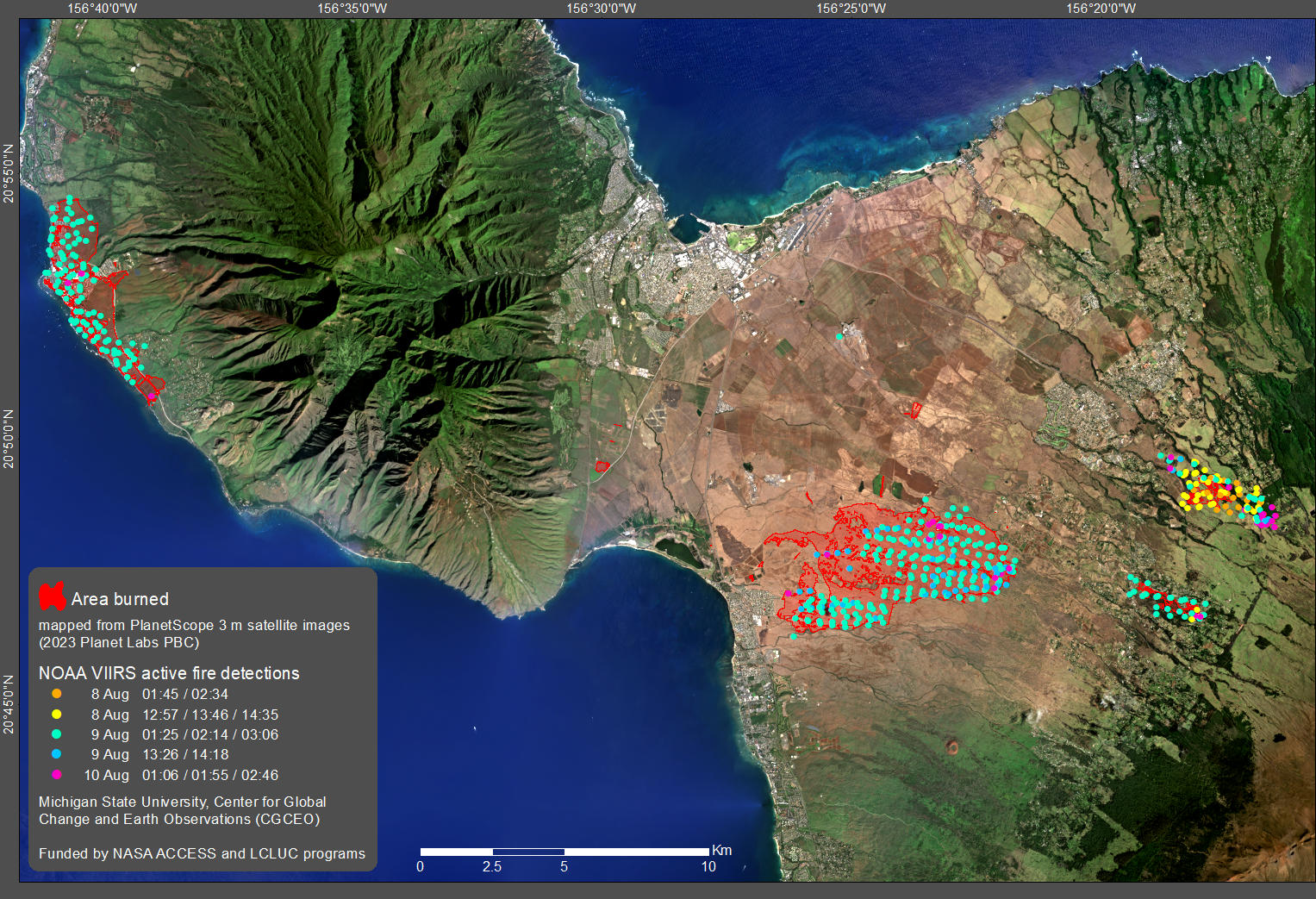
Active fire detections in Maui.
Active fire detections. Courtesy photo.

“When combined with satellite detections of actively burning fires, the patterns of fire across Maui are quite evident from our maps. The active fire detections superimposed on the burned area map show that the fires were burning in the East and continued to burn there, while the fires in Lahaina occurred later,” De Lemos said.

“The fire radiative power is related to the fire intensity, and the maps show that intense fires were burning across the island, although the cause is still being investigated,” Huang said.

The MSU research team discussed their maps with colleagues at the University of Hawaiʻi at Mānoa. Clay Trauernicht, an expert in ecosystems and fire at the university, noted that the fires burned so rapidly because of the windy and dry conditions and the presence of large amounts of non-native grasses that grew in previous wet years.

“If there’s any silver lining, it is that the vegetation can be manipulated in the future to reduce fire risk and create safer conditions for firefighters and our communities,” Trauernicht said.
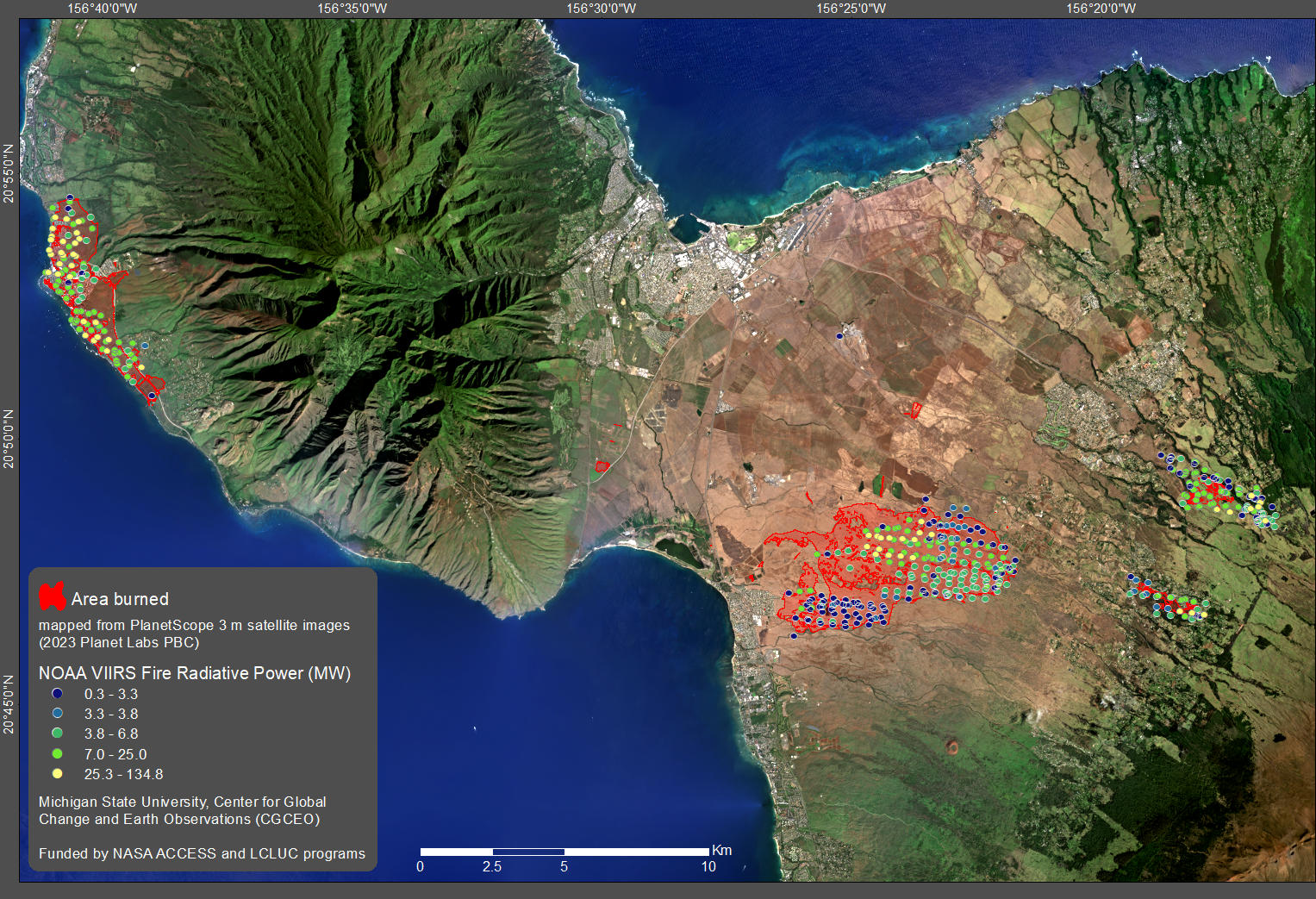
Active fire detections in Maui.
Fire radiative power. Courtesy photo.

Tomoaki Miura, head of the Department of Natural Resources and Environmental Management at the University of Hawaiʻi at Mānoa, said that “New detailed satellite-derived maps like these will play an increasingly valuable role for synoptic assessment of fire and postfire remediation.”

“As we see climate and land use changes create new conditions conducive to wildfires, satellite technology will help us make better decisions to guide the rebuilding process after wildfires. It also will help scientists to model and understand the drivers and constraints on fire and, hopefully, prevent future catastrophic damage,” Roy said.


Social SciencesGovernment and SocietyEngineering, Science and TechnologySocial Sciences

Latest News

MSUToday Weekly Update

The MSUToday Weekly Update email showcases how Spartans are making a difference through academic excellence, research impact and community outreach. Get inspired by these stories of innovation, collaboration and determination. Plus, enjoy photos and videos of campus and more MSU content to help keep you connected to the Spartan community.

Sign UpUpdate My Information

Connect With Us

Visit our Facebook pageVisit our page on XVisit our Instagram pageVisit our LinkedIn pageVisit our YouTube pageVisit our TikTok page

Health and Safety

  • MSU Police and Public Safety
  • Olin Health Center
  • Counseling & Psychiatric Services (CAPS)
  • University Health and Wellbeing
  • MSU Health Care
  • Civil Rights and Title IX
  • Our Commitment
  • Center for Survivors
  • Security & Fire Safety Report
  • University Policy on Relationship Violence and Sexual Misconduct
  • Notice of Non-Discrimination, Anti-Harassment and Non-Retaliation
  • Health Care Non-Discrimination Notice

Support Services

  • Disability Resources
  • Supportive Services
  • Learning Resources

Working at MSU

  • Human Resources
  • EBS Login
  • Job Postings
  • Employee Assistance Program

Reports

  • CARES Act Funding
  • Student Achievement and Outcomes

Contact us

517-355-1855

Address

Michigan State University 426 Auditorium Road East Lansing, MI 48824

Follow Us

  • Visit our Facebook page
  • Visit our page on X
  • Visit our Instagram page
  • Visit our TikTok page
  • Visit our LinkedIn page
  • Visit our YouTube page

If you're having accessibility issues, please let us know.

Know More: Campus Safety Information and ResourcesTransparency Reporting: Budget & Salary/Compensation
  • Contact Information|
  • Site Map|
  • Privacy Statement|
  • Site Accessibility|
  • Call MSU: (517) 355-1855|
  • Visit: msu.edu|
  • Notice of Nondiscrimination|

SPARTANS WILL|© Michigan State University|