Six Spartan Engineering faculty members at Michigan State University have received National Science Foundation Early Career Development Awards and will advance their research efforts with a combined $3.12 million over the next five years.
NSF CAREER Awards support junior faculty members who exemplify the role of teacher-scholars through outstanding research and education. It is among NSF’s most prestigious national honors.
Engineering Dean Leo Kempel said six more NSF CAREER Awards bring the college’s total to 27 in the past six years.
“Six more prestigious NSF Early CAREER Awards for our faculty is very noteworthy,” Kempel said. “I know from personal experience that it can be transformational for a faculty member and allows them to investigate a new area of scholarship with secure funding. I congratulate my colleagues in the College of Engineering and look forward to the innovations they will introduce with the national support.”
Extinction Phenomena in Turbulent Liquid Dual-Fuel Flames

Patton Allison, assistant professor of mechanical engineering, will use a five-year $590,000 CAREER Award to study complex liquid fuels in highly turbulent reacting flows.
“Turbulent combustion of energy-dense, liquid fuels is at the core of aviation applications,” Allison said. “Dual-fuel operation with liquid fuel and hydrogen blends have become a research point of interest.”
Allison said he will investigate the process of lean flame blowoff in turbulent flames operated on blends of jet fuel and hydrogen to improve emissions and efficiency. He will also develop new laser diagnostic tools for insights into how the fuels mix and interact with each other to alter the flame burning.
The blending of hydrogen fuel and standard aviation jet fuels reduces the net carbon content creating a greener fuel mixture. New unobtrusive experimental laser-based methods are being developed to visualize the physics and investigate what happens to temperature, combustion efficiency, and flame geometry when these fuel blends are burned near the lean combustion limit for improved emissions performance, Allison explained.
“Our work will add combustion physics content to undergraduate and graduate courses, and we’ll create some highly visual demonstration activities. The learning modules will be developed for online sharing, televised delivery with PBS WKAR, and for global access on YouTube, he added.”
Improving Attack Resilience in Autonomous Vehicles
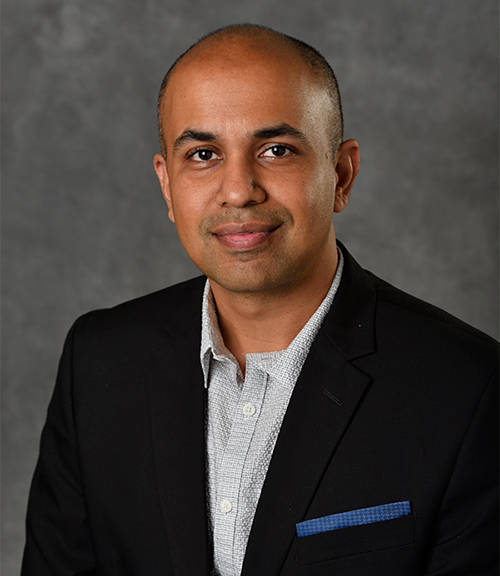
Shaunak Bopardikar, an assistant professor of electrical and computer engineering, will use a five-year $500,000 CAREER Award to tackle security issues during sensing, communication, and control attacks in modern and autonomous vehicles.
“The race to achieve autonomy in future vehicles can make them increasingly susceptible to attacks on their sensors, such as the onboard Global Positioning System or one of the cameras and the underlying control systems,” Bopardikar said. “I will use this CAREER Award to study the mathematical underpinnings of security problems arising in multi-agent systems and make these systems resilient to attacks.”
Along with research, Bopardikar will create educational games in attack resilience. “Outreach activities involving the public and law enforcement will help shape future practices for root-cause analyses of security incidents and deter attacks,” he added.
Designing a ‘Cyborg’ gas sensor to detect lung cancer

Debajit Saha, assistant professor of biomedical engineering, will use a $550,000 five-year CAREER Award to enable the early detection of cancer using lung cancer volatile chemicals present in breath and the olfactory neural circuits of insects.
“It is well known that the presence of cancer changes the volatile chemical composition of human exhaled breath by changing its smell,” Saha said, “making it possible to detect cancer noninvasively. This project aims to develop a lung cancer detection device based on a biological chemical sensory array and biological neural circuitries from insects.”
The goal, he said, is to develop a gas sensor for sensitive, robust, and real-time detection of lung cancer. An antennae-attached ex vivo locust brain will constitute the central gas sensing device, which will be coupled with a miniaturized and implantable electrode array, a multi-channel amplifier, and biological neural computation schemes for developing the part-brain, part-engineered gas sensor.
“The novel gas sensor will add a powerful new dimension to biosensing,” he added.
The educational component of the project will provide early and authentic research exposure to historically underrepresented high school students and personalized research experiences to first-year undergraduates.
Metal additive manufacturing
Haseung Chung, assistant professor of mechanical engineering, will use a five-year, $567,000 CAREER Award to improve the challenges of metal additive manufacturing in metal powder sedimentation, curing capacity and possible oxidation-related defects.
Modern metal additive manufacturing, or AM, mostly relies on a point-by-point printing scheme, in which the fabrication time increases substantially with the size of a part, in particular the cross-sectional area of the part. To overcome this limitation, this CAREER award supports fundamental research for a new metal AM process where a whole layer is printed at once by curing the photopolymer/metal powder mixture using digital light processing, resulting in rapid printing speed.
“The new process hinges on a unique photopolymer with tunable properties, to balance the print-layer curing depth and homogeneous mixing of metal powder in a photopolymer suspension. If successful, this metal AM system, first of its kind, will be beneficial to heavy industries such as transportation, machinery, and construction, and provide a competitive edge to U.S. industries in the global market,” he added.
Microscopy for Molecular Imaging of Brain Tumors
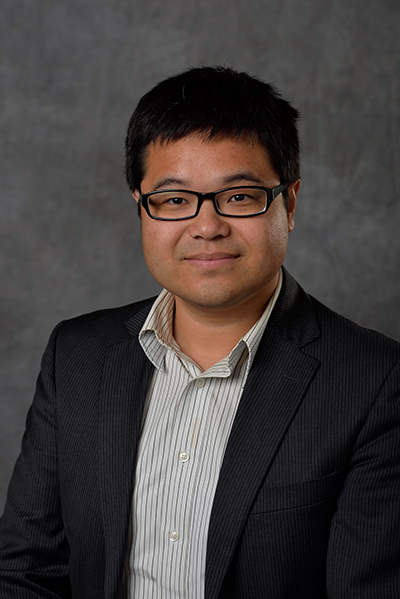
Zhen Qiu, assistant professor of biomedical engineering and electrical and computer engineering, will use a five-year, $503,600 CAREER Award on the development of a tiny microscope for molecularly targeted imaging to study the fundamental mechanism of brain tumors.
“With yearly costs of about $800 billion and an estimated 50 million people afflicted per year, brain diseases are a grand challenge for scientists. There is a pressing and unmet need for miniaturized deep tissue imaging tools that can help neuro-oncologist study the fundamental mechanism of brain tumor and the dynamics in the ligand-receptor interactions,” Qiu said. “The ultimate goal of this research is to provide advanced biomedical tools to drive advancements in both scientific understanding and future clinical applications.”
Qiu said the research’s techniques may lead to new imaging-guided surgery and therapies for clinicians to improve the quality of life for a sizable population.
“The generalized molecular imaging strategies will be applied to other organs, such as the breast, lung, and colon. Interdisciplinary educational activities will be developed for MSU and surrounding communities (Greater Lansing) with emphasis on increasing participation by women and underrepresented minorities.”
Synergistic Inverse Wave Analysis and Computation
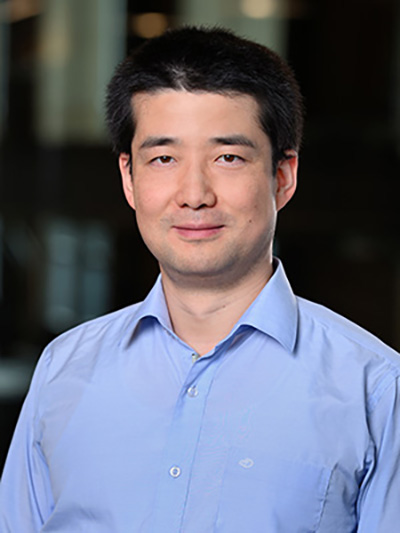
Yang Yang, an assistant professor of computational mathematics, science and engineering, will use a five-year $419,000 CAREER Award to better understand the mathematical principles in non-destructive probing techniques.
“Non-destructive probing techniques utilize waves to probe targets that are not directly observable. They have found broad applications in medical imaging for tumor detection, in seismic imaging for oil prospecting, and in military scenarios for hidden threat detection,” Yang said. “The success of modern non-destructive probing techniques relies on the mathematical principles that reveal the hidden connection between the observation and the targets. In-depth understanding of such principles will reveal the strengths and limitations of the techniques, and future enhancements.”
This project aims to promote understanding of the mathematical principles in non-destructive probing techniques from both theoretical and computational perspectives, Yang explained. The theoretical perspective will develop fundamental mathematical tools and methods that are adaptable to resolve challenges in other mathematical branches. The computational perspective will turn the theory into innovative imaging algorithms that enhances visualization.
Implementation of the project will be integrated with numerous educational activities to involve K-12, undergraduate and graduate students majoring in STEM disciplines, especially those from underrepresented groups with limited educational resources. Students will receive rigorous scientific research training in mathematical and programming skills to prepare them as the next generation of the STEM workforce.
This story originally appeared on the College of Engineering website.