Jump to HeaderJump to Main ContentJump to Footer
Michigan State University
MSUTODAY
  • Browse Stories By

    Topics

    Explore stories by subject area

    • Arts and Culture
    • Business and Economy
    • Climate and Environment
    • Education and Learning
    • Engineering, Science and Technology
    • Government and Society
    • Health and Medicine
    • Media and Communications
    • MSU Leadership and Impact
    • Sports and Recreation
    • Student and Campus Experience
    View All Stories

    Collections

    Curated story series

    • Alumni stories
    • Turfgrass
    • Ask the Expert
    • Big Ideas
    • Climate solutions
    • Water at MSU
    • Mobility
    • Spartan Perspectives
    • Student views
    • Graduate voices
    • Faculty voices
    View All Collections

    Featured

    Editor's picks

    • 9 reasons to love being a Spartan

      Aug. 28, 2026

      9 reasons to love being a Spartan

    • NIH awards multi-university team over $4M to improve women’s health

      Sept. 15, 2026

      NIH awards multi-university team over $4M to improve women’s health

MSUTODAY
  • Browse Stories By

< Browse Stories By

Topics

Explore stories by subject area

  • Arts and Culture
  • Business and Economy
  • Climate and Environment
  • Education and Learning
  • Engineering, Science and Technology
  • Government and Society
  • Health and Medicine
  • Media and Communications
  • MSU Leadership and Impact
  • Sports and Recreation
  • Student and Campus Experience
  • View All Stories

Collections

Curated story series

  • Alumni stories
  • Turfgrass
  • Ask the Expert
  • Big Ideas
  • Climate solutions
  • Water at MSU
  • Mobility
  • Spartan Perspectives
  • Student views
  • Graduate voices
  • Faculty voices
  • View All Collections

Featured

Editor's picks

  • 9 reasons to love being a Spartan

    Aug. 28, 2026

    9 reasons to love being a Spartan

  • NIH awards multi-university team over $4M to improve women’s health

    Sept. 15, 2026

    NIH awards multi-university team over $4M to improve women’s health

  • For Media
  • Experts
  • Releases and Statements
  • Sign Up
  • Update Information

Resources

  • A to Z Index
  • Find People
  • Maps
  • Email
  • Student Information System (SIS)
  • D2L
  • Libraries
  • Tech Support
  • MSU Misconduct Hotline
  • Social Media Directory
  • Events Calendar
  • For Media
Michigan State University
MSUToday
  • For Media
  • Experts
  • Releases and Statements
  • Sign Up
  • Update Information
Natural Sciences

June 22, 2023

Ask the expert: How can the Chignik, Alaska, earthquake help predict future risk?

By: Emilie Lorditch

“Ask the Expert” articles provide information and insights from MSU scientists, researchers and scholars about national and global issues, complex research and general-interest subjects based on their areas of academic expertise and study. They may feature historical information, background, research findings or offer tips. 

Earthquakes are caused by the movement of the tectonic plates that make up Earth’s crust. Off the coast of Alaska, the Pacific plate thrusts underneath the North American plate creating enormous pressure at the Alaska-Aleutian fault. Between 2020 and 2021, the two plates slipped along this fault, producing a series of earthquakes, including the Chignik, Alaska, earthquake on July 29, 2021, which registered an 8.2 in magnitude — the largest earthquake within U.S. territory in 58 years. 

Jeffrey Freymueller, a professor in the College of Natural Science at Michigan State University, is researching this earthquake to learn more about exactly where that slip occurred (and how much) to better understand how faults work and to help evaluate the risk of future earthquakes and tsunamis. Freymueller is an internationally recognized expert in geodesy, or the study of Earth’s size and shape, and serves as MSU’s Endowed Chair for Geology of the Solid Earth. This research appeared recently in the journal Science Advances.  

What are the challenges with studying the Alaska-Aleutian fault?

The biggest challenge is that the fault comes to the surface on the ocean bottom far offshore, and there are kilometers of water in the way! We need to measure how the Earth was permanently moved by the earthquake, and we really need measurements that are made right above the part of the fault that slipped. 
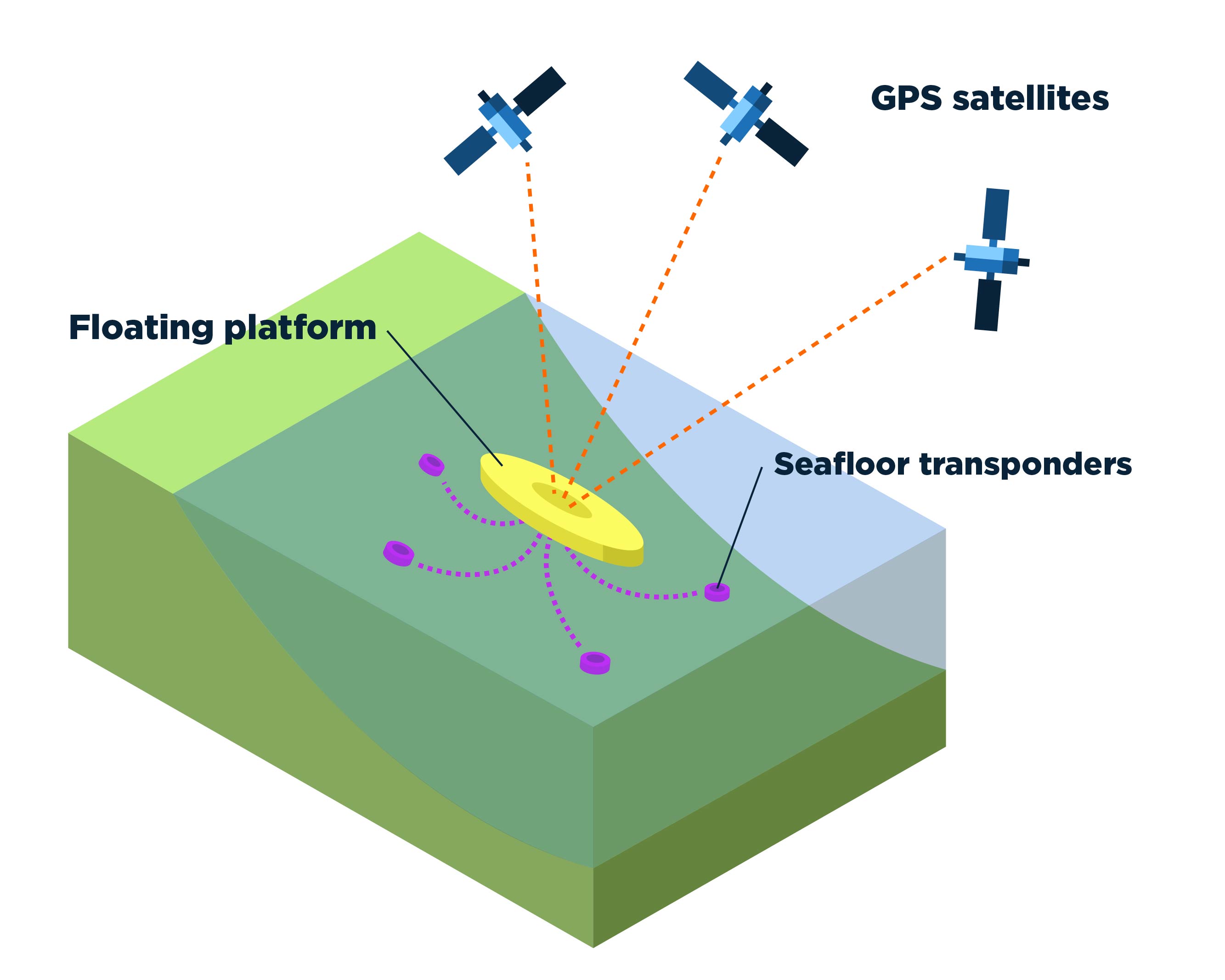
Graphic shows how GPS satellites in the sky send signals to a floating platform (the size of a large surfboard) which sends and received signals from transponders on the ocean floor to study earthquakes on the bottom of the ocean.
To measure earthquakes underwater, researchers must combine data from satellites in the sky with signals from transponders on the ocean floor. Credit: May Napora

On land, we can set up Global Positioning Systems or Global Navigation Satellite Systems — GPS and GNSS, respectively — instruments and record the positions of the plates fairly easily, but the part of the fault that slipped in the earthquake is located pretty far away from land. Radio signals from the GPS satellites will not travel through water, so to get any data we must combine the GPS positioning of a floating platform with acoustic, or sound wave, positioning of the same platform relative to an array of transponders, which pick up and emit signals on the seafloor. This technique is called GPS-acoustic positioning, and by repeating the survey measurements before and after the earthquake, we can measure how much the seafloor moved, and use that to better determine how the fault moved.

Why is studying the Chignik, Alaska, earthquake important to earthquake research?

The most important thing we learned is that the total movement at the GPS-acoustic site offshore was much larger than had been predicted by earlier models for the earthquake. Large earthquakes are important to study because they produce the largest motions and cause the largest changes in stress within the Earth. That means a large signal for us to measure, which is always helpful. The GNSS-acoustic position measurements of the seafloor’s motion are quite noisy because the speed of sound through the water is very sensitive to ocean temperature and varies a lot with time. That means it is hard to measure the acoustic range as precisely as we can measure the GPS part. So, it helps to have a larger motion to measure when the noise level is high.

How does this research help with assessing tsunami hazard risk?

This research helps with assessing hazard and risk. One of the interesting features of this earthquake is that it did NOT generate a large tsunami. Why didn’t it? The reason is that most of the slip on the interface between the plates happened only on the part of the interface that was still quite deep — the earthquake didn’t rupture to the seafloor or even close to it. 

But we really need to know how close to the surface it got, and whether the shallower part of the fault that didn’t slip in this earthquake is capable of doing so in the future. If it is, then the risk of a future large tsunami is high. If the shallow part of the fault just doesn’t slip in earthquakes, but instead creeps along steadily, then the risk of a large tsunami from this part of the fault is much lower. We are still not sure, but now we know more than we did before about what happened in the earthquake. We’re continuing to look at other data, and we hope we will get more GPS-acoustic data as well to figure out how the shallowest part of the fault behaves.


MEDIA CONTACTS

Emilie Lorditch
Natural SciencesEngineering, Science and TechnologyNatural Resources and ConservationClimate and Environment

Collection

more content from this collection

Ask the Expert

Latest News

MSUToday Weekly Update

The MSUToday Weekly Update email showcases how Spartans are making a difference through academic excellence, research impact and community outreach. Get inspired by these stories of innovation, collaboration and determination. Plus, enjoy photos and videos of campus and more MSU content to help keep you connected to the Spartan community.

Sign UpUpdate My Information

Connect With Us

Visit our Facebook pageVisit our page on XVisit our Instagram pageVisit our LinkedIn pageVisit our YouTube pageVisit our TikTok page

Health and Safety

  • MSU Police and Public Safety
  • Olin Health Center
  • Counseling & Psychiatric Services (CAPS)
  • University Health and Wellbeing
  • MSU Health Care
  • Civil Rights and Title IX
  • Our Commitment
  • Center for Survivors
  • Security & Fire Safety Report
  • University Policy on Relationship Violence and Sexual Misconduct
  • Notice of Non-Discrimination, Anti-Harassment and Non-Retaliation
  • Health Care Non-Discrimination Notice

Support Services

  • Disability Resources
  • Supportive Services
  • Learning Resources

Working at MSU

  • Human Resources
  • EBS Login
  • Job Postings
  • Employee Assistance Program

Reports

  • CARES Act Funding
  • Student Achievement and Outcomes

Contact us

517-355-1855

Address

Michigan State University 426 Auditorium Road East Lansing, MI 48824

Follow Us

  • Visit our Facebook page
  • Visit our page on X
  • Visit our Instagram page
  • Visit our TikTok page
  • Visit our LinkedIn page
  • Visit our YouTube page

If you're having accessibility issues, please let us know.

Know More: Campus Safety Information and ResourcesTransparency Reporting: Budget & Salary/Compensation
  • Contact Information|
  • Site Map|
  • Privacy Statement|
  • Site Accessibility|
  • Call MSU: (517) 355-1855|
  • Visit: msu.edu|
  • Notice of Nondiscrimination|

SPARTANS WILL|© Michigan State University|