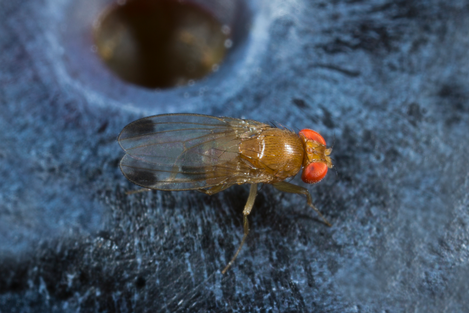
Spotted wing drosophila, or SWD, a small fly native to Asia that first appeared in Michigan in 2010, isn’t like most pests.
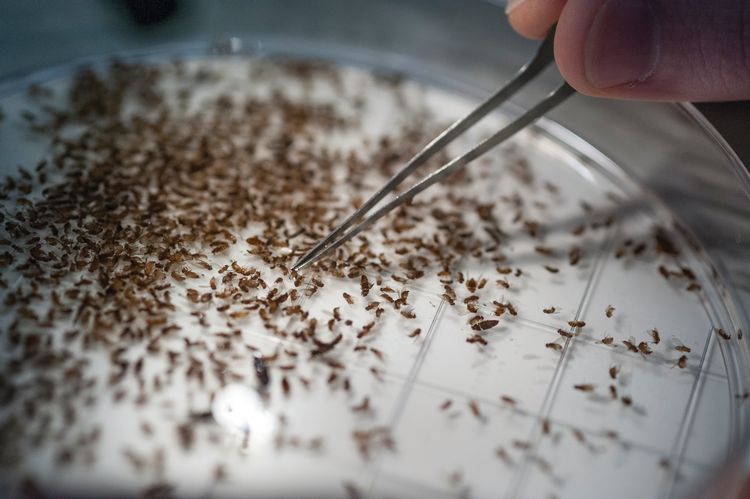
Populations of crop-damaging insects tend to have distinct generations. Not SWD. Several generations overlap and build through the year, attacking vulnerable agricultural crops and wild plants. The situation has created a major challenge for the Michigan berry and cherry industries.
Rufus Isaacs, a professor in the Michigan State University Department of Entomology, was one of the first to discover the pest in the state 13 years ago. While researchers didn’t know much about SWD then, they’ve had to get up to speed quickly.
“SWD is so destructive because it can insert eggs into ripening fruit,” said Isaacs, whose work is supported in part by MSU AgBioResearch. “Larvae can be present in harvested fruit, which can be a big problem for producers. It is also able to reproduce so quickly to build up the population, and it can infest wild fruit outside of farms, creating a reservoir population that continually invades crop fields after they’re treated.”
After hearing about SWD arriving in California in 2008 and then being detected in Florida in 2009, concerns began to mount.
“Shortly after SWD was found in Florida, I went to a conference in Oregon where we discussed measures we may need to take to get ready for the pest,” Isaacs said. “We expected it would be in Michigan before too long.”
Sure enough, Isaacs was right. He received a grant from Project GREEEN — a partnership among MSU AgBioResearch, MSU Extension and the plant agriculture industries of Michigan — in 2010 to monitor for SWD. Isaacs worked with members of the MSU Fruit Team to set small plastic traps with holes that were filled with a cider vinegar lure.
In late 2010, SWD was collected from a site in West Michigan. At that point, the difficult work began and persists today. Research in Isaacs’ lab has been performed in partnership with mostly blueberry and raspberry growers.

The team has tested already-registered pesticides to determine their efficacy, as well as non-chemical controls such as pruning, mulching and physical exclusion methods, where growers place netting around and on top of crops as they begin to ripen.
As a result of this research, online resources have been created to assist growers with SWD identification, pesticide timing and other management strategies.
“We want to ensure we’re responsive to grower needs, first and foremost,” Isaacs said. “That’s why the pairing of research and grower education programs through MSU Extension is so valuable to our team.”
Dennis Vander Kooi, a blueberry grower and owner of Woodland Enterprises Berry Farms in Zeeland, Michigan, and his family have been working with MSU researchers for many years. He is also a board member of the Michigan Blueberry Commission, or MBC, helping to set research priorities for the industry.
“Rufus is one of the nation’s leading researchers on this issue, and we’ve worked with others at MSU as well,” Vander Kooi said. “He’s run several experiments on our farm, and we’ve learned a lot from them. The MBC has supported this work and will continue to in the future as we look for effective ways to manage this pest.”
Vander Kooi said the blueberry industry is undergoing a rejuvenation in Michigan, adopting newer genetics and planting varieties that meet the demands of today’s consumers. This, in conjunction with SWD, makes it a critical time for growers as they look to protect an industry that contributes nearly $132 million to the state’s economy, according to the Michigan Ag Council.
“With the creation of the MBC in 2017, we got the opportunity to start advocating for more dollars for research, and MSU has been instrumental in that,” he said. “To date, we’ve supported more than $390,000 worth of research, much of that going to MSU, and leveraged an additional $600,000 in other funding.”
In addition to the MBC, Project GREEEN has been a significant supporter of Isaacs’ SWD efforts, along with state funding through the Specialty Crop Block Grant program and national projects funded by the U.S. Department of Agriculture.
Assessing biological control options
One of the primary challenges for scientists is focusing on immediate grower needs while also investigating long-term management tactics. It’s a monumental task to balance both simultaneously.

Alongside Isaacs, Marianna Szucs, an assistant professor in the Department of Entomology, has been exploring biological control to reduce populations in the long run. As she noted, when SWD came to the U.S., its natural predators did not.
“Anytime there is introduction of an invasive pest, one of the main issues is that the new landscape doesn’t have natural enemies for it,” she said. “They don’t come with the pest, and the native insects in the new place aren’t equipped to deal with it right away. What we wanted to know is if we exposed parasitoid wasps native to Michigan to SWD, would they begin to see them as a food source?”
A parasitoid insect lays its eggs in or on a host insect, and the developing larvae consume the host until it eventually dies.
Szucs and her team chose two parasitoid wasp species commonly found throughout North America. Researchers initially saw that attack rates in the wild were quite low, and the ability of native species to rapidly adapt to a new food source was unknown. In the lab, the parasitoids were exposed to SWD and forced to prey on them.
Within three generations of selection from a small number of parasitoids — 30 wasps or fewer — successful parasitism improved by 259% for one species and 88% for the other.
“Obviously this is an artificial scenario because we only gave them one option, and in the wild they only attack something if they know to do it,” Szucs said. “But this was a novel way to show that there is some potential to raise native parasitoids and influence their fitness to attack SWD.”
Besides improving native species, the other biological control option is to introduce natural predators. That’s what an MSU team including Isaacs has done with the samba wasp, which is native to Asia. After years of testing and applying for permits, the USDA Animal Plant Health Inspection Service and Michigan Department of Agriculture and Rural Development approved the release of the samba wasp in SWD-threatened locations.
The samba wasp detects already-infested fruit and targets the smallest stages of SWD larvae. Laying its eggs inside its host, the growing samba wasp feeds and ultimately kills the larvae, emerging as a wasp in roughly a month.
Isaacs and Julianna Wilson, an assistant professor in the Department of Entomology, have led the charge to rear large enough populations to eventually release. Last summer, releases took place at the Southwest Michigan Research and Extension Center in Benton Harbor and across the fruit belt of West Michigan, as well as select cherry orchards near the Northwest Michigan Horticulture Research Center (NWMHRC) in Traverse City.
The team will continue to evaluate the wasps’ success in the coming growing season, as well as assessing the ability to survive Michigan winters.
“Hopefully they’re able to survive the winter and the populations are robust enough to be successful next year,” Isaacs said. “We don’t expect results right away, but this is a long-term project for us to determine if this can help reduce the need for insecticides and other management strategies moving forward.”
‘Perfect conditions for SWD’
The northwest portion of Michigan’s Lower Peninsula is world renowned for its cherry production. Growers in the Great Lakes State are responsible for 70% of the U.S. supply of tart cherries, about 80% of which are grown in the northwest Lower Peninsula. But the industry is under siege from a variety of sources, from invasive pests and climate change to competition abroad.

SWD, however, has hit the industry particularly hard. Nikki Rothwell, the coordinator of the NWMHRC and fruit specialist with MSU Extension, said this challenge affects every Michigan cherry grower.
“If an orchard starts with 100 flies in mid-June, and each female can lay 300 eggs each week, even the best growers with the best programs have a hard time controlling millions of flies,” she said. “Plus, cherries are so attractive that it’s hard to monitor the populations once the fruit get ripe, which makes it hard to make good management decisions based on traditional trapping and integrated pest management strategies we’ve successfully used with other pests.”
One of Rothwell’s initial studies showed that tart cherries create the optimal conditions for SWD. While the flies leave most cropping systems during the day to avoid the hot sun, tart cherry canopies provide a cool layer of protection for them to mate and infest fruit. She found that simply pruning the trees and keeping grass clipped helps immensely.
“We did a pruning study in which we removed different numbers of branches and found that if you remove six to 10 branches in a tart cherry canopy, you can reduce SWD infestation by 40% even without insecticides,” Rothwell said. “We also showed that mowing grass short between tree rows reduced infestation.”
Recent research includes modeling SWD in cherries. Rothwell hypothesized that flies seem to be in the orchard at all times during the summer and begin to lay eggs suddenly. She believed flies were present and waiting for the right time to infest ripening fruit.
To better understand this timing, Rothwell and her team have monitored tart cherries as they ripen over the course of the growing season and brought fruit back to the lab. There, they look at when flies begin infestation. Using this information, the team is producing a model for growers that will more precisely indicate ideal timing for pesticides and other management techniques.
“We’re refining the model now, but we’re hoping to have something soon that growers can use,” Rothwell said. “The industry really depends on MSU to help work through this problem.”
Rothwell’s work has been supported by the Michigan Cherry Committee, MDARD, Project GREEEN and the Foundation for Food and Agriculture Research.
This story originally appeared on the Michigan State University AgBioResearch website.

