Climate changes are conjuring a whirlwind ride that seems to present some creatures opportunities to thrive. Scientists scripting supercharged scenarios caution that the difference between seasonal coping and long-term adaption is vast — and tricky to predict.
Michigan State University biologists have studied damselflies — which resemble dragonflies and are abundant as both predator and prey in wetlands — to understand what happens throughout their lifecycle from nymph to winged insect, along with what they eat, when summers grow warmer and longer.
Their work in this week’s Proceedings of the Royal Society B has a twist — combining seasons of observational and experimental work in the field and lab with input from a theoretical ecologist, a mathematician with supersized modeling creds.
The results: A new respect for the blinding speed of global warming and a more realistic look at what a hot summer can bring to a nearby pond.
“We are seeing the pace of climate change is much more rapid than organisms have endured in their evolutionary experience,” said co-author Phoebe Zarnetske, an associate professor of integrative biology, PI of the Spatial and Community Ecology (SpaCE) Lab and director of the Institute for Biodiversity, Ecology, Evolution and Macrosystems, or IBEEM. “That rapid pace is going to be even more of an issue with the increase in extreme events like heat waves.”
The work in “Life-history responses to temperature and seasonality mediate ectotherm consumer–resource dynamics under climate warming” finds that inserting the right level of data gleaned from field experiences, specifically the effects of seasonal changes in temperature on consumer lifecycles, creates a more robust predator-prey simulation model.
The work differs from findings of similar models with less biological realism that predicted warming trends would doom predators. They see Michigan damselflies surviving climate warming by shifting into a lifecycle similar to their southern relatives — squeaking out two lifecycles in a season rather than one.
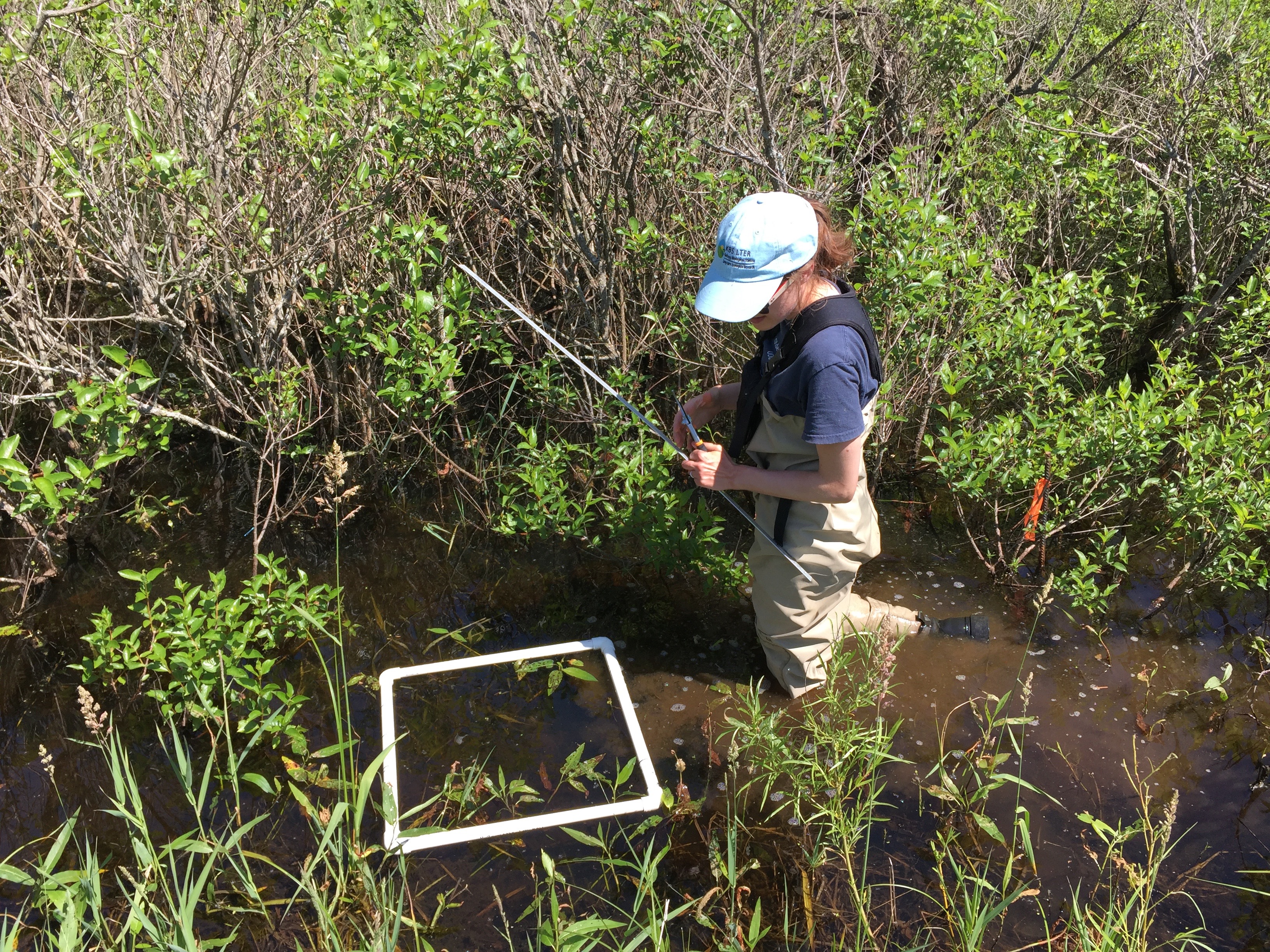
The work developed when first author Laura Twardochleb was a Ph.D. student in Zarnetske’s lab. She had spent time observing damselflies’ one-year lifecycle in Michigan. They emerge as adults from ponds in the spring. They mate, reproduce and the juveniles grow over a year in the pond by eating zooplankton. They make good study subjects, she said, because they thrive both outside and in the laboratory.
Twardochleb, now with the California State Water Resources Control Board, was part of MSU’s Ecology, Evolution, and Behavior, or EEB, Program and as a part of that took a class by Chris Klausmeier, MSU Research Foundation Professor of plant biology and integrative biology.
Klausmeier and Zarnetzke, both in the College of Natural Science, are EEB core faculty members and Twardochleb is an EEB alum.
Twardochleb saw that early models projecting how warming climates would affect ectothermic predators were significantly simpler than the nature she was observing. For one thing, the models didn’t allow for a northern climate’s change of seasons. The models also weren’t keeping track of predator size and growth rate and changes in their lifecycle with warming.
Meanwhile, Klausmeier, a theoretical ecologist, was recognizing the special sauce an experimentalist brings when creating mathematical models that make assumptions about how organisms behave, grow, birth and die.
“I can make up any model I want unconstrained by reality,” Klausmeier said. “But that’s a little dangerous because of course you want something related to the real world. When you join with an experimentalist you can bring not just the experimental results and parameters, but also bring the deep natural history and knowledge to the system to know the key variables and constraints.”
The work, factoring in a warmer, but still seasonal climate, shows how the damselflies can grow and breed more quickly. Creating a model that only allowed the virtual damselflies to live a one-year lifecycle in a warmer world resulted in burn out and death. Extinction was on the horizon.
But allow the bugs the option of bringing two generations into a season, and thriving was a possibility. “A lot of models said [predators] were going to starve,” Twardochleb said. “That’s what’s exciting — that we can make models more realistic.”
Twardochleb said the research is good groundwork to understand how other species will respond to a warmer world, particularly species like mosquitoes which are nuisances and potentially carry diseases.
Zarnetske added that the continual challenge will be beyond the idea that different species will be adapting to a new world. Climate change is outpacing that kind of evolution in an unprecedented way. And the weather extremes — heat waves, droughts, floods — are a whole variable.
“That’s our next step,” Zarnetske said. “Unpredictability is hard.”
The work was supported by the National Science Foundation, NASA, the MSU Department of Fisheries and Wildlife and Environmental Science and Policy Program, Kellogg Biological Station and the Society for Freshwater Science.

