Jump to HeaderJump to Main ContentJump to Footer
Michigan State University
MSUTODAY
  • Browse Stories By

    Topics

    Explore stories by subject area

    • Arts and Culture
    • Business and Economy
    • Climate and Environment
    • Education and Learning
    • Engineering, Science and Technology
    • Government and Society
    • Health and Medicine
    • Media and Communications
    • MSU Leadership and Impact
    • Sports and Recreation
    • Student and Campus Experience
    View All Stories

    Collections

    Curated story series

    • Turfgrass
    • Ask the Expert
    • Big Ideas
    • Climate solutions
    • Water at MSU
    • Mobility
    • Spartan Perspectives
    • Student views
    • Graduate voices
    • Faculty voices
    View All Collections

    Featured

    Editor's picks

    • 9 reasons to love being a Spartan

      Aug. 28, 2026

      9 reasons to love being a Spartan

    • NIH awards multi-university team over $4M to improve women’s health

      Sept. 15, 2026

      NIH awards multi-university team over $4M to improve women’s health

MSUTODAY
  • Browse Stories By

< Browse Stories By

Topics

Explore stories by subject area

  • Arts and Culture
  • Business and Economy
  • Climate and Environment
  • Education and Learning
  • Engineering, Science and Technology
  • Government and Society
  • Health and Medicine
  • Media and Communications
  • MSU Leadership and Impact
  • Sports and Recreation
  • Student and Campus Experience
  • View All Stories

Collections

Curated story series

  • Turfgrass
  • Ask the Expert
  • Big Ideas
  • Climate solutions
  • Water at MSU
  • Mobility
  • Spartan Perspectives
  • Student views
  • Graduate voices
  • Faculty voices
  • View All Collections

Featured

Editor's picks

  • 9 reasons to love being a Spartan

    Aug. 28, 2026

    9 reasons to love being a Spartan

  • NIH awards multi-university team over $4M to improve women’s health

    Sept. 15, 2026

    NIH awards multi-university team over $4M to improve women’s health

  • For Media
  • Experts
  • Releases and Statements
  • Sign Up
  • Update Information

Resources

  • A to Z Index
  • Find People
  • Maps
  • Email
  • Student Information System (SIS)
  • D2L
  • Libraries
  • Tech Support
  • MSU Misconduct Hotline
  • Social Media Directory
  • Events Calendar
  • For Media
Michigan State University
MSUToday
  • For Media
  • Experts
  • Releases and Statements
  • Sign Up
  • Update Information
Natural Sciences

March 13, 2023

MSU study reveals inequity in journal peer review

By: Sue Nichols

Scientists’ careers are defined by their contributions to peer reviewed literature. Yet, a recent Michigan State University study reveals that peer review disadvantages some scientists more than others, but solutions to rectify this disparity remain elusive.


Despite burgeoning cries for greater diversity, equity and inclusion in science, peer reviewed literature remains largely dominated by a handful of groups such as male authors from the United States and United Kingdom. While the reasons for this are multifaceted, the role that bias plays in peer review remains controversial.
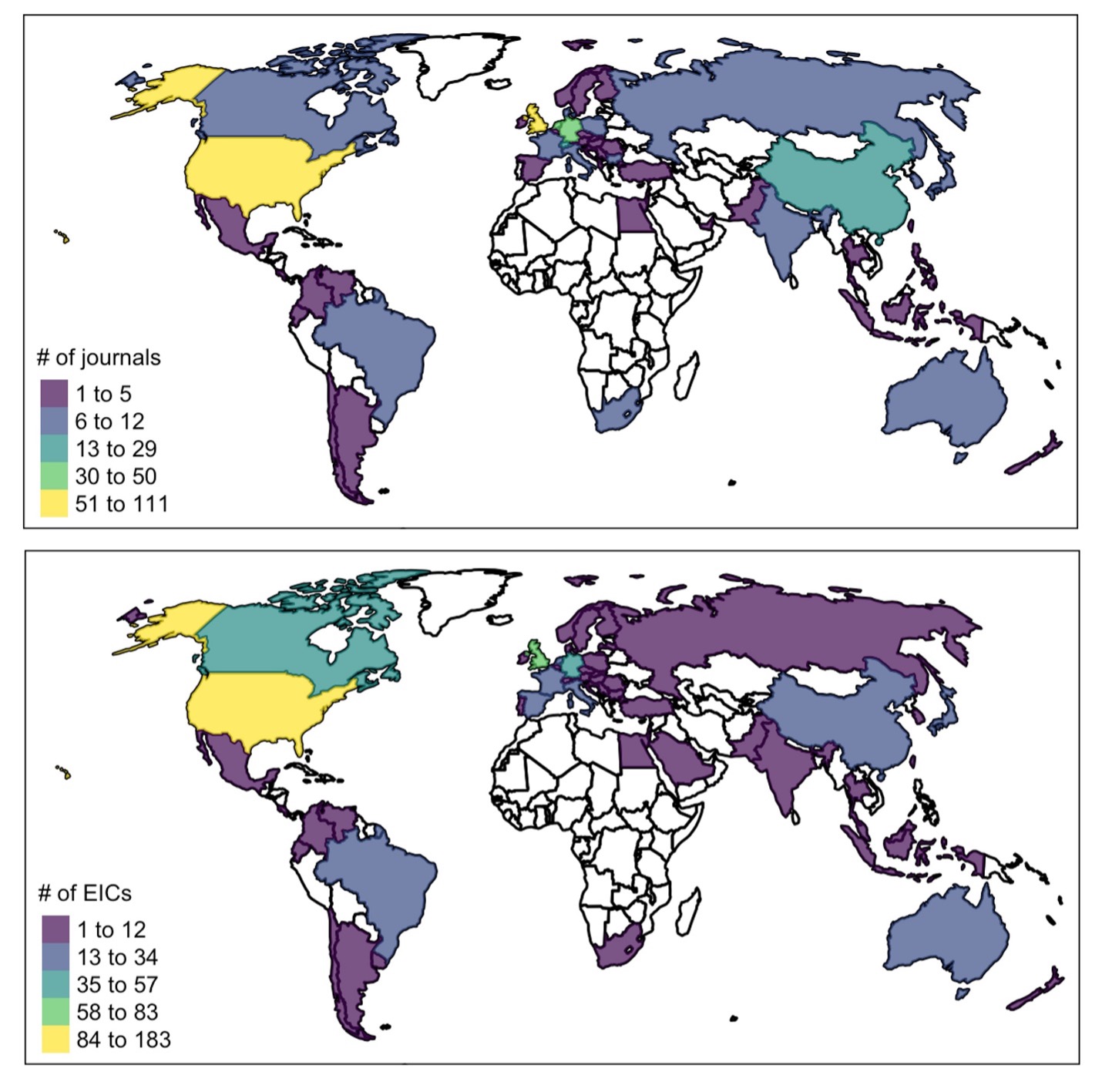
 

Journals and Editors-in-Chief are concentrated in few countries
The locations of the journals and their editors-in-chief were found to be concentrated in just a few parts of the world the same ones with the best outcomes in peer review. Credit: Michigan State University Ecology, Evolution and Behavior Program

MSU researchers analyzed data from more than 300,000 biological science manuscripts to see if the authors’ demographics mattered when it came to deciding if research was worthy of publication.


Their conclusions: Authors from historically excluded groups generally face worse peer review outcomes; few studies exist that examine how well interventions address peer review bias; and journals aren’t doing much to ensure an equitable review process.


“We were inspired to conduct the study after observing explicitly biased comments as co-authors and co-reviewers and experiencing seemingly worse peer review outcomes compared to colleagues that do not identify as members of historically excluded groups,” said Olivia Smith, the study’s lead author and an MSU Presidential Postdoctoral Fellow in Ecology, Evolution and Behavior in the Department of Integrative Biology.
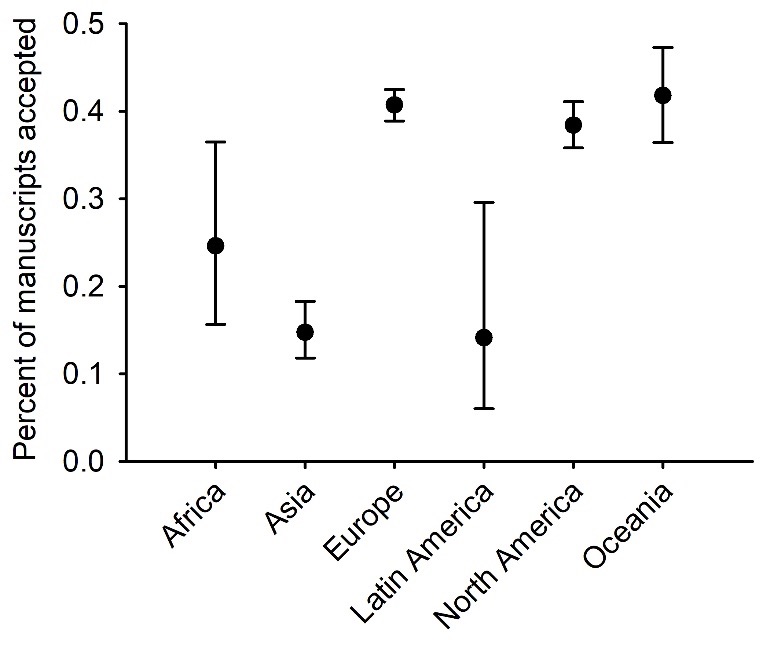
 

A look at who's successful in scientific publishing
The study found lower overall acceptance rates for authors affiliated with institutions in Asia, whose country’s primary language was not English and who were in countries with relatively low measures of social and economic development. Credit: Michigan State University Ecology, Evolution and Behavior Program

The study analyzed data from 31 prior studies to look for evidence of bias due to author demographics. The study found lower overall acceptance rates for authors who were affiliated with institutions in Asia, authors whose country’s primary language is not English and authors in countries with relatively low measures of social and economic development. Authors’ assumed gender also was linked to worse review outcomes.


The study’s researchers looked for solutions to reduce bias but found few studies with that focus despite the wide disparities they uncovered in the review system. The team only uncovered data on how diversity of reviewers and editorial boards and double-blind review — a process in which authors and reviewers remain anonymous to each other — impact review outcomes.


“Academics often self-identify as progressive and profoundly opposed to ethnic and gender discrimination. However, as a community, we have been extremely reticent to make the effort to introduce double-blind peer review,” said Tom Tregenza, professor of evolutionary ecology at the University of Exeter. Tregenza was not involved in the study and has published research on the peer review process. “With Smith et al.’s study, the jury is in — single-blind peer review is discriminatory and we’re not doing enough about it.”


“Double-blind review is far from perfect, but do we need another million data points to convince us that we can’t just keep limping on with a review system that assumes scientists are not subject to the biases that are so well established by their own research,” Tregenza asks.


The authors also examined policies that journals have in place for the peer review process, including peer review models and specific guidelines for authors and reviewers, particularly those addressing inappropriate comments toward non-native English speaking authors. They found that journals aren’t doing much to mitigate potential bias. For example, less than 16% of journals in ecology and evolutionary biology were using a double-blind review model at the time of the study. Further, only 2% had guidelines for peer reviewers that explicitly mentioned social justice issues.


Smith and colleagues further traced the locations of the journals and their editors-in-chief and found them to be concentrated in just a few parts of the world — the same areas that experience the best outcomes in peer review.


Despite the findings, the authors acknowledge their study’s limitations, including the fact that it is difficult to tell if a manuscript is rejected because of bias or because the work did not meet a journals’ standards. 


Whether it is truly bias or disparate outcomes due to other factors, the study clearly shows that across hundreds of thousands of manuscripts, author demographics are a strong predictor of success in peer review — and that the system needs to change.


“Peer review is a central part of the scientific process and key to the advancement of scientists’ careers,” Smith said. “We hope our synthesis will prompt future studies to swiftly and fully document the extent of bias and identify effective solutions. We also hope that it will be a driving force for journals to adopt stronger policies for an equitable peer review system.”


The study is published in the journal Nature Ecology and Evolution.

 

MEDIA CONTACTS

Emilie Lorditch
Natural SciencesEngineering, Science and Technology

Latest News

MSUToday Weekly Update

The MSUToday Weekly Update email showcases how Spartans are making a difference through academic excellence, research impact and community outreach. Get inspired by these stories of innovation, collaboration and determination. Plus, enjoy photos and videos of campus and more MSU content to help keep you connected to the Spartan community.

Sign UpUpdate My Information

Connect With Us

Visit our Facebook pageVisit our page on XVisit our Instagram pageVisit our LinkedIn pageVisit our YouTube pageVisit our TikTok page

Health and Safety

  • MSU Police and Public Safety
  • Olin Health Center
  • Counseling & Psychiatric Services (CAPS)
  • University Health and Wellbeing
  • MSU Health Care
  • Civil Rights and Title IX
  • Our Commitment
  • Center for Survivors
  • Security & Fire Safety Report
  • University Policy on Relationship Violence and Sexual Misconduct
  • Notice of Non-Discrimination, Anti-Harassment and Non-Retaliation
  • Health Care Non-Discrimination Notice

Support Services

  • Disability Resources
  • Supportive Services
  • Learning Resources

Working at MSU

  • Human Resources
  • EBS Login
  • Job Postings
  • Employee Assistance Program

Reports

  • CARES Act Funding
  • Student Achievement and Outcomes

Contact us

517-355-1855

Address

Michigan State University 426 Auditorium Road East Lansing, MI 48824

Follow Us

  • Visit our Facebook page
  • Visit our page on X
  • Visit our Instagram page
  • Visit our TikTok page
  • Visit our LinkedIn page
  • Visit our YouTube page

If you're having accessibility issues, please let us know.

Know More: Campus Safety Information and ResourcesTransparency Reporting: Budget & Salary/Compensation
  • Contact Information|
  • Site Map|
  • Privacy Statement|
  • Site Accessibility|
  • Call MSU: (517) 355-1855|
  • Visit: msu.edu|
  • Notice of Nondiscrimination|

SPARTANS WILL|© Michigan State University|
