Jump to HeaderJump to Main ContentJump to Footer
Michigan State University
MSUTODAY
  • Browse Stories By

    Topics

    Explore stories by subject area

    • Arts and Culture
    • Business and Economy
    • Climate and Environment
    • Education and Learning
    • Engineering, Science and Technology
    • Government and Society
    • Health and Medicine
    • Media and Communications
    • MSU Leadership and Impact
    • Sports and Recreation
    • Student and Campus Experience
    View All Stories

    Collections

    Curated story series

    • Turfgrass
    • Ask the Expert
    • Big Ideas
    • Climate solutions
    • Water at MSU
    • Mobility
    • Spartan Perspectives
    • Student views
    • Graduate voices
    • Faculty voices
    View All Collections

    Featured

    Editor's picks

    • 9 reasons to love being a Spartan

      Aug. 28, 2026

      9 reasons to love being a Spartan

    • NIH awards multi-university team over $4M to improve women’s health

      Sept. 15, 2026

      NIH awards multi-university team over $4M to improve women’s health

MSUTODAY
  • Browse Stories By

< Browse Stories By

Topics

Explore stories by subject area

  • Arts and Culture
  • Business and Economy
  • Climate and Environment
  • Education and Learning
  • Engineering, Science and Technology
  • Government and Society
  • Health and Medicine
  • Media and Communications
  • MSU Leadership and Impact
  • Sports and Recreation
  • Student and Campus Experience
  • View All Stories

Collections

Curated story series

  • Turfgrass
  • Ask the Expert
  • Big Ideas
  • Climate solutions
  • Water at MSU
  • Mobility
  • Spartan Perspectives
  • Student views
  • Graduate voices
  • Faculty voices
  • View All Collections

Featured

Editor's picks

  • 9 reasons to love being a Spartan

    Aug. 28, 2026

    9 reasons to love being a Spartan

  • NIH awards multi-university team over $4M to improve women’s health

    Sept. 15, 2026

    NIH awards multi-university team over $4M to improve women’s health

  • For Media
  • Experts
  • Releases and Statements
  • Sign Up
  • Update Information

Resources

  • A to Z Index
  • Find People
  • Maps
  • Email
  • Student Information System (SIS)
  • D2L
  • Libraries
  • Tech Support
  • MSU Misconduct Hotline
  • Social Media Directory
  • Events Calendar
  • For Media
Michigan State University
MSUToday
  • For Media
  • Experts
  • Releases and Statements
  • Sign Up
  • Update Information
Natural Sciences

March 7, 2023

MSU researchers help resolve a 50-year-old fish controversy

An international consortium that includes Michigan State University researchers has solved an evolutionary quandary that’s been the subject of debate for five decades.
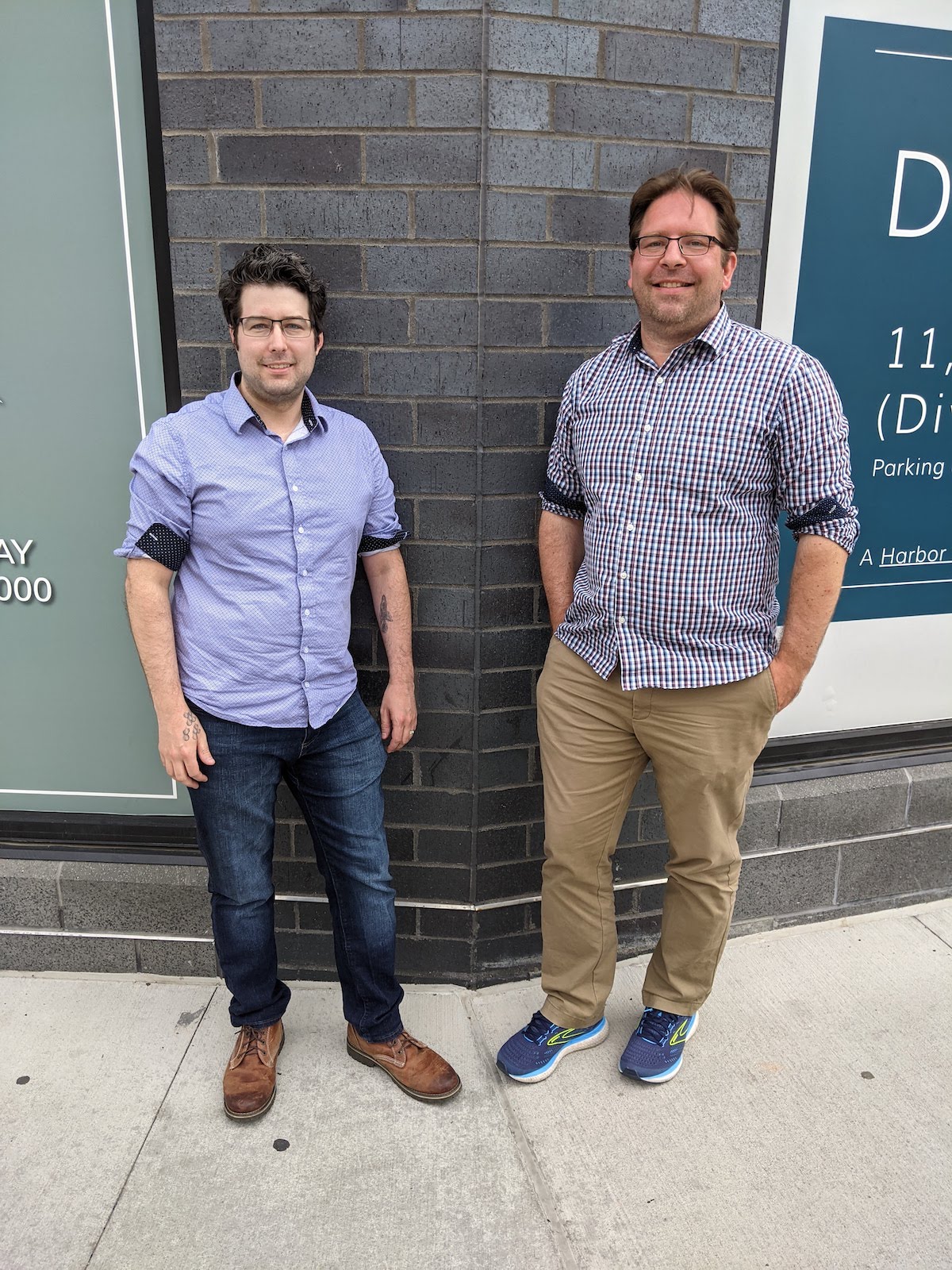
Michigan State University Associate Professor Ingo Braasch (right) and Andrew Thompson, who worked on the new report in Science as a postdoctoral scholar at MSU. Thompson is now an assistant professor at Western Michigan University and an adjunct assistant professor at MSU. Photo by Matt Davenport

Publishing its results in February in the journal Science, the team’s genomic analyses conclusively resolve which modern fish lineage branched off earliest within the tree of life. The findings shed new light on the evolutionary history of fishes and the understanding of evolutionary processes.

“By verifying how lineages are related to each other, it becomes possible to reconstruct the last common ancestor of the modern fishes, the so-called teleost fishes,” said Ingo Braasch, an associate professor of integrative biology in the College of Natural Science. “This is a prerequisite to figuring out how fish are related to one another and understanding vertebrate evolution in general.”

Braasch and his team contributed genetic sequence information and analyses on one of the fish tied up in the controversy. All told, the GenoFish Consortium that published the paper generated new genome sequences for seven fish species and involved researchers from 18 different institutions across the United States, Asia and Europe.

The project was led by Yann Guiguen of the French National Research Institute for Agriculture, Food and Environment as well as Hugues Roest Crollius and Camille Berthelot of INSERM, the French National Institute of Health and Medical Research.
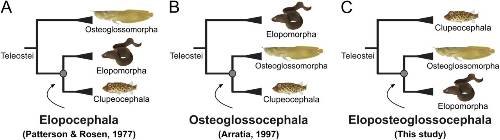
Trees of life of teleost fishes representing the two hypotheses of the controversy and its resolution in the present study. Courtesy GenoFish Consortium

Understanding the history of species through their evolutionary relationships is a key issue and is regularly the subject of scientific controversy. This particular controversy centered on which group of modern fish was the first to branch off from the others: the eels or the bony tongued fishes.

“They’re called bony tongues because they literally have bones in their tongues,” said Braasch, whose team studied the goldeye species of bony tongue fish.

Both eels and bony tongues belong to what are called teleost fishes, which first appeared toward the end of the Jurassic period. Today, teleost fishes are the largest group of modern fishes and include more than 30,000 species. Approximately half of all living vertebrates — animals with backbones — are teleost fishes.

In the 1970s, researchers posited that bony tongues were the earliest branching group, based solely on anatomical criteria. In the 1990s, studies using DNA sequences to help reconstruct evolutionary history named eels as the first group to diverge from the others.

The new study, using the most complete genetic and genomic analyses to date, arrived at a new conclusion. That is, neither of the two previous hypotheses were correct.

Rather these two lineages belong to a single group, which the GenoFish Consortium has christened “eloposteoglossocephalans.”

This also means that it was actually a third group of fishes, called clupeocephalans, that branched away first. Clupeocephalans include tuna, perch, salmon, pufferfish, zebrafish, goldfish and most other modern aquarium fishes.
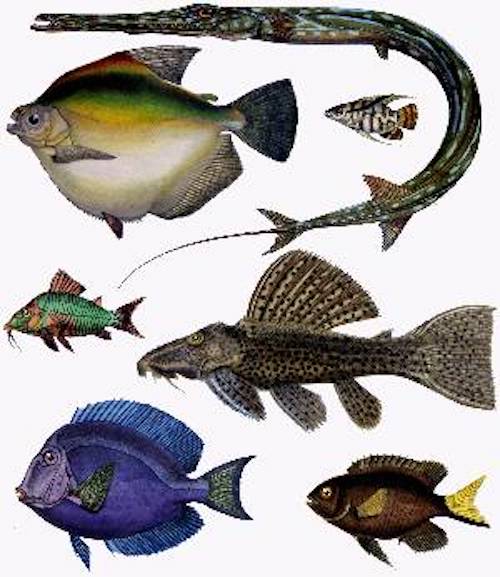
Paintings of teleost fish by Francis de Laporte de Castelnau from the 1850s.

From a technical standpoint, what makes this study unique is how it leveraged the complete genomes of different species, Braasch said. Researchers not only examined different DNA sequences, but they also studied how the same genes were arranged along the chromosomes of different fish species.

Braasch compared the genome sequencing efforts to reconstructing the encyclopedia of teleost evolution. When scientists first started sequencing the DNA of different fish, the community began learning the words that were used in the history text, but it remained difficult to see the organization of the DNA sequence into the books, or chromosomes.

As technology has evolved, scientists could see full chromosomes and genomes. Now, researchers had the words and understood how those were put together on a page and how those pages were arranged into the different books of the encyclopedia.

“Before now, it basically wasn’t possible to read the entirety of books at once. We knew the text, but not how it was organized,” Braasch said. “So what this study shows is a novel way of analyzing the organization of genomes into chromosomes and this principle can be applied to reconstructing any branch in the tree of life, not just the fish branch.”

This article originally appeared on the College of Natural Science website.

MEDIA CONTACTS

Val Osowski
Natural SciencesEngineering, Science and TechnologyMSU ResearchMSU Leadership and ImpactBiodiversity and WildlifeClimate and Environment

Latest News

MSUToday Weekly Update

The MSUToday Weekly Update email showcases how Spartans are making a difference through academic excellence, research impact and community outreach. Get inspired by these stories of innovation, collaboration and determination. Plus, enjoy photos and videos of campus and more MSU content to help keep you connected to the Spartan community.

Sign UpUpdate My Information

Connect With Us

Visit our Facebook pageVisit our page on XVisit our Instagram pageVisit our LinkedIn pageVisit our YouTube pageVisit our TikTok page

Health and Safety

  • MSU Police and Public Safety
  • Olin Health Center
  • Counseling & Psychiatric Services (CAPS)
  • University Health and Wellbeing
  • MSU Health Care
  • Civil Rights and Title IX
  • Our Commitment
  • Center for Survivors
  • Security & Fire Safety Report
  • University Policy on Relationship Violence and Sexual Misconduct
  • Notice of Non-Discrimination, Anti-Harassment and Non-Retaliation
  • Health Care Non-Discrimination Notice

Support Services

  • Disability Resources
  • Supportive Services
  • Learning Resources

Working at MSU

  • Human Resources
  • EBS Login
  • Job Postings
  • Employee Assistance Program

Reports

  • CARES Act Funding
  • Student Achievement and Outcomes

Contact us

517-355-1855

Address

Michigan State University 426 Auditorium Road East Lansing, MI 48824

Follow Us

  • Visit our Facebook page
  • Visit our page on X
  • Visit our Instagram page
  • Visit our TikTok page
  • Visit our LinkedIn page
  • Visit our YouTube page

If you're having accessibility issues, please let us know.

Know More: Campus Safety Information and ResourcesTransparency Reporting: Budget & Salary/Compensation
  • Contact Information|
  • Site Map|
  • Privacy Statement|
  • Site Accessibility|
  • Call MSU: (517) 355-1855|
  • Visit: msu.edu|
  • Notice of Nondiscrimination|

SPARTANS WILL|© Michigan State University|
